RBI 2026 Recovery Agent Training Rules: Compliance Guide | Leap10x
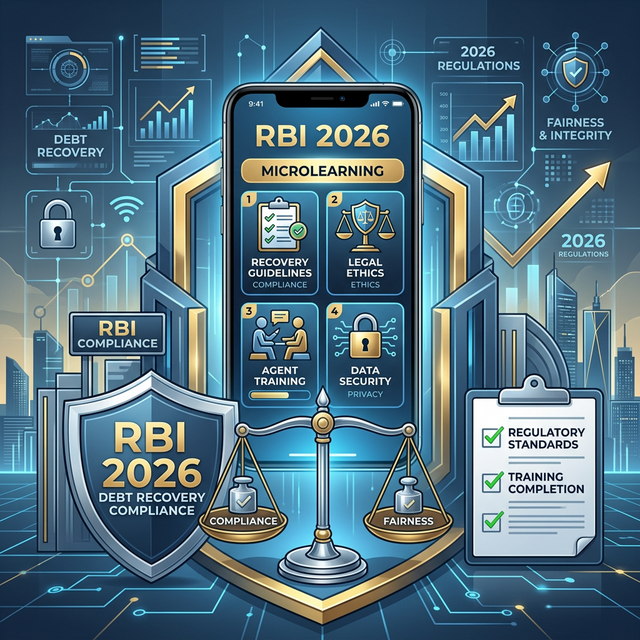
In February 2026, the RBI published draft directions mandating formal training and certification for all recovery agents before they begin collection work. Enforcement is expected from July 2026. If you're a Collections Head, VP Risk, or Compliance Officer at a bank, NBFC, or fintech lender — this changes your operating model.
Every recovery agent in India — whether your in-house telecaller or a third-party field collector — must now complete structured training on RBI compliance, borrower rights, communication guidelines, and ethical conduct. Non-compliance means regulatory penalties and reputational damage.
The problem: most collection agents are the ultimate deskless workers. They're on the phone or in the field all day. They don't have laptops. They don't have LMS access. And your training deadline is July 2026.
This guide covers exactly what the RBI 2026 draft requires, what the FACE (SRO-FT) guidelines add, and how to train 500–5,000 collection agents on these rules via WhatsApp before the deadline.
What the RBI 2026 Draft Directions Require
The RBI's 2026 draft directions for loan recovery and collection introduce several mandatory requirements for lenders:
- Formal training before deployment. Every recovery agent must complete a structured training programme before engaging in any collection activity. No more "learn on the job" for collection agents.
- Certification. Agents must be certified as trained. Lenders must maintain records of training completion for each agent.
- Code of conduct. Agents must be trained on a defined code of conduct covering professional behavior, communication standards, and ethical practices.
- Contact hour restrictions. Agents can only contact borrowers between 8 AM and 7 PM. This must be part of the training.
- Call recording compliance. Agents must understand that calls may be recorded and reviewed. Training must cover appropriate language and conduct on recorded calls.
- Complaint resolution protocols. Agents must know how to handle borrower complaints and escalate appropriately — rather than escalating aggression.
What the FACE Guidelines Add
The FACE (Fintech Association for Consumer Empowerment), recognized by the RBI as an SRO-FT (Self-Regulatory Organization for Fintech), published debt recovery guidelines in August 2025 that add further requirements:
- Approved communication scripts. Agents must use pre-approved language for calls and visits. No improvised threats or misleading statements.
- Agent ID verification. Every field agent must carry authorized identification. Borrowers have the right to verify agent identity.
- No contact outside 8 AM–7 PM. Reinforcing RBI's contact hour restrictions.
- Empathy training for vulnerable customers. Agents must be specifically trained to handle distressed borrowers — those who've lost jobs, faced medical emergencies, or are in financial hardship.
- Professional dress code. Field collection agents must maintain professional appearance during visits.
- Digital nudge protocols. Guidelines on how and when digital reminders (SMS, WhatsApp, email) can be sent to borrowers.
What This Means for Your Collection Team
The combined impact of RBI 2026 directions and FACE guidelines:
Every agent needs training BEFORE operating. This isn't a "nice to have." An untrained agent making collection calls after July 2026 exposes your organization to regulatory action.
Training must be documented and auditable. The regulator will ask: "Show me proof that Agent X completed compliance training on Date Y." You need completion records, certification, and quiz scores — not just attendance sheets from a classroom session.
Non-compliance consequences are real. RBI has been increasing enforcement against aggressive collection practices. An RBI survey found that 39% of borrowers have faced abusive recovery calls. The 2026 rules are designed to fix this — and regulators expect lenders to act.
Training must be continuous, not one-time. Agent turnover in collections is 40–70% annually. New agents join every month. Regulations evolve. A one-time classroom session doesn't work when your agent base changes every quarter.
Why Traditional Classroom Training Won't Work for Collection Agents
Collection agents are distributed across cities, work irregular hours, and are often employed by third-party agencies. Here's why classroom training fails:
- Agents are distributed. A bank's collection operation might span 30–50 cities. Flying agents to centralized training is impractical and expensive.
- High turnover means continuous onboarding. With 40–70% annual turnover, you're training new agents every month. You can't schedule classroom batches that frequently.
- Third-party agents don't attend your training. Most collection work is outsourced to agencies. These agents work for multiple lenders simultaneously and aren't available for your classroom sessions.
- Training must reach agents in Tier 2/3 cities. A field collection agent in Dharwad or Muzaffarpur needs the same compliance training as one in Mumbai. Classroom models don't scale to smaller cities.
- No platform currently targets this niche. Disprz, Enthral, and Stratbeans serve BFSI with LMS platforms — but none has collection-specific training content or a delivery mechanism built for field collectors.
The WhatsApp Microlearning Solution for Collection Compliance Training
Leap10x delivers RBI-compliant collection training directly to agents' WhatsApp. Here's what the training modules look like:
Module 1: RBI Compliance — Contact Hours, Language, and Borrower Rights
What agents learn: when they can contact borrowers (8 AM–7 PM only), what language is acceptable, what borrower rights they must respect, and what happens if they violate these rules. Quiz verifies understanding.
Module 2: Communication Scripts — Approved Formats for Calls and Field Visits
What agents learn: the exact scripts approved by your compliance team for opening a collection call, making a payment request, handling "I can't pay" responses, and closing the conversation. Scenario-based — agents practice with real examples.
Module 3: Empathy and De-escalation — Handling Distressed Borrowers
What agents learn: how to handle borrowers who've lost their job, faced medical emergencies, or are in genuine financial distress. De-escalation techniques when borrowers become angry. The FACE guidelines specifically require this training.
Module 4: Legal Boundaries — What Agents Can and Cannot Do
What agents learn: what constitutes harassment under Indian law, what agents can legally say and do during collection, when to escalate to supervisors, data privacy requirements for borrower information.
Module 5: Daily Quiz to Verify Understanding + Completion Certificate
Each module ends with a quiz. Agents must score above the passing threshold. Completion certificate is generated automatically — linked to the agent's ID, dated, and stored for audit purposes.
Implementation: Train 1,000+ Collection Agents in 2 Weeks via WhatsApp
Days 1–3: Leap10x's AI converts your existing collection SOPs, compliance documents, and scripts into WhatsApp-ready micro-modules. No instructional design team needed. Content reviewed by your compliance team.
Days 4–7: Pilot with 100 collection agents (mix of in-house and third-party). Collect feedback on content clarity, quiz difficulty, and language accuracy.
Days 8–14: Full rollout to all collection agents. Modules pushed via WhatsApp. Agents complete on their phone between calls and visits. Dashboard tracks completion in real-time.
By day 14, you have: every collection agent trained, certified, and documented — ready for the July 2026 deadline.
Audit-Ready Reporting
The Leap10x dashboard provides the documentation regulators expect:
- Per-agent completion records: Which agent completed which module, when, and with what score.
- Certification tracking: Downloadable certificate per agent — date-stamped, module-specific.
- Compliance gap reports: Which agents haven't completed training. Which regions are lagging. Which modules have low pass rates (indicating content needs improvement).
- Regulatory documentation: Export-ready reports formatted for RBI audit submissions.
Get RBI-Compliant Collection Training Live in 14 Days
The RBI deadline is approaching. Every bank, NBFC, and fintech lender must train their collection agents on the new rules — or face regulatory consequences.
Leap10x is the only platform that delivers collection compliance training directly to agents' WhatsApp, in 15+ Indian languages, with quiz-gated certification and audit-ready reporting. Companies like HDFC already use Leap10x for collection team training, and Finnable has requested the same.
Don't wait until June to start.
Book a Collection Training Demo →
FAQs
- Q: What are the RBI 2026 recovery agent training rules?
A: The RBI's 2026 draft directions mandate that all recovery agents must complete formal, structured training and certification before engaging in any collection activity. Requirements include training on a code of conduct, contact hour restrictions (8 AM–7 PM only), call recording compliance, borrower rights, and complaint resolution protocols. Enforcement is expected from July 2026. - Q: Do RBI collection training rules apply to third-party agencies?
A: Yes. The RBI 2026 draft directions specifically state that lenders must ensure agents undergo structured training before engaging in recovery activities — including agents employed by third-party collection agencies. Lenders are responsible for proving training compliance for all agents acting on their behalf. - Q: How can collection agents be trained without classroom sessions?
A: WhatsApp-based microlearning delivers compliance training directly to collection agents' phones. Agents receive short modules (5 minutes each) covering RBI compliance, approved scripts, empathy training, and legal boundaries. Each module includes a quiz for verification and generates an audit-ready completion certificate. No app download, no login required. - Q: What is the FACE guideline for collection agent training?
A: FACE (Fintech Association for Consumer Empowerment), recognized by RBI as an SRO-FT, published debt recovery guidelines in August 2025 requiring: approved communication scripts, agent ID verification, empathy training for distressed borrowers, professional dress code, no contact outside 8 AM–7 PM, and digital nudge protocols. These requirements supplement the RBI 2026 directions. - Q: How long does it take to make a collection team RBI-compliant with Leap10x?
A: A typical deployment takes 14 days. Days 1–3: AI converts your existing SOPs and compliance documents into WhatsApp modules. Days 4–7: Pilot with 100 agents. Days 8–14: Full rollout with completion tracking. By day 14, every agent is trained, certified, and documented for regulatory audit.