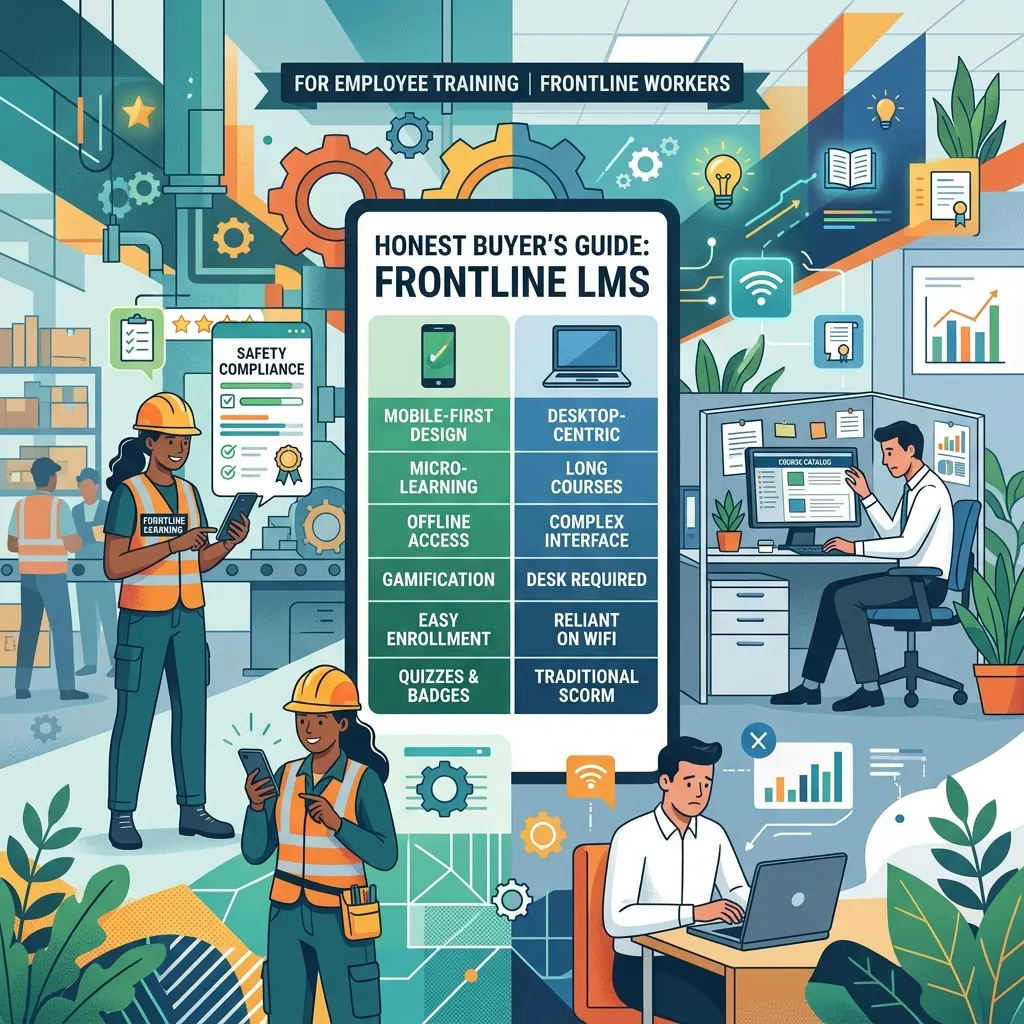
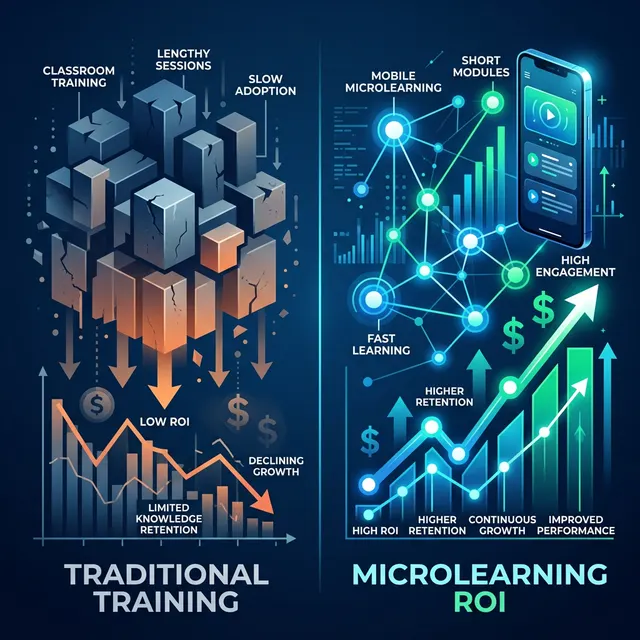
Why Your LMS Is Failing Frontline Workers (And the Fix)
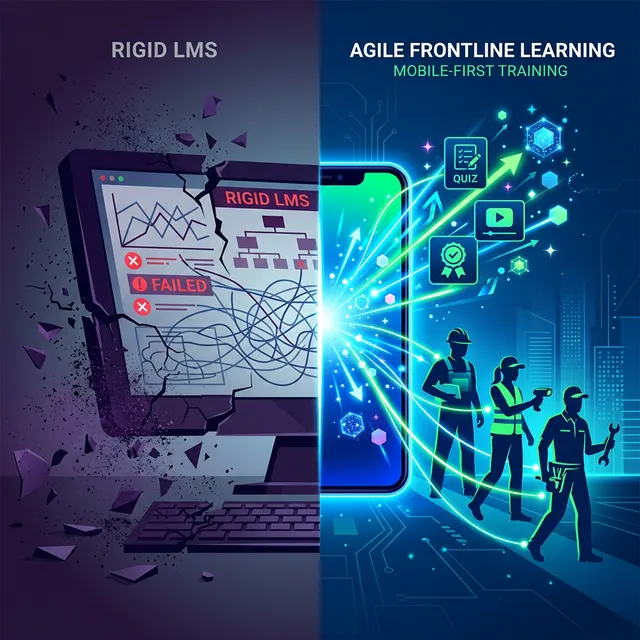
Your LMS was built for people who sit at desks, have corporate email addresses, and can block 30 minutes on their calendar for a training module. Your frontline workers have none of those things.
And yet, when the question comes up — "How do we train our warehouse operators? Our retail associates? Our security guards?" — the default answer is still: "Put it on the LMS."
The result is predictable. Completion rates for frontline workers on traditional LMS platforms sit below 20% in most organizations. Not because the workers don't care about training, but because the system was never designed for how they work.
This isn't a minor inconvenience. When frontline workers aren't trained, the consequences show up as safety incidents, compliance gaps, customer complaints, quality defects, and the kind of attrition that costs 30–50% of annual salary per replacement.
This article makes the case — with data and practical examples — that traditional LMS fails frontline teams, and presents what the alternative looks like.
The Uncomfortable Truth: LMS Completion Rates for Frontline Workers
Let's start with the number most L&D teams know but don't talk about openly: the completion rate for frontline worker training on traditional LMS platforms is typically below 20%.
Think about what that means. If you have 5,000 frontline workers and you assign a mandatory safety training module through your LMS, fewer than 1,000 will complete it. The other 4,000 either never logged in, couldn't find the module, got frustrated with the interface, or simply didn't have time to sit at a computer they don't have access to.
Meanwhile, your compliance report shows "training assigned" — which satisfies no auditor worth their clipboard. And your actual safety knowledge on the floor is a fraction of what you think it is.
This isn't a motivation problem. It's a design problem. The LMS is working exactly as it was designed — for desk workers. It's failing because you're asking it to serve a workforce it was never built for.
5 Reasons Your LMS Fails Frontline Teams
1. It requires a laptop or desktop
The most fundamental problem is the most obvious one. Traditional LMS platforms are designed for browser-based access on a computer. Frontline workers — factory operators, retail associates, delivery drivers, security guards, housekeeping staff — don't have computers at their workstations.
Some LMS platforms offer "mobile-responsive" versions. But a "responsive" LMS is still a web application that requires a browser, a stable internet connection, and navigation skills that many frontline workers don't have. It's not the same as delivering training natively on the device and app workers already use.
2. It requires login credentials
To access an LMS, workers need a username and password — usually tied to a corporate email address. Most frontline workers don't have corporate email. Even when HR creates accounts for them, the password reset cycle alone kills adoption: worker forgets password → can't reset without email → gives up → compliance report shows "not completed."
The entire credential management system assumes a workforce that regularly uses email and web browsers. That assumption fails for most deskless teams.
3. Content is too long
Traditional LMS courses are designed in 30-to-60-minute blocks. This format works for an office employee who can set aside time during the workday. It doesn't work for a factory worker who gets two 15-minute breaks per shift or a retail associate who's on the floor for 8 hours straight.
When the only option is a 45-minute module, workers either skip it entirely or rush through it without absorbing anything. The format creates compliance checkboxes, not competent workers.
4. It's English-centric
Most LMS platforms operate in English. Content libraries are in English. Interface navigation is in English. For a workforce where the majority speaks Hindi, Tamil, Marathi, Bengali, or any of dozens of other languages, this creates a comprehension barrier that directly undermines the purpose of training.
Translating LMS content is technically possible but practically expensive and slow — requiring manual localization of every module, interface element, and assessment question. Few organizations invest in this at the scale needed for frontline workforces.
5. It's not truly mobile-optimized
"Mobile app available" on an LMS product page usually means "we have an app that mirrors our web platform on a smaller screen." The experience is typically a shrunken version of the desktop interface: small text, complex navigation, large file downloads, and buffering on mobile data.
True mobile optimization for frontline workers means training that's designed for a 5-inch screen on a 4G connection, takes under 5 minutes to complete, and doesn't require navigating menus or managing files. That's a fundamentally different product from a responsive LMS.
The Real Cost of Failed Frontline Training
When your LMS doesn't reach frontline workers, the consequences go beyond low completion rates:
- Compliance gaps and penalties: Unverified training means you can't document that workers were trained on safety procedures, regulatory requirements, or company policies. During an audit — whether regulatory, client, or internal — gaps become liabilities.
- Safety incidents: Workers who weren't effectively trained on hazard procedures, PPE usage, or emergency response are more likely to be involved in workplace accidents. The financial and human cost of this is significant.
- Higher attrition: Multiple studies show that employees who feel undertrained are more likely to leave. A 2023 McKinsey survey found that 64% of frontline workers said they would stay longer at their employer if given better upskilling opportunities. When your training system doesn't reach workers, it contributes to the turnover cycle.
- Inconsistent quality and customer experience: In retail, logistics, and hospitality, untrained frontline workers deliver inconsistent service. This shows up in customer complaints, negative reviews, and lost repeat business.
- Manager burden: When formal training fails, the load falls on frontline managers to train workers informally. This ad hoc approach is inconsistent, untrackable, and adds to manager burnout.
What the Alternative Looks Like
The alternative to forcing frontline workers into an LMS isn't "no training system." It's a system designed from the ground up for how frontline workers actually operate:
Messaging-first delivery. Training arrives through WhatsApp — the channel frontline workers already use for hours every day. No app download. No login. No password. The training comes to them, not the other way around.
Micro-content in 3–5 minutes. Modules are designed for work break lengths, not calendar blocks. One topic, one learning objective, one quiz. Workers complete them during a shift changeover, a loading wait, or a tea break.
Vernacular language by default. Content is generated in the worker's language using AI — Hindi, Tamil, Telugu, Marathi, Bengali, or any of 15+ regional languages. Not just translated menus, but actual training content in the language the worker thinks in.
AI-generated from existing documents. You don't start from scratch. Upload your existing SOPs, safety manuals, and product guides. AI converts them into WhatsApp-ready micro-modules. What used to take an instructional designer weeks is ready in hours.
Real completion tracking. Every module completion is tracked with timestamps and quiz scores — per worker, per module, per location. Exportable for compliance audits. This isn't self-reported attendance; it's verified understanding.
LMS Replacement vs LMS Supplement: When to Use Each
Not every organization needs to replace their LMS entirely. The right approach depends on your workforce mix:
Replace your LMS for frontline teams when:
- Fewer than 20% of frontline workers are completing LMS-based training
- Workers don't have corporate email or regular computer access
- Your workforce is multilingual and English-only content creates comprehension issues
- You need compliance documentation that proves understanding, not just attendance
- The cost of maintaining LMS licenses for workers who never log in exceeds the cost of a frontline-specific platform
Supplement your LMS with a frontline platform when:
- You have both desk workers and frontline workers in the same organization
- Your LMS serves corporate and management training well but fails for the floor/field
- You need to maintain a single training record across the organization and can integrate both systems
- You want to use the LMS for in-depth courses and the frontline platform for micro-training and reinforcement
Many organizations use both: the LMS for knowledge workers and management, and a platform like Leap10x for the frontline workforce that the LMS can't reach.
How Leap10x Complements or Replaces Your LMS for Frontline Teams
Leap10x is not another LMS. It's a different category of tool — purpose-built for the workers your LMS can't reach.
- For workers with WhatsApp and no laptop: Training arrives on WhatsApp. No browser, no app, no credentials.
- For content in 15+ languages: AI generates micro-modules in the worker's language from your existing English documents.
- For compliance that needs proof: Every completion is tracked with timestamps and quiz verification — audit-ready without paper sign-off sheets.
- For continuous training, not annual events: Modules are sent regularly, with spaced repetition for critical topics. Training becomes a habit, not a one-time disruption.
Companies like Siemens and Tata Electronics use Leap10x to train frontline teams that their enterprise LMS couldn't reach — across manufacturing, retail, and field operations.
Book a Consultation
If your LMS completion rates for frontline workers are below 20%, switching to a different LMS won't fix the problem. The problem is the model, not the vendor.
Book a consultation to discuss whether Leap10x should replace or supplement your LMS for frontline teams — based on your workforce, your industries, and your compliance requirements.
FAQs
- Q: Why do LMS platforms fail for frontline workers?
A: Traditional LMS platforms were designed for desk-based employees with laptops, corporate email, and scheduled training time. Frontline workers lack all three. The result is completion rates below 20% — not because workers don't want training, but because the delivery system doesn't match how they work. Workers need training delivered to devices they already use (like WhatsApp), in their language, in modules short enough to complete during work breaks. - Q: What is the best LMS for deskless employees?
A: For truly deskless workers, the "best LMS" may not be an LMS at all. Purpose-built frontline training platforms like Leap10x deliver training through WhatsApp in local languages, without requiring app downloads, login credentials, or computers. If your deskless workers have completion rates below 20% on your current LMS, the issue is the delivery model — switching to another traditional LMS won't change the fundamentals. - Q: Can microlearning replace an LMS?
A: For frontline workers, yes — a microlearning platform that delivers content on mobile/WhatsApp, tracks completions, and generates compliance reports can fully replace the LMS that those workers never used effectively. For desk workers and management, a traditional LMS may still serve well for in-depth courses and certifications. Many organizations use both: LMS for corporate teams, microlearning platform for frontline teams. - Q: How much does it cost to switch from LMS to a frontline training platform?
A: The cost comparison often favors the switch. You're likely paying LMS license fees for frontline users who never log in. A platform like Leap10x has lower per-user costs (designed for emerging market pricing) and eliminates trainer travel, venue booking, and printed material expenses. The total cost of training frontline workers typically decreases, while completion rates increase. See Leap10x pricing → - Q: What's the difference between microlearning and LMS-based e-learning?
A: LMS-based e-learning delivers 30–60 minute courses through a web portal requiring login and a computer or app. Microlearning delivers 3–5 minute modules through mobile channels like WhatsApp. For frontline workers, the practical difference is enormous: microlearning modules get completed; LMS courses often don't. The content quality can be identical — the difference is how and where it reaches the learner. - Manufacturing Training Solutions
- Safety & Compliance Training Use Case
- Employee Onboarding Microlearning