Facility Management Training: How to Onboard and Upskill Housekeeping, Security, and Maintenance Teams
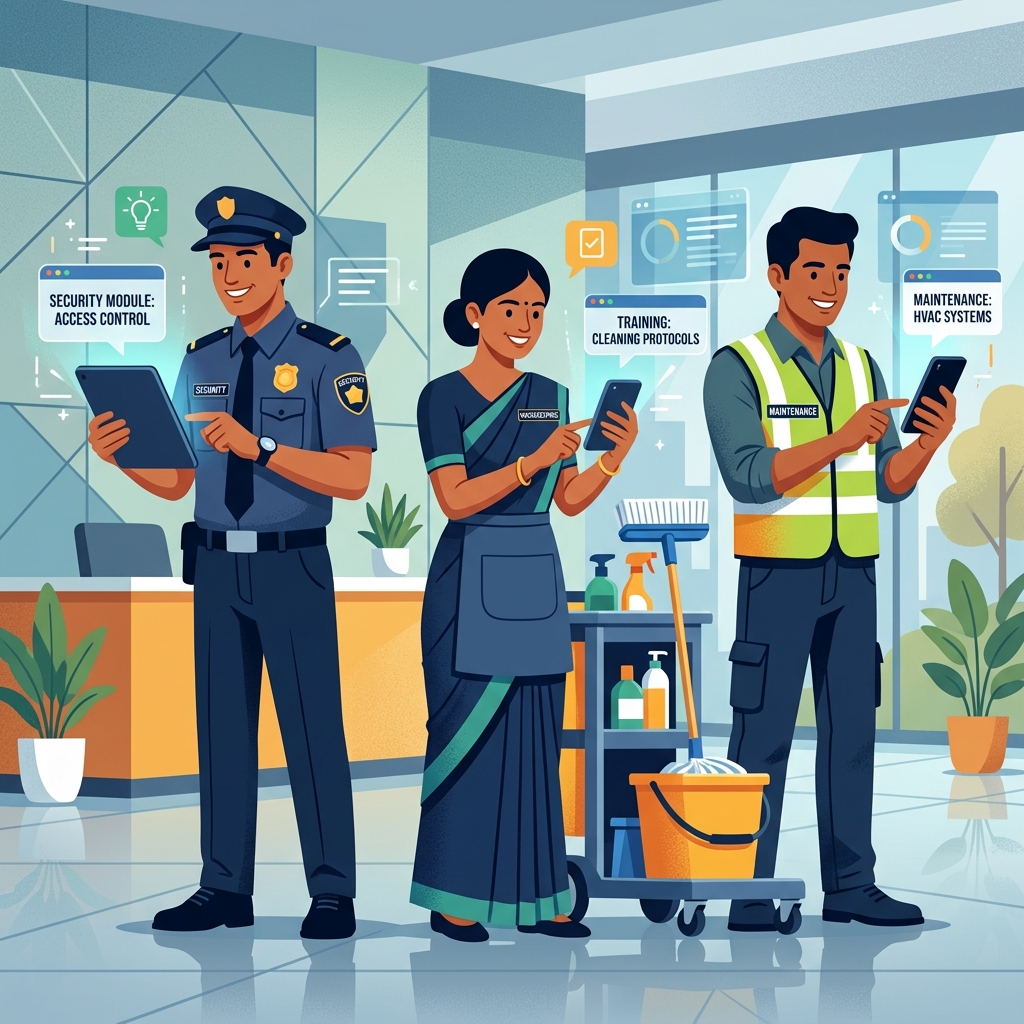
India's facility management (FM) industry is valued at over $50 billion and employs an estimated 6 million+ workers across housekeeping, security, maintenance, pantry services, and landscaping. It's one of the largest employers of blue-collar workers in the country - and one of the most overlooked when it comes to structured training.
These workers are the first people visitors encounter at a corporate office, the last line of defense against security incidents, and the invisible hands that keep critical building systems running. Yet most receive little more than a brief orientation before being deployed.
The Unique Training Challenges in Facility Management
Highly Dispersed Workforce
Workers are deployed across hundreds of client sites - office buildings, hospitals, malls, residential complexes, IT parks, factories. Classroom training across 200+ sites is logistically nightmarish.
Limited Digital Literacy
Many FM workers are first-generation smartphone users. Navigating an LMS portal or enterprise software is unrealistic.
High Turnover and Contractual Employment
Attrition exceeds 60-80% annually. Many workers are on contractual payroll through staffing agencies. Organizations are perpetually onboarding new workers who need to be operational quickly.
Multilingual and Multi-Literate
A housekeeping team in a Bangalore IT park might include workers speaking Kannada, Tamil, Telugu, and Hindi/Bhojpuri. Literacy levels vary widely.
Shift-Based Schedules with Zero Dedicated Training Time
FM workers operate in 8-12 hour shifts with every minute accounted for in client SLAs. Training must fit into pre-shift briefings or breaks.
What Effective FM Training Looks Like
Effective FM training must be: mobile-delivered (WhatsApp/SMS), multilingual, bite-sized (3-5 minutes), visual-first, automated, and trackable.
Housekeeping Training
- Cleaning procedures: Step-by-step visual guides for washroom sanitation, floor cleaning, carpet maintenance
- Chemical handling: Which chemicals can be mixed, dilution ratios, PPE requirements, first aid
- Infection control: Hand hygiene, surface disinfection, waste segregation
- Guest interaction etiquette: How to behave in occupied spaces, handle complaints
- Equipment operation: Floor scrubbers, vacuum cleaners, pressure washers
Security Guard Training
- Access control: Visitor management, ID verification, vehicle checking
- Emergency response: Fire evacuation, first aid basics, incident communication
- Legal awareness: Powers and limitations under Indian law, documentation requirements
- Technology operation: CCTV, access control systems, metal detectors
- Client-specific protocols: Unique security requirements per deployment site
Maintenance Team Training
- Preventive maintenance: Checklists, inspection points, replacement intervals
- Safety protocols: Lockout/tagout, electrical safety, working at heights, confined space entry
- Troubleshooting guides: Decision trees for common issues
- Energy efficiency: Optimizing building systems for conservation
Implementation Framework for FM Companies
Phase 1: Standardize Core Competencies
Define baseline skills for each function. Create a competency matrix mapping skills to training modules.
Phase 2: Develop Visual Micro-Courses
Create 3-5 minute courses heavy on visuals, light on text. Use real photographs. Include audio narration in all required languages. Use AI to generate from existing SOPs and manuals.
Phase 3: Deploy via WhatsApp with Role-Based Paths
Auto-assign content based on role and site. Workers receive 1-2 modules per day during the first two weeks, then weekly reinforcement.
Phase 4: Enable Site Supervisors
Give supervisors visibility into training progress through simple, mobile-optimized dashboards.
Phase 5: Demonstrate Value to Clients
Show clients real-time training data - completion rates, assessment scores, compliance status. Training analytics become a selling point during contract renewals.
The Competitive Advantage of Training in FM
- Lower incident rates - trained workers are safer
- Higher client satisfaction - properly trained teams deliver better service
- Reduced rework and complaints - fewer mistakes
- Better compliance - audit-ready documentation
- Lower attrition - workers who receive development feel valued and stay longer
The Invisible Workforce Deserves Visible Training
Facility management workers keep India's offices clean, buildings secure, and infrastructure running. They deserve training designed for their reality - mobile phones, multiple languages, limited time, dispersed locations, and demanding work.
CTA: Leap10x helps facility management companies train housekeeping, security, and maintenance teams at scale - via WhatsApp, in any language. Book a free demo and see how top FM companies are upgrading their workforce.