How to Measure Training ROI for Deskless Workers: Metrics That Actually Matter
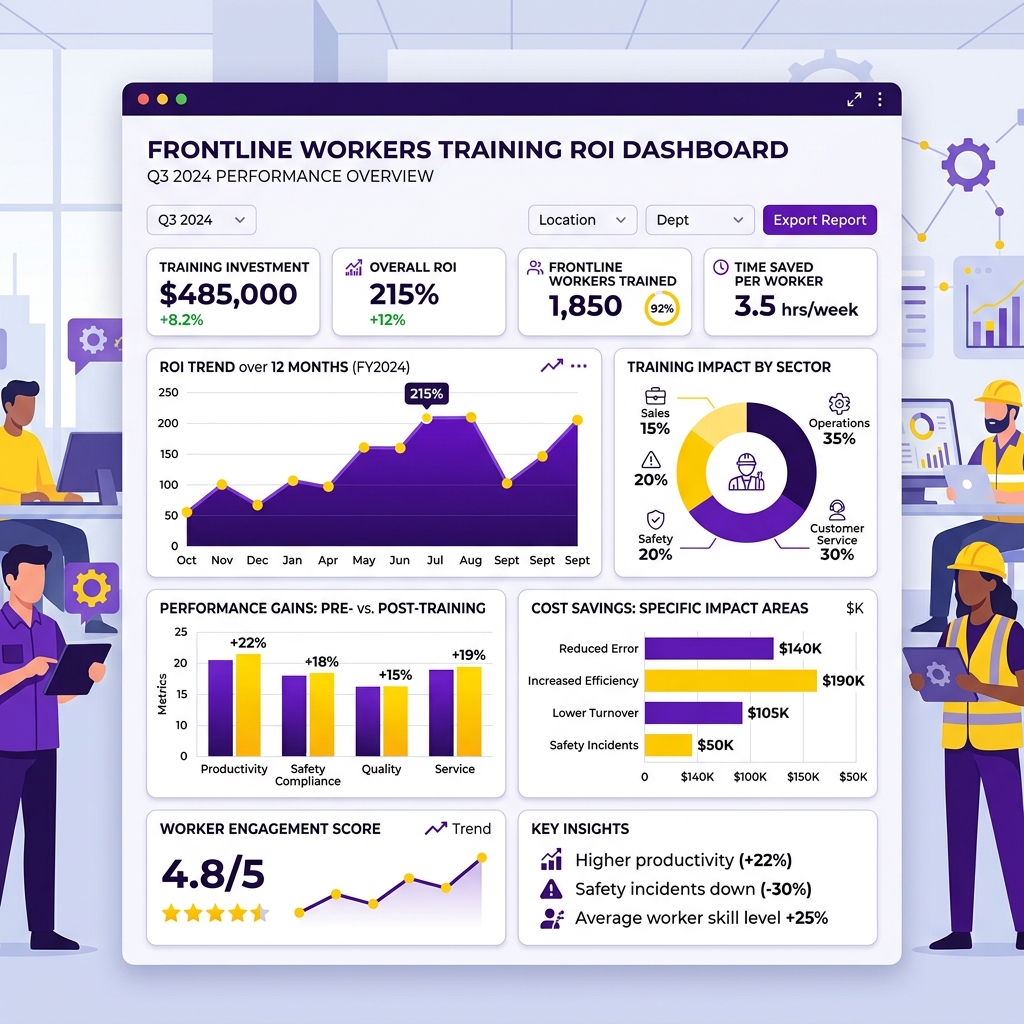
The ROI Question That Keeps L&D Leaders Up at Night
Every training leader in India has heard some version of this question from their CFO or COO: "We spent X lakhs on training last quarter. What did we get for it?"
For frontline and deskless worker training, the question is especially difficult to answer. Traditional training metrics - completion rates, attendance logs, learner satisfaction scores - don't tell the business anything meaningful. A 95% completion rate sounds impressive until you realize it says nothing about whether workers actually changed their behaviour, reduced errors, or improved customer interactions.
McKinsey's research highlights the gap starkly: companies spend an estimated $9,100 per employee annually on software tools but only $1,200 on training and development. When training budgets are already a fraction of technology spending, L&D teams face enormous pressure to demonstrate that every rupee invested in frontline training produces measurable returns.
The problem isn't that training doesn't create value. It's that most organizations lack the frameworks and metrics to prove it. This guide lays out practical approaches to measuring training ROI for deskless workers - methods that work even without sophisticated analytics infrastructure.
Why Traditional Training Metrics Fall Short
Completion Rates Measure Compliance, Not Competence
Completion rates are the most commonly reported training metric. They answer one question: did the worker finish the module? They don't answer the questions that matter: did they understand the content? Can they apply it? Did it change their work performance?
In the age of AI, this weakness is even more exposed. Workers can speed-click through modules, and some are even using AI assistants to auto-complete training assessments. A 100% completion rate might mean 0% actual learning.
Satisfaction Scores Measure Feelings, Not Impact
Post-training surveys ("How would you rate this training on a scale of 1-5?") measure learner sentiment. A worker might rate training highly because it was entertaining, or rate it low because it was challenging - even though the challenging training produced better skill outcomes. Satisfaction scores are a vanity metric that tells L&D teams what they want to hear.
Attendance Logs Prove Presence, Not Performance
For classroom-based frontline training, attendance sheets remain the primary documentation. An auditor can verify that 200 workers attended a safety training session. Nobody can verify from attendance alone whether those workers now follow safety protocols more consistently.
The Metrics Framework That Works for Frontline Training
Instead of traditional metrics, measure training impact across four levels, adapted from Kirkpatrick's model but grounded in frontline operational realities.
Level 1: Engagement Metrics (Leading Indicators)
These metrics indicate whether training is reaching workers and holding their attention. They're not enough on their own, but they're the necessary foundation.
- Active participation rate: Not just completion - what percentage of workers actively engaged with interactive elements (answered questions, watched videos to completion, participated in scenario exercises)?
- Time-to-completion: How long did workers actually spend on each module? Unusually fast completion suggests clicking through without engagement.
- Voluntary revisits: Are workers coming back to reference training content after initial completion? This signals genuine utility.
- Drop-off points: Where in the module do workers stop engaging? Drop-off data reveals content quality issues more accurately than satisfaction surveys.
WhatsApp-delivered microlearning has a built-in advantage here: message open rates and response rates provide real-time engagement data that desktop LMS platforms can't match for frontline audiences.
Level 2: Knowledge Metrics (Learning Indicators)
These metrics verify that workers actually learned the content.
- Assessment scores: Pre-test and post-test comparisons for each module. The gap between pre and post scores quantifies learning gain.
- Scenario-based assessment accuracy: Present workers with realistic workplace scenarios and measure whether they select the correct response. This tests application ability, not just recall.
- Spaced repetition retention: Test the same concepts at intervals (1 day, 7 days, 30 days after training). Retention curves reveal whether knowledge sticks or fades.
- Error rate in AI-generated quiz responses: Are workers answering thoughtfully or pattern-matching? Randomize question order and answer options to ensure genuine understanding.
Level 3: Behaviour Metrics (Application Indicators)
This is where ROI starts to become visible. Behaviour metrics measure whether training changes what workers do on the job.
- Safety incident rates (manufacturing/logistics): Did safety training reduce recordable incidents? Track 30/60/90-day trends post-training.
- Compliance violation rates (BFSI): Did compliance training reduce RBI audit findings or customer complaints related to agent conduct?
- Customer satisfaction scores (retail/hospitality): Did customer service training improve NPS or CSAT at trained locations?
- Quality defect rates (manufacturing): Did SOP training reduce defect-per-million-opportunities (DPMO)?
- First-time-right rates: In any frontline role, did training improve the percentage of tasks completed correctly on the first attempt?
For Indian enterprises, connecting training data to operational metrics requires basic integration between your training platform and operational systems (ERP, HRMS, quality management, CRM). The integration doesn't need to be sophisticated - even a monthly manual correlation of training completion data with operational metrics produces actionable insights.
For strategies on reducing attrition specifically, see our Reduce Frontline Attrition with Better Training: Data Guide.
Level 4: Business Impact Metrics (ROI Indicators)
The ultimate level connects training to financial outcomes.
- Cost avoidance: Compliance penalties avoided due to better-trained workers. A single RBI penalty for NBFC non-compliance can run into lakhs - if training prevents even one violation, the ROI is immediate.
- Productivity gains: Faster onboarding means new hires reach full productivity sooner. If training reduces onboarding time from 4 weeks to 2 weeks, calculate the value of those 2 weeks of additional productive output per new hire.
- Attrition reduction: Workers who receive effective training are more likely to stay. Calculate the cost of replacing a frontline worker (recruitment + onboarding + ramp-up) and multiply by the reduction in turnover attributable to training.
- Revenue per worker: In sales-oriented frontline roles (retail, field sales), did trained workers generate more revenue than untrained peers?
A Practical ROI Calculation Template
Here's a simplified framework Indian L&D teams can use immediately:
Training Investment:
- Platform costs (annual or per-user)
- Content development costs (internal team time + any vendor costs)
- Lost productivity during training (for classroom-based; near-zero for WhatsApp microlearning)
Measurable Returns:
- Compliance penalties avoided (quantify based on regulatory history)
- Reduced onboarding time × number of new hires × daily cost-to-company
- Reduced attrition × replacement cost per worker
- Productivity improvement × output value per worker
- Quality improvement (reduced defect costs, fewer rework hours)
ROI Formula:
ROI = (Total Measurable Returns - Total Training Investment) / Total Training Investment × 100
Even conservative estimates typically show positive ROI within the first quarter for well-designed frontline training programs. WhatsApp-delivered microlearning has a structural cost advantage because it eliminates classroom costs, travel expenses, and lost-shift productivity.
Common Mistakes in Frontline Training ROI Measurement
Mistake 1: Measuring Everything, Acting on Nothing
Some L&D teams collect dozens of metrics and produce elaborate dashboards that nobody reads. Focus on 3-5 metrics that your specific business stakeholders care about. For manufacturing, that's safety incidents and quality defects. For BFSI, it's compliance violations and customer complaints. For retail, it's NPS and sales-per-associate.
Mistake 2: Expecting Instant Results
Behavioural change takes time. Don't measure training impact after one week and conclude it didn't work. Establish 30/60/90-day measurement windows for behaviour and business impact metrics.
Mistake 3: Ignoring the Counterfactual
ROI requires comparison. What would have happened without training? The simplest approach: compare performance metrics for trained groups vs. untrained groups (if available) or compare post-training performance against pre-training baselines.
Mistake 4: Not Accounting for Delivery Channel Savings
When comparing classroom training ROI to WhatsApp microlearning ROI, include the full cost picture. Classroom training carries hidden costs: venue booking, trainer travel, worker downtime, batch scheduling delays. Mobile-delivered training eliminates most of these, which dramatically improves the denominator in your ROI equation.
For a broader view on L&D strategy adaptation in India, read our Leveraging Continuous Learning: Empowering L&D Agility in the Indian Business Landscape.
Getting Started: The 90-Day ROI Sprint
Month 1: Establish Baselines
- Select one training program (e.g., safety onboarding for new hires)
- Document current operational metrics: incident rate, onboarding time, first-30-day attrition
- Calculate current training costs: classroom time, materials, trainer costs, lost productivity
Month 2: Run the Pilot
- Deliver the same training content via WhatsApp microlearning to a pilot group
- Track engagement metrics (completion, active participation, assessment scores)
- Continue tracking operational metrics for the pilot group
Month 3: Calculate and Present
- Compare pilot group operational metrics vs. baseline
- Calculate cost difference between classroom and mobile delivery
- Present ROI findings to leadership with the four-level framework
This sprint approach gives L&D teams a concrete business case they can present to leadership - with real numbers from their own workforce, not industry benchmarks.
The Bottom Line
Measuring training ROI for deskless workers is harder than measuring it for knowledge workers - but it's not impossible. The key is moving beyond vanity metrics (completion rates, satisfaction scores) to operational metrics (safety incidents, compliance violations, quality defects, attrition rates) and financial metrics (cost avoidance, productivity gains, revenue impact).
Indian L&D leaders who master this measurement discipline gain something priceless: credibility with business leadership. When you can show the CFO that last quarter's training investment saved X lakhs in compliance penalties and reduced new hire attrition by Y percent, training stops being a cost centre and starts being a strategic investment.
Want a training platform that gives you built-in ROI analytics for your frontline? Explore Leap10x - track engagement, assessments, and completion in real-time across your entire deskless workforce.