POSH Compliance Training via WhatsApp: How to Train 1,000+ Employees in Under a Week
Quick answer
The Sexual Harassment of Women at Workplace (Prevention, Prohibition and Redressal) Act, 2013 - commonly known as the POSH Act - mandates that every…
POSH Training Isn't Optional - And Your Current Approach Probably Isn't Working
The Sexual Harassment of Women at Workplace (Prevention, Prohibition and Redressal) Act, 2013 - commonly known as the POSH Act - mandates that every organization in India with 10 or more employees must conduct regular awareness and training programs on prevention of sexual harassment.
This isn't a soft recommendation. It's a legal requirement with real consequences. Companies that fail to comply risk penalties of up to INR 50,000 for first offences, with the possibility of licence cancellation for repeated non-compliance. In 2024-2025, the Ministry of Women and Child Development stepped up enforcement, and landmark court rulings reinforced employer obligations to provide meaningful POSH training - not just token awareness.
For organizations with large frontline workforces - manufacturing plants, retail chains, logistics networks, BFSI field operations - the compliance challenge is immense. How do you train 1,000+ workers who are dispersed across locations, working rotating shifts, speaking different languages, and carrying only smartphones?
Classroom-based POSH training barely works at scale. Annual two-hour sessions check a legal box but rarely build genuine awareness. Workers sit through presentations, sign attendance sheets, and forget the content by their next shift.
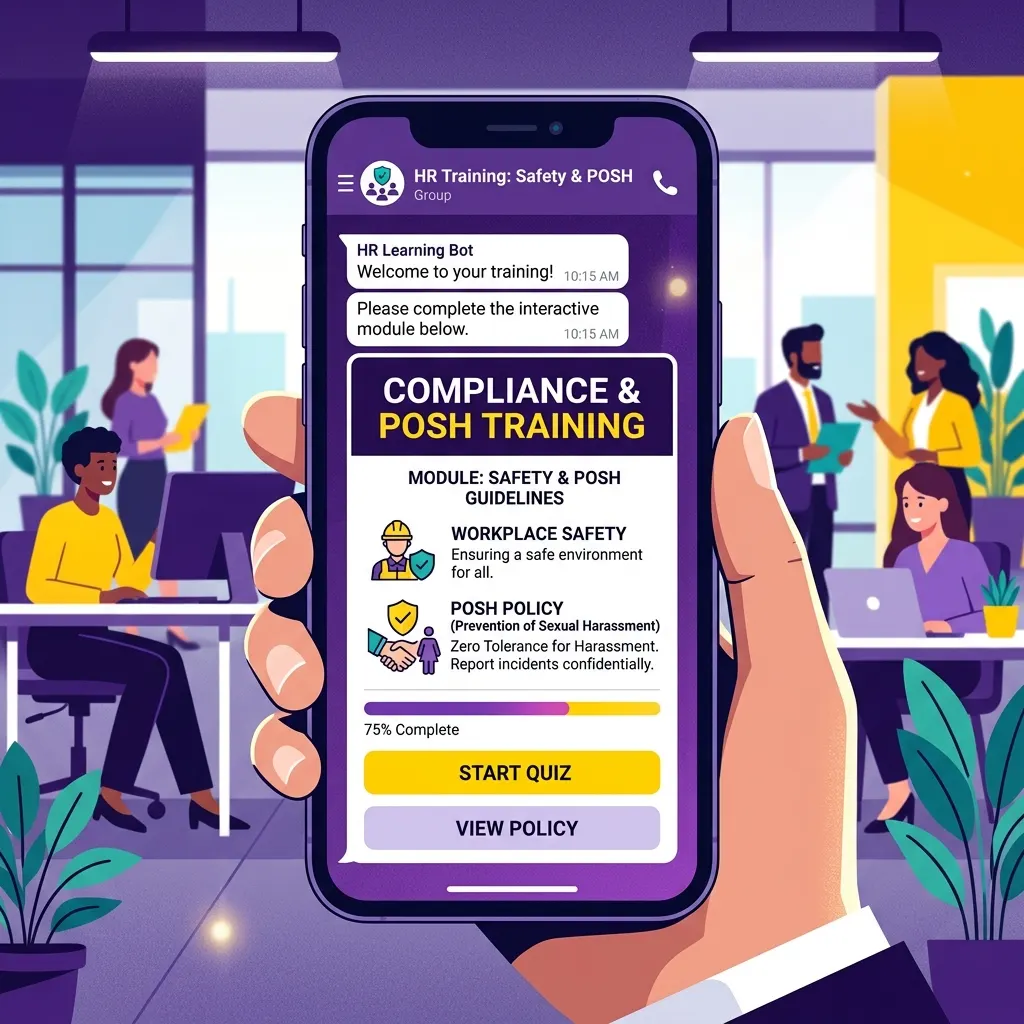
WhatsApp-based POSH training solves this at scale. Here's how to design and deliver a program that meets legal requirements, builds real awareness, and reaches every employee in under a week.
What the POSH Act Actually Requires from Training
Before designing training, understand the legal baseline:
Mandatory Awareness Components
The POSH Act and its rules require employers to:
- Display information about the POSH policy at conspicuous locations
- Organize workshops and awareness programs at regular intervals
- Inform employees about the provisions of the Act and the Internal Complaints Committee (ICC)
- Train ICC members on conducting inquiries and processing complaints
Who Must Be Trained
POSH training isn't limited to women employees or permanent staff. The Act covers:
- All employees regardless of gender (awareness applies to everyone)
- Permanent, temporary, contractual, and daily wage workers
- Workers at the workplace, client sites, and during work-related travel
- Third-party workers (vendors, contractors) operating on your premises
For a frontline-heavy organization, this means factory operators, delivery agents, warehouse workers, retail associates, security staff, housekeeping teams, and contract labourers all fall within the training mandate.
Documentation Requirements
The Internal Complaints Committee must submit an annual report to the employer and the District Officer that includes the number of complaints received, actions taken, and details of awareness programs conducted. Training documentation - who was trained, when, on what content, and with what assessment results - becomes part of this compliance record.
Why Classroom POSH Training Fails for Frontline Workforces
The standard approach - quarterly or annual classroom sessions conducted by an external trainer or ICC member - fails for the same structural reasons that all classroom training fails for frontline workers:
Scheduling is impossible at scale. Pulling 1,000+ workers off shifts for a 2-hour session requires weeks of scheduling coordination across locations and shift patterns. Many workers simply can't attend due to operational constraints.
Sensitive topics suffer in group settings. POSH content involves discussions of harassment, consent, and reporting mechanisms. In a room of 30-50 workers who know each other, many are reluctant to ask questions, share concerns, or engage honestly. The social dynamics of a factory floor carry into the training room.
Language barriers reduce comprehension. External POSH trainers typically deliver in English or Hindi. Workers in Tamil Nadu, Karnataka, West Bengal, and other non-Hindi states miss critical nuances.
Retention is poor. A single annual session on a sensitive topic produces minimal long-term awareness. By the time the next session comes around, workers have forgotten the reporting process, the ICC composition, and their rights under the Act.
For strategies on making all types of compliance training more engaging, see our piece on How to Make Compliance Training Not So Boring.
Designing WhatsApp-Based POSH Training That Works
Module Architecture: 5 Days, 5 Modules
Structure the program as a 5-day microlearning journey, with one module per day. Each module takes 4-6 minutes to complete.
Day 1: What Is Sexual Harassment at the Workplace?
- Define sexual harassment under the POSH Act (with examples relevant to the workplace type: factory, retail store, warehouse)
- Distinguish between physical, verbal, non-verbal, and digital harassment
- Scenario-based question: "Is this harassment?" (real-world situations workers might encounter)
Day 2: Your Rights Under the POSH Act
- What protections the Act provides
- Who is covered (emphasis on contractual and temporary workers who often don't know they're included)
- The right to a safe workplace and freedom from retaliation
- Quick quiz on rights awareness
Day 3: How to Report - The ICC and Complaint Process
- Introduce the Internal Complaints Committee: who they are, their contact details, how to reach them
- Walk through the complaint filing process step-by-step
- Address common fears: confidentiality protections, anti-retaliation provisions
- Scenario exercise: "What would you do if...?"
Day 4: Bystander Responsibility
- The role of witnesses and bystanders
- How to support a colleague who reports harassment
- What constitutes acceptable workplace behaviour
- Interactive scenario: identifying and responding to inappropriate behaviour
Day 5: Assessment and Certificate
- 10-question scenario-based assessment covering all four days of content
- Passing threshold: 70%
- Auto-generated completion certificate with name, date, and score
- Remediation module for those who don't pass on first attempt
Content Design Principles for Sensitive Topics
Use scenarios, not lectures. Instead of defining harassment abstractly, present realistic workplace scenarios and ask workers to identify what's appropriate and what isn't. This builds judgment, not just awareness.
Keep tone respectful and non-judgmental. Workers from diverse backgrounds will engage with this content. Avoid patronizing language. Present the content as a shared responsibility, not an accusation.
Use visual storytelling. Short animated videos or illustrated scenarios work better than text-heavy content for sensitive topics. Workers engage more deeply with visual narratives than with legal definitions.
Offer private engagement. WhatsApp delivery has a built-in advantage here: workers complete the module privately on their own phones. They don't have to raise their hand in a room or show discomfort in front of colleagues. This privacy encourages honest engagement with the content.
Vernacular Delivery
POSH concepts must be understood, not just consumed. Delivering harassment prevention content in English to a Marathi-speaking factory worker defeats the purpose. Auto-translate all modules into the regional languages of each location.
Pay special attention to terminology: legal terms like "Internal Complaints Committee" and "sexual harassment" need culturally appropriate translations that convey the correct meaning without softening or distorting the message.
For a broader framework on WhatsApp-based compliance delivery, see our NBFC Compliance Training via WhatsApp: A Complete Playbook for 2026.
Scaling to 1,000+ Employees in Under a Week
Here's the operational playbook:
Day 0 (Preparation):
- Finalize content in base language (English or Hindi)
- Auto-translate into all required regional languages
- Set up delivery groups by location and language preference
- Configure assessment scoring and certificate generation
Days 1-5 (Delivery):
- Each day at a scheduled time (e.g., 10 AM), the day's module is pushed to all employees via WhatsApp
- Workers complete at their convenience during the day
- Real-time dashboard tracks completion by location, language, and individual
- Day 5 assessment auto-scores and generates certificates
Day 6-7 (Follow-up):
- Push reminders to employees who haven't completed all modules
- Send remediation modules to those who failed the assessment
- Generate compliance reports: completion rates, scores by location, certificate list
Total elapsed time: 7 days from content finalization to full compliance documentation for 1,000+ workers. Compare this to the 2-3 months it would take to schedule and deliver classroom sessions across multiple locations.
Building Audit-Ready Documentation
Your ICC annual report needs training data. WhatsApp-based delivery provides:
- Complete list of trained employees with timestamps
- Individual assessment scores
- Module completion records (which modules were completed, when)
- Certificate records with unique identifiers
- Language of delivery for each employee
- Remediation completion records for failed assessments
This documentation is more comprehensive than any attendance sheet. When the District Officer or an auditor asks about your POSH training program, you're presenting digital records with individual assessment verification - not just signed paper saying people sat in a room.
Special Considerations for Different Workforce Types
Manufacturing Plants
- Include scenarios specific to factory floor dynamics: shift supervisor-worker interactions, shared facilities, break room behaviour
- Address the power dynamics inherent in manufacturing hierarchies
- Deliver in the dominant regional language of the plant location
Retail Stores
- Include customer-to-employee harassment scenarios (not just employee-to-employee)
- Address the unique vulnerability of evening/weekend shift workers
- Cover third-party harassment from delivery vendors and suppliers
BFSI Field Operations
- Include client-facing scenarios: borrower interactions, collection visits, field verification situations
- Address the pressure dynamics in lending and recovery operations
- Cover digital harassment: inappropriate messages, social media contact
Logistics and Delivery
- Address scenarios unique to delivery workers: customer interactions at doorsteps, interactions with co-workers at sorting centres
- Cover harassment in transit and at temporary work locations
- Emphasize the complaint process for workers who don't have a fixed workplace
For the broader framework of WhatsApp-based training delivery mechanics, see our WhatsApp-Based Training for Employees: Complete 2026 Guide.
The Bottom Line
POSH compliance isn't just a legal obligation. It's a statement about the kind of workplace your organization builds. When training is delivered in a way that every worker can access, understand, and engage with - privately, in their language, on their phone - you move from performative compliance to genuine prevention.
The 2013 Act is over a decade old. The enforcement landscape is tightening. The tools to comply at scale exist today. The question isn't whether to do POSH training properly. It's whether to do it this week or risk being unprepared when the audit arrives.
Ready to make your entire workforce POSH-compliant in under a week? Book a demo with Leap10x - WhatsApp-native compliance training with built-in assessments and audit-ready documentation.