India's Skill India 2.0: What It Means for Frontline Training and L&D Teams
Quick answer
India is one of the youngest countries in the world. Over 65% of its population is under 35.
India's Skilling Ambition Has a New Chapter
India is one of the youngest countries in the world. Over 65% of its population is under 35. That demographic reality is either a massive economic advantage or a ticking time bomb - and the difference comes down to whether those young people have employable skills.
The numbers suggest the gap is still wide. According to the India Skills Report 2025, employability among Indian graduates has improved to 54.81% - better than a few years ago, but still meaning nearly half of all graduates aren't job-ready. The International Labour Organisation estimates India could face a shortage of 29 million skilled workers by 2030. Accenture has put a price tag on inaction: the skill deficit could cost India $1.97 trillion in GDP over the next decade.
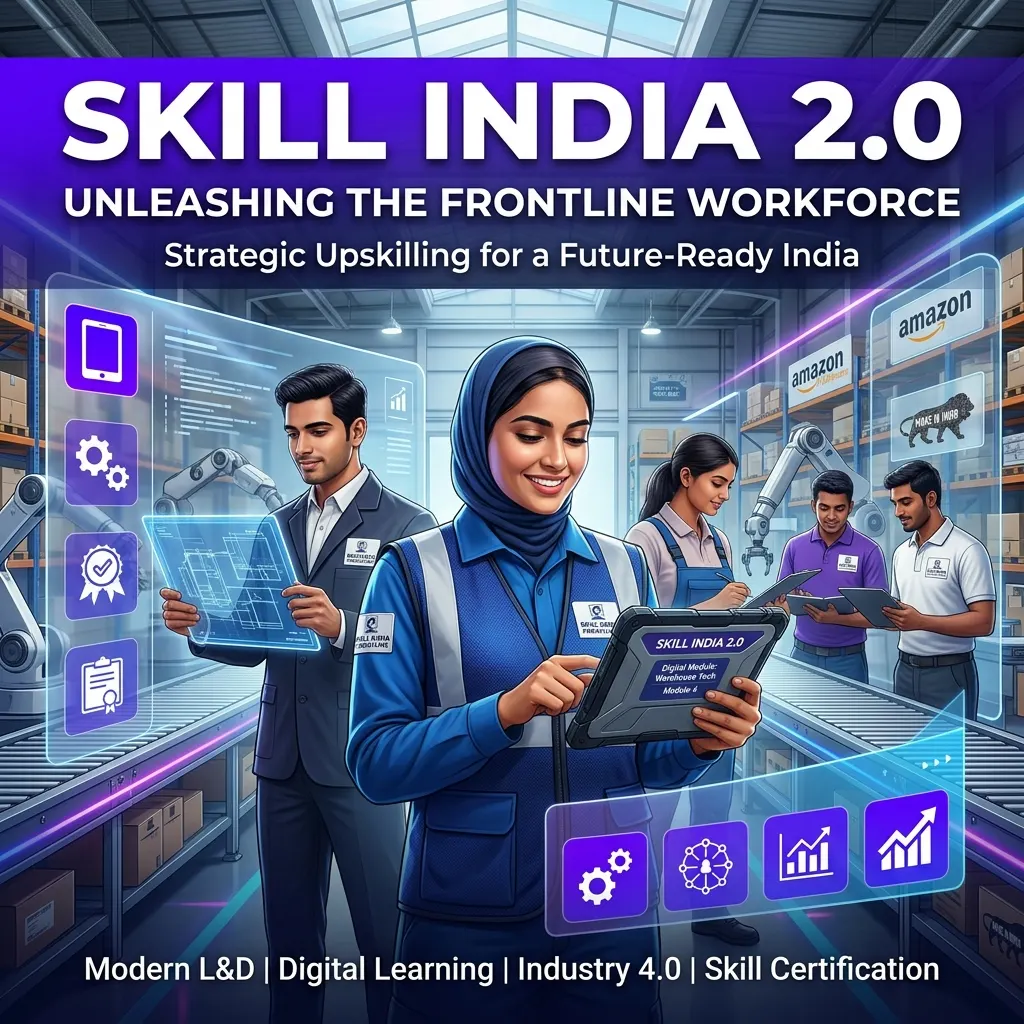
The government isn't standing still. In February 2025, the Union Cabinet approved the continuation and restructuring of the Skill India Programme (SIP) through 2026 with an outlay of ₹8,800 crore (approximately $1.02 billion). This restructured program - sometimes referred to as Skill India 2.0 - combines three flagship schemes under a single umbrella and introduces technology-first training delivery.
For corporate L&D teams, HR heads, and training managers at Indian enterprises, this isn't just government policy. It's a shift in the ecosystem that directly affects how you recruit, onboard, train, and retain frontline workers.
Here's what's actually changing, what it means for your organization, and how to position your training strategy to benefit.
What's Inside Skill India 2.0
The restructured program consolidates three schemes into one composite framework:
1. Pradhan Mantri Kaushal Vikas Yojana 4.0 (PMKVY 4.0)
PMKVY is the flagship. Since its initial pilot, the program has trained over 1.63 crore (16.3 million) candidates across traditional and emerging sectors. PMKVY 4.0 emphasizes:
- Industry-aligned curriculum: Training mapped to specific job roles and developed with industry input, rather than generic vocational education
- Emerging technologies: New-age skills including AI basics, machine learning, robotics, cloud computing, cybersecurity, and green energy
- Inter-ministerial convergence: A whole-of-government approach that connects skilling initiatives across ministries - linking with PM Vishwakarma (MSME), PM Surya Ghar (renewable energy), and the National Green Hydrogen Mission
- International mobility: Mobility Partnership Agreements with countries including Japan, training in domain skills, language proficiency, and soft skills for overseas employment
2. PM National Apprenticeship Promotion Scheme (PM-NAPS)
Apprenticeships are getting a significant push. PM-NAPS aims to expand hands-on, on-the-job training opportunities across industries. For employers, this means government-supported apprenticeship programs that reduce the cost of training entry-level workers while providing structured skill development.
3. Jan Shikshan Sansthan (JSS)
Community-based learning for underserved populations - particularly in rural and semi-urban areas. JSS targets marginalized communities, including women and youth who may not access formal training centres.
The Digital Infrastructure: Skill India Digital Hub
Perhaps the most consequential piece for corporate L&D is the Skill India Digital Hub (SIDH) - an online platform that provides courses, career tools, and AI-based skill matching. The Hub aims to connect learners directly with industry demand, creating a pipeline of pre-trained candidates that employers can tap into.
The broader vision under Skill India 2.0 includes training 30 million youth by 2030 with demand-driven skills, expanding the AI for India 2.0 program (free AI training for youth), and increasing apprenticeship programs to boost hands-on learning.
For a broader look at how L&D strategy is evolving in India, read our piece on Leveraging Continuous Learning: Empowering L&D Agility in the Indian Business Landscape.
The Gap Between Policy and Practice
It's important to look at Skill India with clear eyes. The ambition is significant, but the ground reality has challenges.
The formal training gap remains stark: only 4-5% of India's total workforce has received formal skill training. Compare that to Germany's 70%+ rate. India is starting from a very different baseline.
Placement rates from government short-term training programs range from 10-23% - meaning the majority of trainees don't transition into formal employment after completing their certification. A 2025 CAG audit found irregularities including ghost accounts and dubious certifications within the program.
The structural issues are well-documented:
- Skill mismatch: What's taught in training centres often doesn't match what local businesses actually need
- Quality variation: Too many low-quality training centres operate with insufficient oversight
- Urban-rural divide: Digital learning is reaching small towns, but infrastructure and access remain uneven
Budget 2026 has reinforced skilling as a central pillar of India's economic strategy, with a push toward outcome-based training rather than just enrollment-based metrics. The policy direction is moving from "how many people did we train?" to "how many people got jobs?"
What This Means for Corporate L&D Teams
1. A Growing Pool of Pre-Trained Candidates
As Skill India scales - particularly through PMKVY 4.0 and the Digital Hub - the pipeline of candidates with basic vocational training will expand. For manufacturers, logistics companies, retailers, and BFSI organizations that hire frontline workers at scale, this means:
- More candidates arriving with foundational skills and government certifications
- The ability to reduce internal onboarding time by building on baseline skills
- Opportunities to partner with NSDC or Sector Skill Councils to align your internal training with nationally recognized frameworks
However, don't assume Skill India graduates are job-ready. Your internal training still needs to bridge the gap between generic vocational training and your specific operational requirements.
2. Apprenticeship Opportunities With Government Support
PM-NAPS provides financial incentives for employers who offer apprenticeships. If your organization hasn't explored this, the math is worth examining: government-subsidized apprenticeship programs reduce your cost of developing entry-level talent while providing structured on-the-job training.
For manufacturing and logistics companies with high turnover, apprenticeship programs create a pipeline of workers who are already familiar with your operations, culture, and systems when they transition to full employment.
3. Digital Skills Are Now Table Stakes
Skill India 2.0's emphasis on AI, digital literacy, and technology skills signals a broader shift: even frontline roles are becoming more technology-intensive. Retail associates use digital POS systems. Warehouse workers operate WMS interfaces. Factory operators interact with IoT-enabled machinery.
Your training programs need to account for varying levels of digital literacy among new hires - even those who arrive with Skill India certifications. Build digital skills training into your onboarding, don't assume it.
4. Vernacular and Mobile-First Training Aligns With Government Strategy
Skill India's push for accessible, technology-enabled training across India aligns with the same delivery model that works for corporate frontline training: mobile-first, vernacular content delivered through familiar channels.
The government is investing in translation infrastructure (Bhashini platform), AI-powered skill matching, and digital delivery. Corporate L&D teams that adopt the same principles - training in regional languages, delivered on mobile, in short digestible formats - will find their approach validated by the broader ecosystem.
Our WhatsApp-Based Training for Employees guide covers exactly how to build this type of mobile-first, multilingual training program.
5. Compliance Training Becomes More Critical
As government training programs grow, so does regulatory scrutiny on workforce compliance. NBFCs must train field agents on RBI guidelines. Manufacturers must document safety training under the Factories Act. Retailers must ensure labour law compliance.
Skill India creates a broader expectation that trained workers should be documented - with certificates, assessments, and audit trails. Corporate training programs that can't demonstrate compliance documentation will face increasing pressure.
How to Position Your L&D Strategy
Audit Your Baseline
Assess which Skill India certifications your incoming workforce holds. Map these against your internal competency requirements. Identify gaps.
Build Bridge Training
Design short, targeted training modules that bridge the gap between government vocational training and your specific operational needs. These modules should be mobile-delivered, vernacular-friendly, and focused on your company's SOPs, safety standards, and customer service protocols.
Partner Strategically
Explore partnerships with NSDC, Sector Skill Councils, or local ITI/ITCs to align your training with nationally recognized frameworks. This creates mutual benefit - workers get recognized credentials and you get a trained talent pipeline.
Invest in Documentation
Create systems that track all employee training - government certifications, internal onboarding, compliance modules, and ongoing skill development. As the regulatory and compliance environment tightens, comprehensive training records become a business asset.
Deliver Training in the Worker's Language, on Their Phone
The biggest lesson from Skill India's evolution applies equally to corporate L&D: training only works when it reaches the learner in a format they can access, understand, and apply. For India's frontline workforce, that means mobile delivery, regional language content, and microlearning modules that fit between shifts.
The Bottom Line
Skill India 2.0 represents the most significant government investment in workforce training since the program's inception. The ₹8,800 crore outlay, the consolidation of schemes, and the technology-first approach signal that India is serious about closing its skills gap.
For corporate L&D teams, this creates both opportunity and obligation. The opportunity: a growing pipeline of pre-trained workers and government support for apprenticeships. The obligation: training programs that match the ambition of national policy with the reality of how frontline workers actually learn - on their phones, in their language, in the moments they can spare.
Want to build training that bridges the gap between Skill India and your shop floor? Explore Leap10x - mobile-first, WhatsApp-native training designed for India's frontline workforce.
Frontline training
Training software built for deskless teams
Onboarding, SOPs, safety refreshers, and compliance evidence for workers with no corporate email and no company device — tracked by site, role, and shift.