Vernacular Training for India's Frontline: Why Regional Languages Beat English-Only Programs
Quick answer
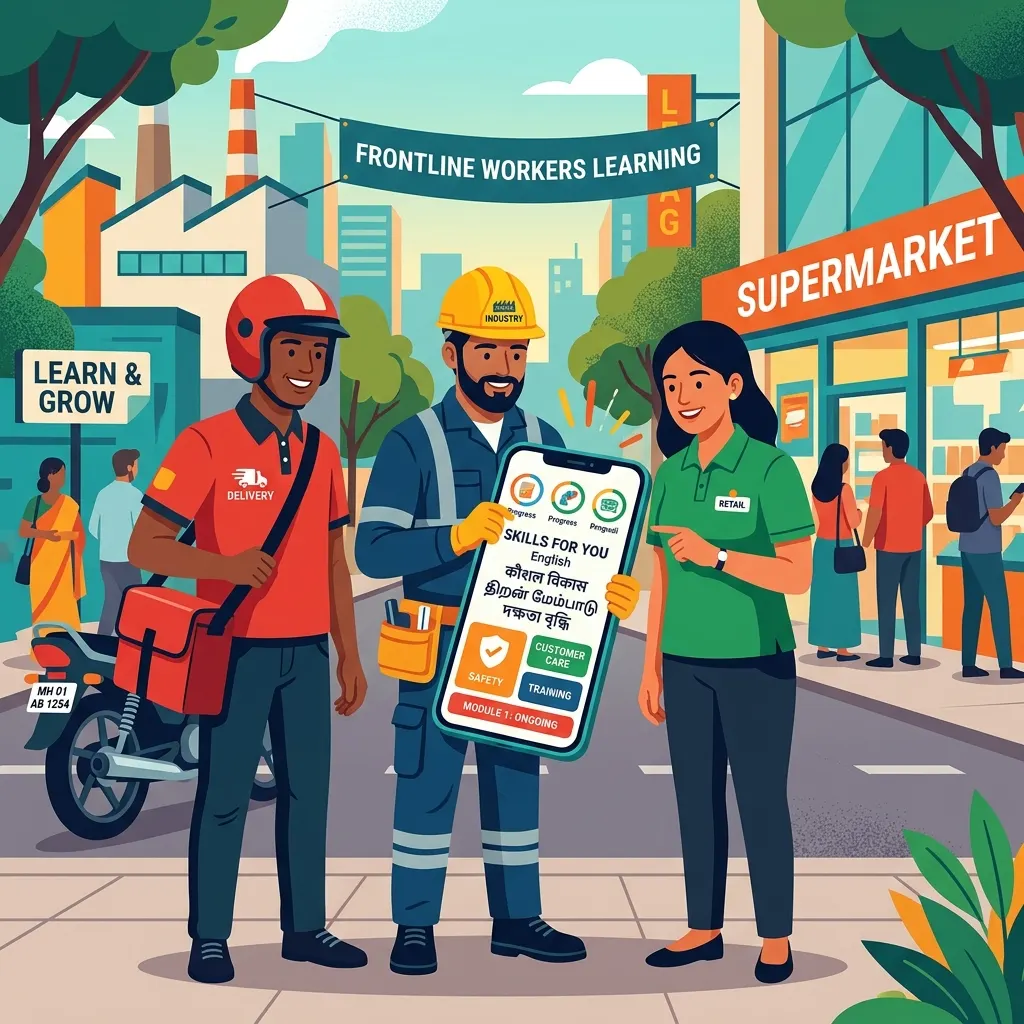
India employs over 450 million frontline and informal workers - delivery riders, factory operators, retail associates, bank field agents, and warehouse staff.
The Language Problem Hiding in Plain Sight
India employs over 450 million frontline and informal workers - delivery riders, factory operators, retail associates, bank field agents, and warehouse staff. These workers form the backbone of the economy, yet vernacular training for frontline workers in India remains largely underutilized.
Consider the disconnect: only about 10-12% of India's population speaks English fluently. Among frontline workers in manufacturing plants, logistics hubs, and retail chains, that number drops dramatically. A line supervisor in a Pune auto-parts factory likely communicates in Marathi. A delivery agent in Chennai thinks in Tamil. A recovery agent covering rural Uttar Pradesh operates entirely in Hindi.
When you hand these workers an English-language training module on safety procedures or compliance protocols, you're not just creating a comprehension barrier - you're building a system designed to fail.
The data supports what anyone who has spent time on an Indian factory floor already knows: vernacular training dramatically outperforms English-only programs in engagement, retention, and real-world application.
Why English-Only Training Falls Flat
Comprehension Gaps Lead to Compliance Gaps
When a worker doesn't fully understand training content, they don't ask for clarification - they guess. In a compliance-heavy environment like BFSI or manufacturing, guessing leads to regulatory violations, safety incidents, or customer complaints.
A study from Disprz found that frontline employees in India who received training in their preferred language showed measurably higher engagement and knowledge retention. The reason is straightforward: people process information faster and more accurately in their mother tongue. Cognitive load decreases, and working memory can focus on the actual content rather than translation.
Low Completion Rates Signal Disengagement
English-only training programs for non-English-speaking frontline teams consistently see lower completion rates. Workers open the module, struggle through the first few screens, and abandon it. The training gets marked as incomplete, the L&D team reports low engagement, and the cycle continues.
Vernacular delivery flips this equation. When the same content reaches a warehouse worker in Telugu or a retail associate in Bengali, they engage with it because they understand it. Completion rates rise not because the content changed, but because the delivery matched the learner.
Knowledge Doesn't Transfer to the Floor
The ultimate test of training isn't whether someone finished a module - it's whether they change their behaviour at work. A safety training module delivered in English to a Kannada-speaking factory worker might achieve technical completion, but the knowledge rarely transfers to their daily habits. They revert to what they understood before training.
Vernacular training creates a direct link between learning and doing because the instructions exist in the same language the worker thinks in.
The Vernacular Tech Revolution in India
India's technology ecosystem is rapidly solving the language infrastructure problem that held back vernacular training for years.
The Ministry of Electronics' Bhashini platform, part of the National Language Translation Mission, provides free cloud APIs, datasets, and models for all 22 scheduled Indian languages. This means training platforms can now leverage government-backed translation infrastructure to deliver content across languages without building everything from scratch.
NITI Aayog's AI roadmap includes Digital ShramSetu, a mission designed to empower India's 490 million informal workers with digital skills through voice-first, AI-powered interfaces that work in regional languages. The vision is that by 2035, voice-first AI will make digital platforms universally accessible - but the foundation is being built today.
Research projects like AI4Bharat and IndicNLP are collecting text and audio from regional sources to train AI engines that understand Indian languages with far greater accuracy than global models. Google's MuRIL (Multilingual Representations for Indian Languages) is specifically designed for Indian scripts and contexts, improving voice transcription and chatbot accuracy across Hindi, Tamil, Bengali, and other languages.
In January 2026, Udemy announced a strategic partnership with Entri - a platform serving India's 400 million vernacular learners - to expand upskilling in Hindi, Tamil, Telugu, and Malayalam. The partnership signals that even global platforms recognize that India's next wave of learners will come from native-language audiences.
For a broader perspective on how L&D strategy is adapting to India's market dynamics, check out Leveraging Continuous Learning: Empowering L&D Agility in the Indian Business Landscape.
Building a Vernacular Training Strategy: A Practical Framework
Step 1: Audit Your Workforce Language Map
Before building multilingual content, understand what languages your frontline actually speaks. Survey your workforce by location and role. You'll likely find patterns:
- Manufacturing plants: Language clusters around the state where the plant is located (Marathi in Maharashtra, Tamil in Tamil Nadu, Gujarati in Gujarat)
- Logistics networks: More diverse, with workers from multiple states converging at hubs. Hindi serves as a bridge in North India; you'll need Southern languages for hubs in Bengaluru, Hyderabad, and Chennai
- BFSI field agents: Match the language to the borrower population they serve. A recovery agent in rural Rajasthan needs training in Hindi with Rajasthani context
- Retail chains: Match store-level language needs - a Delhi store needs Hindi, a Kolkata store needs Bengali
Step 2: Choose a Delivery Channel That Supports Vernacular
Not every training platform handles multilingual content well. Key capabilities to evaluate:
- Auto-translation with accuracy verification: Can the platform translate training content automatically into 10+ Indian languages? What's the accuracy rate?
- Right-to-left script support: Relevant if your workforce includes Urdu speakers
- Audio and video vernacular support: Text translation alone isn't enough. Voice-over in regional languages significantly improves engagement, especially for workers with limited reading proficiency
- WhatsApp-native delivery: Since 72% of APAC frontline employees lack computer access (per Gallup), training must reach workers on their phones through familiar channels
Our WhatsApp-Based Training for Employees guide covers the delivery mechanics in depth.
Step 3: Localize Content, Don't Just Translate It
Translation is necessary but not sufficient. Localization means adapting examples, scenarios, and cultural references to the learner's context.
A safety training module for a factory in Gujarat should reference local equipment types and procedures, use units of measurement workers are familiar with, and present scenarios that reflect the actual working conditions on their floor - not a generic factory from a stock photo.
For compliance training in BFSI, localize the scenarios to regional lending practices. A KYC training module for field agents in Bihar should include examples of locally common identity documents and address formats, not just Aadhaar and PAN in generic terms.
Step 4: Implement Spaced Repetition in the Learner's Language
Spaced repetition - delivering content in intervals over days or weeks rather than in one sitting - works across all languages. But it works better in the learner's native language because each repetition reinforces understanding rather than requiring re-translation.
Structure your vernacular training as:
- Day 1: Core concept module (5 minutes)
- Day 3: Scenario-based practice question
- Day 5: Quick refresher with a new example
- Day 7: Assessment quiz
This cadence, delivered in the worker's mother tongue via WhatsApp, produces retention rates that classroom training simply cannot match.
Step 5: Measure What Matters
Track these metrics across languages:
- Completion rate by language: Are some language groups completing at lower rates? That signals translation quality issues.
- Assessment scores by language: Consistently lower scores in a specific language may indicate that content localization needs improvement.
- Time-to-completion by language: If Tamil-speaking workers take significantly longer than Hindi-speaking workers on the same module, the Tamil version may need simplification.
- Behavioral outcomes by language group: Track safety incidents, compliance violations, or customer satisfaction scores segmented by language group to measure real-world impact.
The Business Impact of Going Vernacular
Companies investing in vernacular training report tangible results:
- Higher training completion rates: When workers understand the content, they finish it. Completion rates of 90%+ are common with vernacular microlearning versus 50-60% for English-only programs.
- Faster onboarding: New hires reach productivity faster when they receive onboarding training in their language. The learning curve shortens because cognitive resources go toward skill building, not translation.
- Reduced safety incidents: In manufacturing and logistics, clear communication saves lives. Training that workers actually understand produces measurably fewer safety violations.
- Stronger compliance: In regulated industries like BFSI, vernacular compliance training closes the gap between "training completed" and "training understood."
- Lower attrition: Workers who feel their employer invests in communicating with them - not at them - report higher engagement. And engaged workers stay longer.
The Bottom Line
India's frontline workforce speaks 22 scheduled languages and hundreds of dialects. Building training programs in English and hoping for the best isn't a strategy - it's a liability.
The technology to deliver vernacular training at scale exists today. The government infrastructure (Bhashini, AI4Bharat) is accelerating. The business case is clear. The question isn't whether to go vernacular. It's how fast you can get there.
Want to deliver training in every language your workforce speaks? Explore Leap10x - WhatsApp-native training that auto-translates and reaches your entire frontline, no matter what language they speak.
Microlearning
Turn your SOPs into 3-minute modules
Upload a PDF, deck, or video and Leap10x's AI builds micro-modules with quizzes and spaced-repetition schedules — delivered where your frontline already is.