AI Agents vs WhatsApp Training Bots: What Actually Works for Blue-Collar Workforces
Every enterprise learning platform is talking about AI agents in 2026.
Docebo launched AgentHub at Inspire 2026, promising autonomous AI agents that can manage learning programs, run skills campaigns, and deliver personalized training reminders. 7taps introduced Copilot, an AI co-creator for instructional design. Across the LMS landscape, the narrative is clear: the future of corporate training is agentic - meaning AI that doesn't just respond to prompts but proactively reasons, decides, and acts.
It's an exciting vision. But there's a question nobody in the enterprise learning world seems to be asking:
Does any of this work for the 2.7 billion frontline and blue-collar workers who don't use enterprise software?
What Are AI Training Agents?
Before we compare approaches, let's clarify what "AI agent" means in the learning context.
An AI training agent is software that goes beyond simple chatbot responses. Instead of just answering questions, it:
- Proactively identifies skill gaps based on performance data
- Creates and assigns personalized learning paths
- Sends targeted training reminders at optimal intervals
- Generates new content based on organizational knowledge
- Acts autonomously - without a human needing to trigger each step
Docebo's AgentHub, for example, promises agents that can "run skills campaigns, support content creation, and follow through on learning programs without someone manually setting it all in motion." The AI reads your organization's learning data, spots who needs what training, and delivers it.
This sounds powerful. And for knowledge workers sitting at desks with Slack and browser access, it probably is.
But let's talk about who this technology actually reaches - and who it doesn't.
The Access Divide: Why Enterprise AI Agents Miss Blue-Collar Workers
Here's the fundamental disconnect. Most AI training agents operate inside enterprise ecosystems - they require:
- Browser or app access: The worker needs to log into a learning platform or have an app installed
- Email/SSO authentication: Access is typically tied to corporate credentials
- English proficiency: While translation features exist, the agent interactions, content creation, and skill mapping are typically designed for English-speaking knowledge workers
- Digital literacy: Interacting with an AI agent through a web interface requires comfort with enterprise software - typing queries, navigating menus, understanding AI-generated suggestions
Now consider the reality for India's factory workers, delivery riders, hotel housekeepers, and retail store associates:
- 80% of frontline workers globally lack access to corporate technology (according to Gallup's State of the Global Workplace)
- Many blue-collar workers in India are first-generation smartphone users
- Their primary - and often only - digital communication channel is WhatsApp
- Literacy levels vary significantly, making text-heavy interfaces ineffective
- They don't have company email addresses or SSO credentials
An AI agent that lives inside an enterprise LMS is invisible to these workers. No matter how sophisticated its reasoning capabilities, if it can't reach the worker, its intelligence is wasted.
The WhatsApp Training Bot Approach
A WhatsApp training bot operates on fundamentally different assumptions about who the learner is and how they interact with technology.
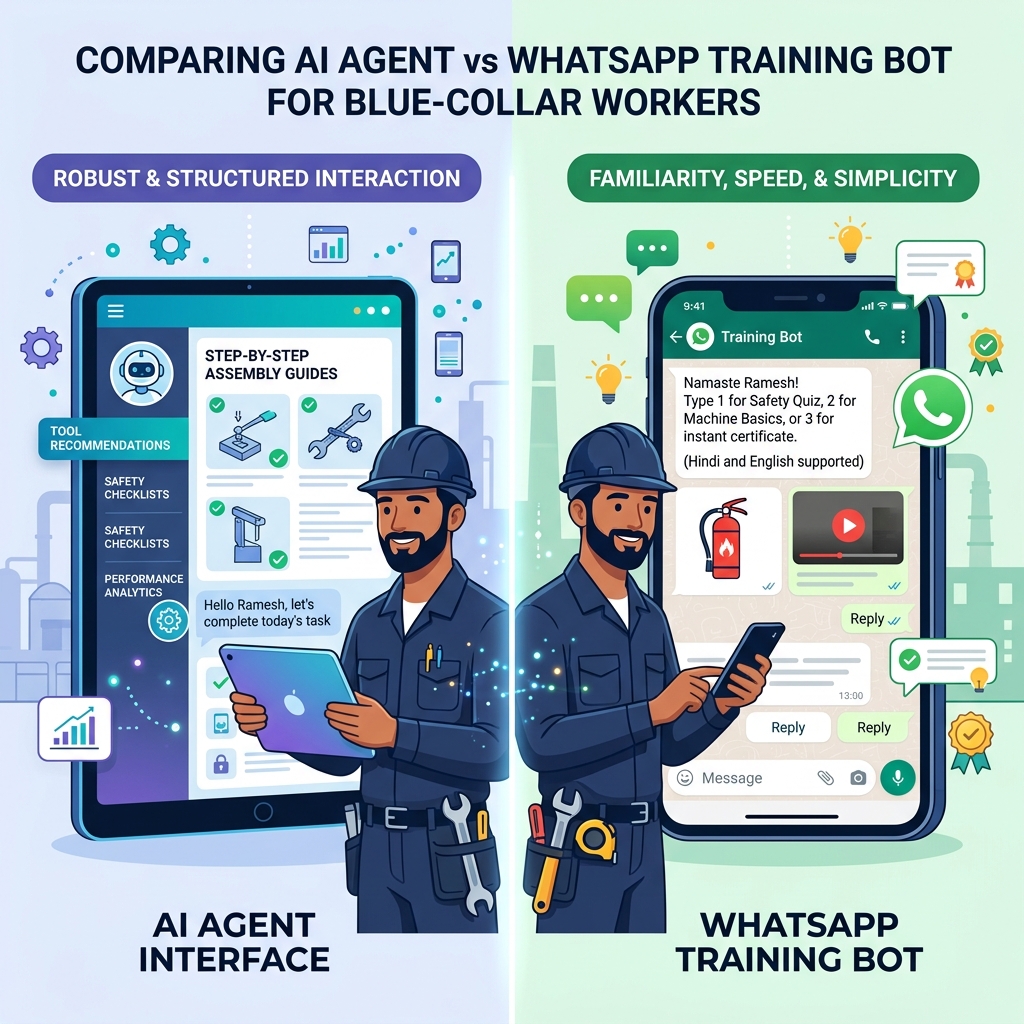
Instead of sitting inside a browser-based platform waiting for the learner to log in, a WhatsApp training bot meets the worker where they already are - inside their most-used app - and delivers training as a conversation.
Here's how it typically works:
Proactive Delivery
Like an AI agent, a well-designed WhatsApp training bot doesn't wait for the worker to come to it. It pushes training based on:
- Role and department: A new kitchen worker receives food safety modules; a security guard receives emergency protocol training
- Tenure-based triggers: Week 1 onboarding content differs from Month 3 upskilling content
- Compliance calendars: Safety refreshers, FSSAI recertification, POSH awareness modules arrive automatically based on regulatory timelines
- Performance signals: If quiz scores on a particular topic are low across a team, the bot automatically sends reinforcement content
Conversational Interaction
Instead of navigating menus or typing queries into a search bar, workers interact through chat - the same way they communicate with family and friends:
- "Type 1 for Safety Training"
- "Reply with the correct answer: A, B, or C"
- Voice-note responses for workers with limited text literacy
- Image and video-based content that doesn't require reading
Multilingual by Default
A WhatsApp training bot can detect a worker's language preference and deliver all content - modules, quizzes, reminders, feedback - in their mother tongue. For a workforce spanning Hindi, Tamil, Telugu, Marathi, Kannada, and Bengali, this isn't a feature. It's the difference between training that works and training that's ignored.
Zero-Friction Access
No app download. No login. No password reset. The worker receives a WhatsApp message and opens it. That's the entire access journey. For a population that may struggle with enterprise app interfaces, this simplicity is a massive retention multiplier.
They're Not Competing - They're Solving Different Problems
Here's the nuance that most vendor comparisons miss: enterprise AI agents and WhatsApp training bots aren't really competing for the same audience.
If you're training 500 software engineers or corporate sales representatives who live in Slack and use browser-based tools all day, an AI agent embedded in your LMS makes perfect sense.
But if you're training 20,000 warehouse workers, 50,000 retail store associates, or 10,000 hotel housekeepers - workers who don't have LMS access and never will - you need a fundamentally different approach.
The real question for L&D leaders isn't "AI agent or WhatsApp bot?" It's "Who are we trying to train, and what's the path of least resistance to reaching them?"
When WhatsApp Training Bots Outperform AI Agents
There are specific scenarios where WhatsApp-based training clearly wins:
High-turnover environments: When 60-100% of your frontline workforce turns over annually, you can't afford a training system that requires onboarding workers into yet another platform. WhatsApp training starts on Day 1 with zero setup.
Multilingual, multi-location workforces: A restaurant chain with locations across 15 Indian states needs training in 8+ languages delivered to workers who may be semi-literate. WhatsApp bots handle this natively.
Compliance-heavy industries: When you need to prove that 10,000+ workers completed mandatory safety training, you need a system with near-100% reach. WhatsApp's ubiquity ensures training reaches everyone - not just the digitally savvy.
Budget-constrained organizations: Enterprise AI agent platforms typically start at $5-15 per user per month. For organizations training large blue-collar workforces in emerging markets, WhatsApp-based platforms offer dramatically lower per-worker costs.
Rapid deployment: When a new safety regulation drops or a product recall requires immediate retraining, WhatsApp bots can push emergency training to the entire workforce in hours - not the days or weeks it takes to create, upload, and assign content through an LMS.
The Future: Conversational AI on WhatsApp
The distinction between "AI agents" and "WhatsApp bots" is already blurring. The next generation of WhatsApp-based training platforms is incorporating genuine AI agent capabilities - proactive skill gap detection, adaptive learning paths, intelligent content creation - while maintaining the zero-friction delivery that makes WhatsApp effective for deskless workers.
The future isn't choosing between intelligence and accessibility. It's bringing intelligence to the channel where your workers already are.
For the 84% of organizations that still don't use AI-enabled training for their frontline employees, the opportunity isn't to adopt the most sophisticated AI agent in the market. It's to adopt the one that can actually reach their workforce.
CTA: See how Leap10x combines AI-powered training intelligence with WhatsApp-native delivery. Book a free demo and experience the difference between enterprise AI hype and frontline training that actually works.