Why Chatbots Failed at Employee Training (And What Agentic AI Gets Right)
Between 2018 and 2023, hundreds of companies launched training chatbots. HR departments were sold on the vision: an always-available assistant that could answer employee questions, deliver training content, and guide learners through modules.
Most of those chatbots are dead now. Not officially retired - just quietly abandoned. The Slack channel nobody uses. The HR portal widget nobody clicks. The WhatsApp number that sends the same five messages regardless of what you ask.
If you implemented a training chatbot in the last five years and were disappointed by the results, you're not alone. A 2024 Gartner survey found that 54% of organisations using chatbots for internal processes reported low adoption rates, with "lack of conversational depth" and "inability to handle complex queries" as the top complaints.
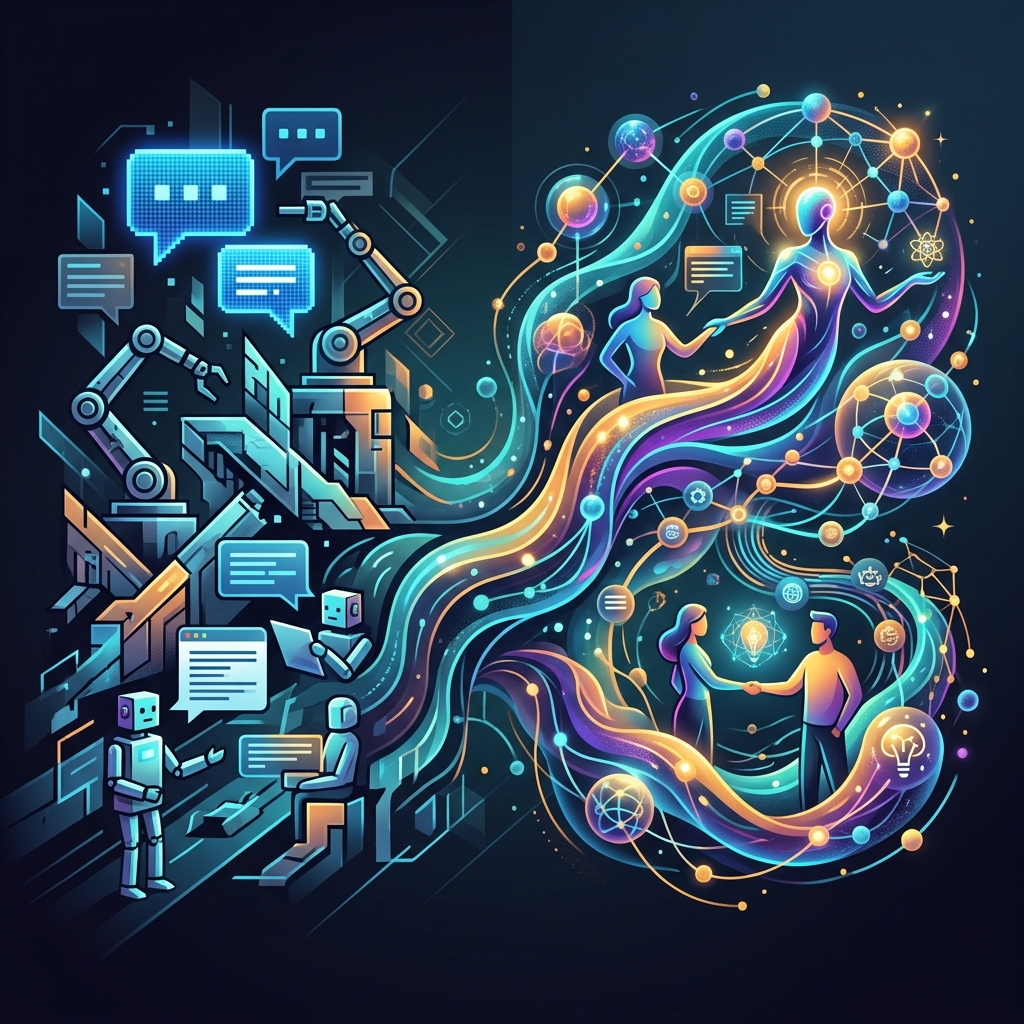
But the failure wasn't inevitable. And the technology replacing those chatbots - agentic AI - isn't just a rebrand. It represents a fundamentally different approach to how AI interacts with learners.
Let's dissect what went wrong, and what's different now.
The Three Fundamental Failures of Training Chatbots
Failure 1: They Were Reactive, Not Proactive
Traditional training chatbots waited for the learner to initiate. A worker had to open the platform, type a question, and hope the bot understood it. If the worker never reached out, the chatbot did nothing.
This model assumed that learners would actively seek training - an assumption that contradicts everything we know about frontline worker behaviour. When you're a retail associate handling a queue of customers, a warehouse picker filling orders against a timer, or a hotel housekeeper cleaning 15 rooms before shift end, you're not pausing to type questions into a training bot.
The result: chatbots sat idle while workers stayed untrained. The tool existed. The usage didn't.
Agentic AI flips this model. Instead of waiting for the learner, it initiates contact based on data signals:
- A compliance certification is expiring in two weeks → AI sends a refresher
- A team's safety quiz scores dropped below threshold → AI pushes targeted modules
- A new hire just completed Day 3 of onboarding → AI delivers the Day 3 knowledge check
- A new product launched company-wide → AI immediately sends product training to all relevant roles
The shift from reactive to proactive is the single biggest difference between chatbots and agentic AI. Workers don't need to remember to train. The AI remembers for them.
Failure 2: They Followed Scripts, Not Context
Early training chatbots were essentially glorified FAQ databases. They matched keywords in a user's question to pre-written answers. Ask the right question in the right way, and you'd get a useful response. Phrase it differently, and you'd get: "I'm sorry, I didn't understand that. Would you like to try again?"
This works for simple queries like "What's the PF deduction policy?" It fails completely for anything nuanced:
- "I have a customer who wants to return a product but doesn't have the receipt and is getting angry" - a scripted bot doesn't know what to do with this
- "The machine on Line 3 is making a weird sound, should I stop production?" - a scripted bot can't process context
- "I'm new and I'm not sure what I'm supposed to do after finishing the induction video" - a scripted bot delivers the same generic response regardless of the learner's stage
Agentic AI understands context because it's powered by large language models that process natural language, not keyword matching. But more importantly, it has access to contextual data about the learner:
- Their role, tenure, and location
- What training they've completed and how they performed
- What topics they've struggled with
- What their manager has flagged as priority areas
When Suresh from the Pune warehouse asks about chemical handling, the agentic AI doesn't give a generic answer. It knows Suresh scored 60% on last week's chemical safety quiz, that his specific station handles sulfuric acid, and that his shift has had two near-miss incidents this month. The response is tailored, specific, and useful - not a canned FAQ.
Failure 3: They Delivered Content, Not Coaching
The most sophisticated training chatbots could serve up training modules, track completion, and even deliver quizzes. But they couldn't coach.
Coaching requires three things that chatbots lacked:
Observation: Understanding not just what the learner answered, but how they answered. Were they confident? Did they hesitate? Did they demonstrate understanding or just recall?
Adaptation: Adjusting the next interaction based on the learner's performance. Not just serving the next module in a linear sequence, but identifying the specific skill gap and addressing it.
Follow-through: Coming back after days or weeks to check whether knowledge was retained. Chatbots delivered content once and considered the job done.
Agentic AI combines all three. It observes patterns in a worker's responses over time. It adapts the training path based on demonstrated strengths and weaknesses. And it follows through with spaced reinforcement - automatically returning with a follow-up question or practice scenario when the science of memory tells us the learner is about to forget.
Related: The Forgetting Curve: Why Frontline Workers Forget 90% of Training
What Makes Agentic AI Fundamentally Different
Let's make the distinction concrete with a side-by-side comparison:
This isn't an incremental improvement. It's a category shift. The chatbot was a content delivery pipe. Agentic AI is a training partner.
The WhatsApp Advantage: Why Channel Choice Matters
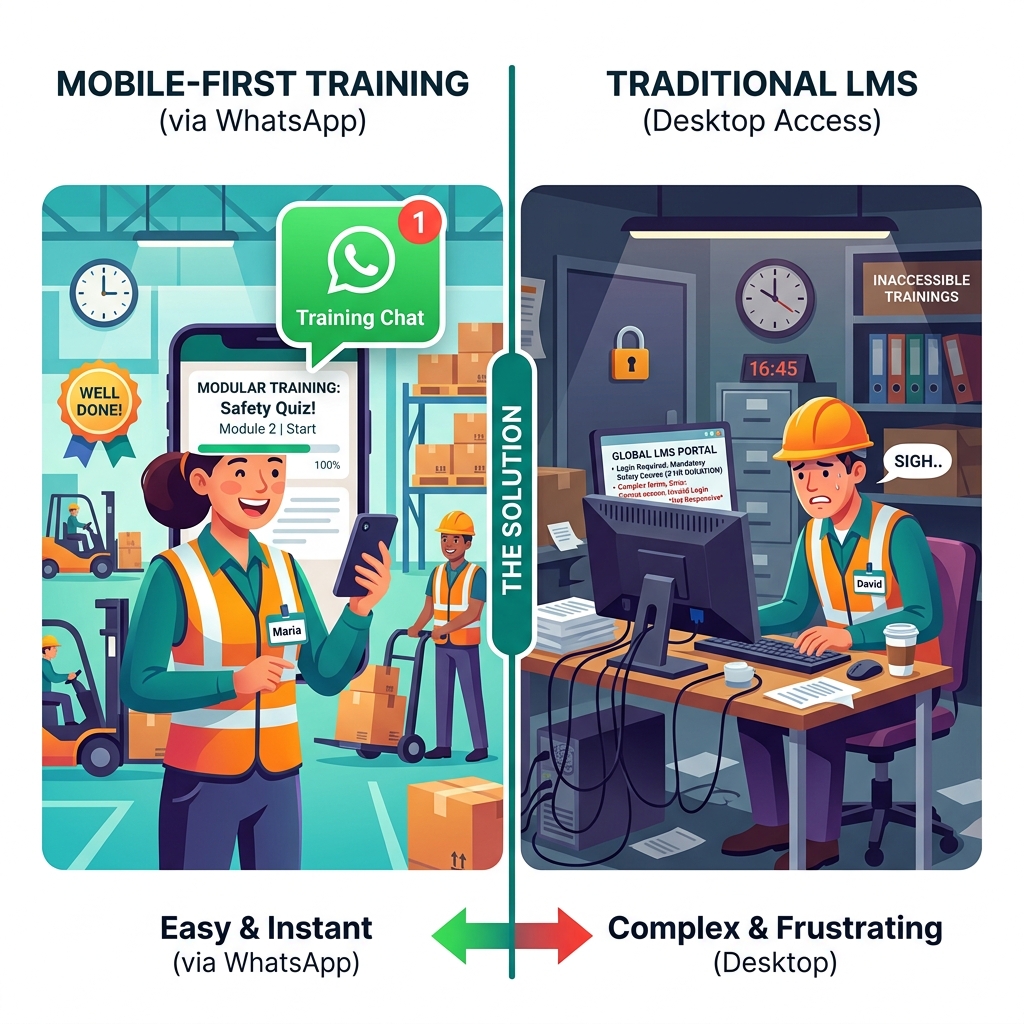
Even the most intelligent agentic AI is useless if it can't reach the learner. And for frontline workers - the 80% of the global workforce that doesn't sit at desks - the channel question is decisive.
Enterprise chatbots typically lived inside corporate platforms: HRIS portals, LMS dashboards, Slack workspaces, or dedicated mobile apps. For knowledge workers, that's fine. For a delivery rider in Lucknow or a factory operator in Coimbatore, those platforms might as well not exist.
WhatsApp changes the equation because it's already universally adopted by the workforce you're trying to reach. India alone has 500+ million WhatsApp users. For most frontline workers, WhatsApp isn't just the most-used app on their phone - it's the only business communication tool they use.
When agentic AI operates through WhatsApp, you get:
- Instant reach: No app download, no onboarding, no credential management
- Natural interaction: Workers are already comfortable with chat and voice on WhatsApp
- Higher engagement: Training arrives in the same feed as family messages and friend group chats - it gets seen
- Voice capability: For semi-literate workers, WhatsApp voice notes and calls enable interaction that text-based platforms can't support
Related: AI Agents vs WhatsApp Training Bots: What Actually Works for Blue-Collar Workforces
Five Signs You've Outgrown Your Training Chatbot
If any of these sound familiar, it's time to consider the agentic alternative:
Making the Transition: From Chatbot to Agentic AI
If you're ready to move beyond the chatbot era, here's a practical path:
Step 1: Audit your current chatbot's actual usage data. What percentage of your workforce interacts with it? What types of queries does it handle well vs. poorly? This baseline helps you define what the agentic system needs to improve.
Step 2: Identify the highest-impact training workflows. Start with compliance refreshers, onboarding sequences, or safety training - areas where proactive delivery and spaced reinforcement will show measurable results quickly.
Step 3: Choose a platform that delivers agentic AI through WhatsApp natively. The capability is important, but the channel is what determines whether your frontline workers will actually use it.
Step 4: Launch a pilot with one team or location. Measure engagement rates, assessment scores, and - critically - compare operational metrics (safety incidents, customer complaints, quality scores) between the pilot group and a control group.
Step 5: Scale based on data, not assumptions.
The Bottom Line
Chatbots promised to democratise training. They didn't - because they required workers to come to the technology instead of bringing the technology to workers.
Agentic AI fixes the fundamental failures: it's proactive instead of reactive, contextual instead of scripted, and coaching-oriented instead of content-focused. And when it operates through WhatsApp, it finally reaches the workforce that chatbots never could.
The chatbot era taught us what doesn't work. The agentic era shows us what does.
Ready to replace your training chatbot with an AI that actually coaches? Book a demo with Leap10x and see the difference between a chatbot and an agentic training partner on WhatsApp.
Internal Backlinks: