The Forgetting Curve: Why Frontline Workers Forget 90% of Training - and How WhatsApp Spaced Repetition Fixes It
You've invested weeks developing a safety training module. Your factory supervisors spent two days in a classroom. Everyone passed the quiz. And within a month, the accident rate is back to where it started.
Sound familiar? You're not dealing with careless workers. You're dealing with human biology.
What Is the Forgetting Curve - and Why Should L&D Leaders Care?
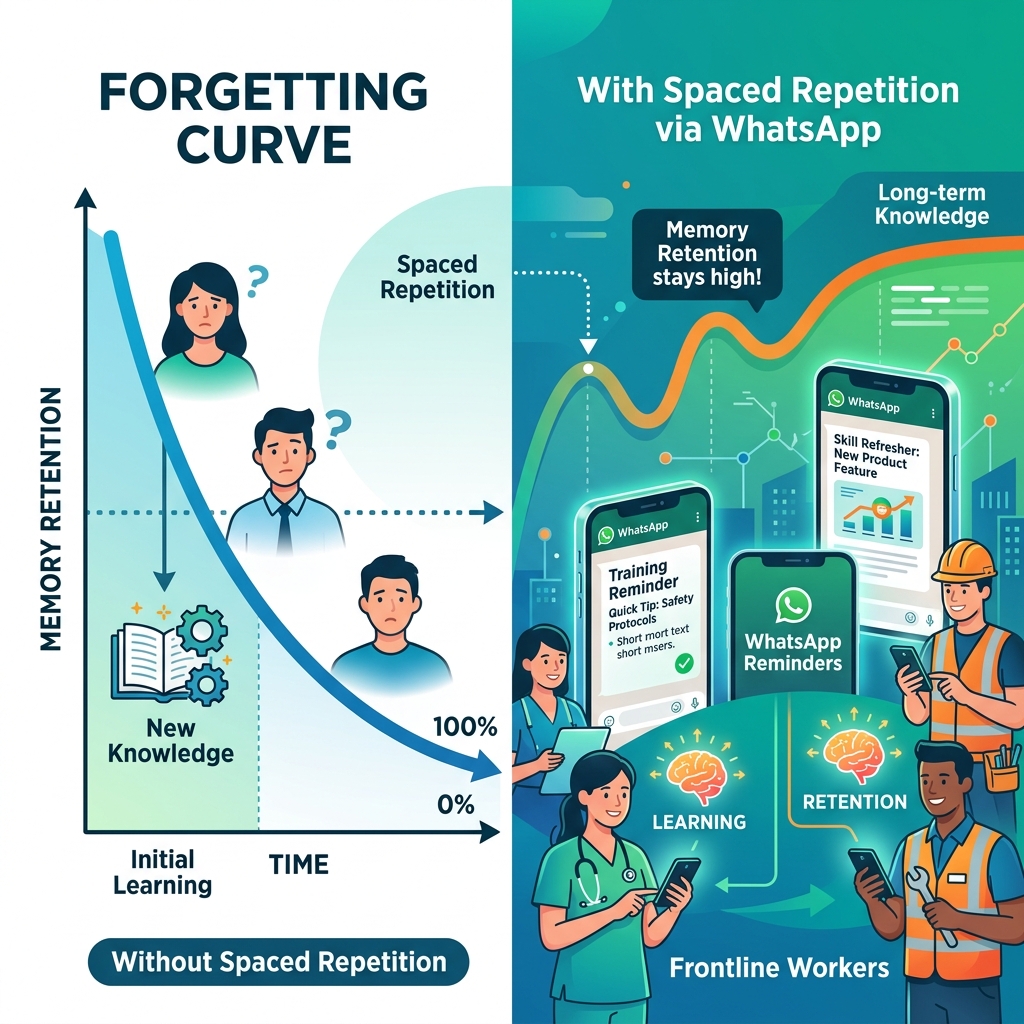
In 1885, German psychologist Hermann Ebbinghaus ran a series of experiments on memory and discovered something that still haunts learning professionals today: humans forget roughly 70% of newly learned information within 24 hours. Within a week, that number climbs past 90%.
He called it the forgetting curve - a predictable pattern showing how quickly the brain discards information that isn't reinforced. And more than a century later, the forgetting curve hasn't changed. What has changed is how we can fight it.
For frontline and blue-collar workers, this problem is magnified. These employees don't sit at desks revisiting training materials on a laptop. They're on factory floors, in retail stores, driving delivery trucks, or serving customers in hotels. Their work environment doesn't naturally reinforce what was taught in a one-time training session.
The result? Companies spend thousands on training that evaporates within days.
Why Traditional Training Fails Frontline Workers
Let's look at the typical training cycle for a frontline workforce:
Step 1: Classroom or eLearning session (1-4 hours)
Step 2: Assessment or quiz (passed immediately after training)
Step 3: Back to work (training materials forgotten in a binder or inaccessible LMS)
Step 4: Knowledge decay begins within 24 hours
A 2025 study by the Association for Talent Development (ATD) found that 75% of organizations still rely on on-the-job coaching by managers as their primary training method for frontline employees. The same study revealed that 84% of organizations do not use AI-enabled training for their frontline workforce - often because they lack the staff with knowledge to implement it.
The gap between how training is delivered and how the brain actually retains information is enormous. And for deskless workers - who make up roughly 2.7 billion people globally - the access barrier makes it worse.
Consider this: your warehouse operator completes a safety module on a Monday. By Friday, they've retained maybe 10-20% of that information. There's no desktop where they can revisit the content. They don't have a company email to receive follow-up resources. And their shift schedule doesn't include "review time."
The forgetting curve wins every time.
The Science Behind Spaced Repetition
The antidote to the forgetting curve is a technique called spaced repetition - and it's not new. Ebbinghaus himself discovered that reviewing information at strategic intervals dramatically slows the rate of forgetting.
Here's how it works:
- First review: 24 hours after initial learning → retention jumps back to ~90%
- Second review: 3-5 days later → retention holds above 80%
- Third review: 2 weeks later → the information begins to shift into long-term memory
- Fourth review: 1 month later → knowledge is largely cemented
Each review session doesn't need to be long. Research published in the Journal of Applied Psychology shows that even 2-3 minute recall exercises can produce the same reinforcement effect as longer study sessions - provided they're timed correctly.
The problem has never been knowing that spaced repetition works. The problem has been delivering it to workers who don't have laptops, LMS logins, or dedicated learning time.
Why WhatsApp Changes the Equation for Deskless Workers
Now think about what every frontline worker does have: a smartphone with WhatsApp.
In India alone, WhatsApp has over 500 million active users. Across Southeast Asia, Africa, Latin America, and the Middle East, it's the dominant communication app for exactly the population that traditional LMS platforms can't reach - factory workers, delivery personnel, retail associates, housekeeping staff, and field technicians.
WhatsApp-based training solves the three biggest barriers to implementing spaced repetition for frontline workers:
1. Zero Access Friction
No app download. No login credentials. No LMS portal. Workers receive a training message in the app they already open 80+ times per day. The friction between "receiving training" and "ignoring training" drops to nearly zero.
Compare this to a traditional LMS where a worker needs to remember a URL, enter login credentials, navigate to the right module, and find where they left off. For someone operating a machine or stocking shelves, that's five barriers too many.
2. Natural Fit for Spaced Intervals
WhatsApp's chat-based format is perfectly designed for spaced repetition. Here's what a reinforcement sequence might look like for a safety training program:
- Day 1: Complete a 5-minute micro-course on chemical handling procedures (images + quiz)
- Day 3: Receive a 90-second recall quiz: "What's the first step when a chemical spill occurs?" with visual answer options
- Day 7: Get a short scenario: "Raju notices a leaking container near Station 4. What should he do first?"
- Day 21: Final reinforcement quiz with new variations of the same core safety concepts
Each interaction takes under 3 minutes. The worker completes it during a chai break or before a shift. The information moves progressively from short-term to long-term memory - exactly as Ebbinghaus's research predicts.
3. Vernacular Language Support
A critical factor the forgetting curve research often overlooks is language. When training is delivered in a language that isn't the worker's first language, initial comprehension drops - and the forgetting curve steepens even further.
For India's workforce, where factory floors might have workers speaking Hindi, Tamil, Telugu, Marathi, Bengali, and Kannada, delivering reinforcement in each worker's mother tongue isn't a nice-to-have. It's a retention multiplier.
AI-powered platforms can now auto-generate training content in 100+ languages, deliver it natively through WhatsApp, and ensure that every spaced repetition touchpoint arrives in the language that maximizes comprehension.
What the Data Shows: Spaced Repetition + Mobile Delivery
The results of combining spaced repetition with mobile-first delivery are consistent across studies:
- Microlearning boosts knowledge retention by up to 50% compared to traditional training methods (Brandon Hall Group)
- Employees are 58% more likely to engage with learning delivered through microlearning techniques
- 92% of microlearning activity happens on mobile devices
- Organizations using spaced repetition report that learners retain 80% of information after 60 days, compared to less than 20% with single-session training
- AI-powered spaced repetition reduces content design time by up to 94% (LD Trends 2024), making it practical to deploy at scale
When you layer WhatsApp delivery on top of these numbers, you eliminate the last-mile problem. The knowledge reaches the worker. The reinforcement happens on schedule. And the forgetting curve flattens.
How to Implement WhatsApp Spaced Repetition for Your Frontline Teams
If you're ready to move beyond one-and-done training, here's a practical framework:
Step 1: Identify High-Stakes Knowledge Areas
Start with the training topics where forgetting carries the most cost - safety compliance, quality protocols, customer service standards, or regulatory procedures. These are areas where knowledge decay directly translates to accidents, fines, or revenue loss.
Step 2: Break Content into 3-5 Minute Micro-Modules
Take your existing training material and break it into standalone micro-modules. Each module should teach one concept and include at least one recall element (a quiz question, a visual scenario, or a decision-making prompt).
Step 3: Design a Reinforcement Schedule
Map your micro-modules to a spaced repetition calendar:
- Day 1: Initial learning
- Day 2-3: First recall quiz
- Day 7: Scenario-based reinforcement
- Day 14-21: Final assessment with new variations
Step 4: Deliver Through WhatsApp
Use a platform that pushes these modules automatically through WhatsApp at the scheduled intervals. The worker shouldn't need to "log in" to anything. The training should arrive like a message from a colleague - because that's what makes WhatsApp so effective. It feels natural.
Step 5: Measure Retention, Not Just Completion
Track quiz scores at each interval to see if retention is actually improving over time. Look for patterns: Are certain topics being forgotten faster? Are specific teams struggling more than others? Use this data to adjust your spacing intervals and content difficulty.
The Bottom Line
The forgetting curve is not a theory. It's a biological reality that every L&D professional must design around - especially when training frontline workers who don't have the luxury of revisiting materials on a desktop.
Spaced repetition is the most evidence-backed method to combat it. And WhatsApp is the delivery channel that finally makes spaced repetition practical for the 2.7 billion deskless workers who've been left out of the corporate learning revolution.
If your current training program delivers content once and hopes it sticks, it won't. The science is clear on that.
The question isn't whether you need spaced repetition. It's whether your training platform can deliver it where your workers actually are.
CTA: Want to see how WhatsApp-based spaced repetition works in practice? Book a free demo with Leap10x and discover how leading manufacturers and retailers are beating the forgetting curve - without an app, without a login, and in their workers' own language.