Hospitality Training in India: How Hotels and QSRs Can Upskill 100,000+ Staff Without an App
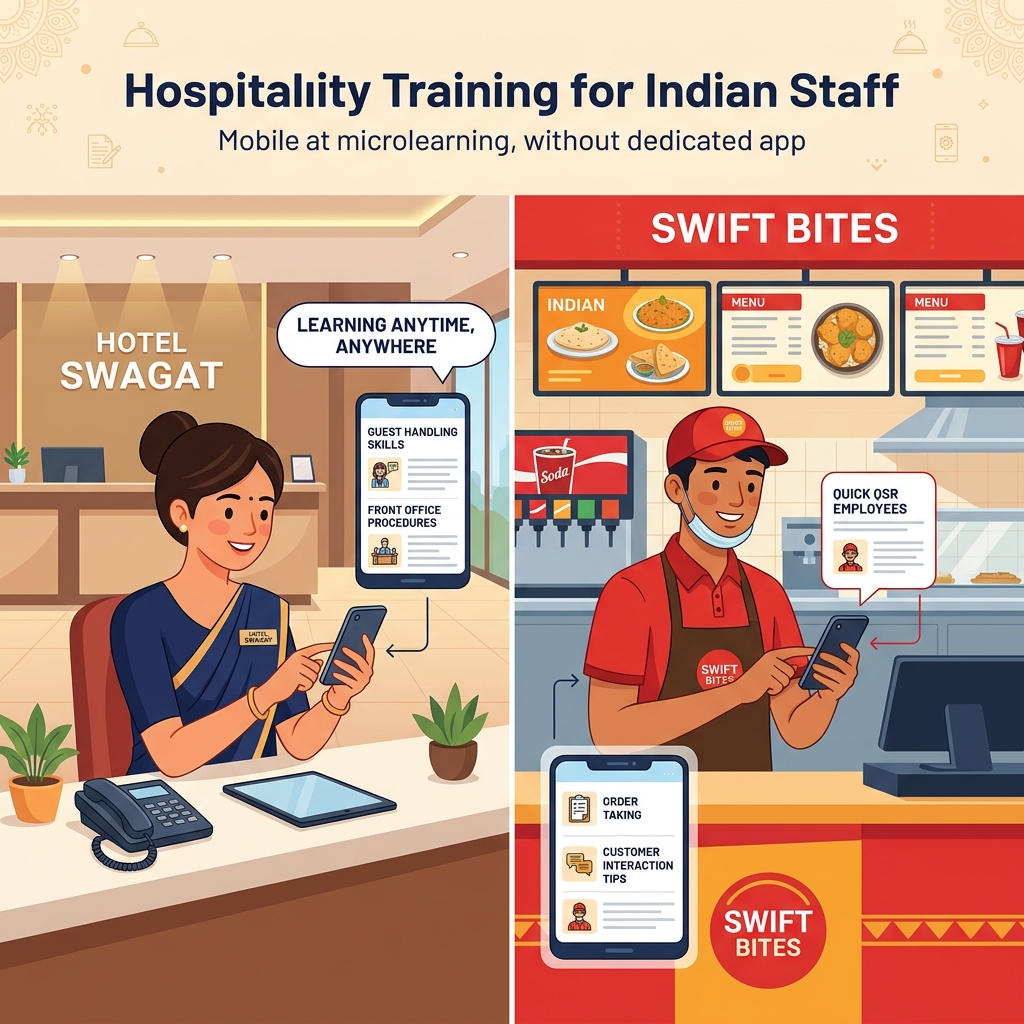
India's hospitality sector tells two stories simultaneously.
On one side, the industry is booming. The country's hotel market is projected to exceed $30 billion by 2028. Quick-service restaurant chains are expanding to tier-2 and tier-3 cities at record pace. India welcomed over 19 million foreign tourists in 2024, and the domestic travel market is growing even faster.
On the other side, the workforce powering this growth - housekeepers, servers, front desk associates, kitchen staff, delivery riders - receives some of the least structured training in any industry.
This gap is where both guest experience and revenue quietly bleed out.
The Training Reality for India's Hospitality Workforce
Talk to any operations head at a mid-to-large hotel chain or QSR franchise in India, and you'll hear the same set of problems:
Turnover is relentless. Annual attrition in India's hospitality industry regularly exceeds 60-70%, with some QSR chains seeing numbers above 100%. Every new hire needs training. And by the time they're trained, a significant portion has already left.
Training doesn't scale. A flagship hotel in Mumbai might have excellent training standards. But when the same brand opens its 40th property in Indore or its 100th in Lucknow, the quality of training drops dramatically. There aren't enough trainers. Travel costs for regional training sessions eat into margins. And classroom sessions pull staff off the floor during peak service hours.
Workers don't have corporate tech access. Most hospitality frontline staff don't have company email addresses. Many don't have personal laptops. A significant percentage - especially in housekeeping, kitchen, and back-of-house roles - are more comfortable in Hindi, Tamil, Telugu, or Bengali than in English. Asking them to log into an LMS portal is asking them to navigate a world they don't operate in.
Compliance training is a checkbox exercise. Food safety (FSSAI), fire safety, POSH compliance, hygiene protocols - these are mandatory. But the typical approach involves a one-time induction session that workers forget within weeks. When an audit happens, the documentation exists, but the actual knowledge doesn't.
Why Global Hospitality Training Solutions Don't Work Here
It's tempting to look at what's working in the US and UK hospitality markets and try to replicate it. Platforms like Opus Training have earned recognition (including Fast Company's Most Innovative Companies 2026) for transforming restaurant training in the US market. Their approach - mobile-first content, AI-assisted content creation, multilingual auto-translation - is genuinely effective.
But there's a fundamental mismatch when you try to port these solutions to India's hospitality landscape.
App-download requirement: Most Western hospitality training platforms require workers to download a mobile app. For India's frontline hospitality staff, app fatigue is real. Their phone storage is limited. They're already juggling WhatsApp, a payments app, and maybe a personal entertainment app. Adding a training app that they'll use for a few weeks before quitting doesn't work - either practically or economically.
Pricing built for Western markets: Enterprise training platforms typically charge $3-8 per user per month. When you're training 10,000+ housekeeping staff or delivery riders in India, Western pricing models break the math.
English-centric content design: Even platforms offering auto-translation often start with English content and machine-translate. For a housekeeper in Chennai, receiving training that was originally written for an American restaurant server - even if translated into Tamil - feels disconnected from their actual work context.
No WhatsApp integration: The most widely-used communication channel in India's hospitality workforce is WhatsApp. Workers use it to coordinate shifts, share updates with supervisors, and stay connected with their teams. Training that doesn't live in this channel is training that lives in a parallel universe most workers never visit.
What Effective Hospitality Training in India Actually Looks Like
The hospitality brands that are getting training right in India aren't trying to replicate Western models. They're building from the ground up around three principles:
1. Deliver Training Where Workers Already Are
The most successful programs push training directly to WhatsApp or SMS - requiring zero downloads, zero logins, and zero IT setup. A new housekeeper at a hotel in Jaipur receives their first training module the same way they receive a message from their supervisor. It feels natural, not institutional.
This approach works because it eliminates the single biggest training barrier: access. When training arrives in the same app where workers communicate daily, completion rates jump dramatically. Organizations that deliver training through messaging channels consistently report 80-95% completion rates, compared to the 20-30% that traditional LMS platforms struggle to achieve.
2. Build Content in Vernacular Languages from the Start
India's hospitality workforce speaks dozens of languages across regions. A hotel chain operating in 15 states might need training content in 8-10 languages at minimum. Creating this content manually is prohibitively expensive and slow.
AI-powered content creation has changed this equation. Modern platforms can take a single training outline - say, a 10-step room cleaning procedure or a food safety checklist - and generate engaging micro-courses in Hindi, Tamil, Telugu, Marathi, Kannada, Bengali, Malayalam, and more. The content isn't just translated; it's localized with culturally relevant examples, appropriate imagery, and audio narration for workers with limited reading proficiency.
When a kitchen worker in Hyderabad receives fire extinguisher training in Telugu with visual step-by-step instructions, their comprehension and retention is fundamentally different from receiving the same content as a translated English PDF.
3. Use Microlearning That Fits Between Service Cycles
Hospitality is a rhythm business. There are intense service peaks (breakfast rush, check-in time, dinner service) and quieter intervals between them. Effective training slots into these natural pauses.
A 5-minute micro-module on "handling guest complaints about room cleanliness" can be completed between check-out and check-in. A 3-minute quiz on food allergen safety fits into the gap between lunch and dinner service. A 90-second video demonstrating proper bed-making technique can be watched before a shift starts.
The key is that none of these require the worker to leave the floor, find a computer, or attend a scheduled session. Learning happens in the flow of work - and it happens consistently, not just during induction week.
Building a Hospitality Training Program for Scale
Here's a practical framework for hotel chains and QSR brands looking to train at scale across India:
Phase 1: Map Your Critical Training Tracks
Identify the 4-5 non-negotiable training tracks every worker needs:
- Induction/Onboarding: Brand standards, workplace conduct, basic operations
- Role-Specific Skills: Housekeeping procedures, kitchen protocols, front desk operations, service etiquette
- Compliance: FSSAI food safety, fire safety, POSH, hygiene standards
- Ongoing Development: Upselling techniques, guest experience improvement, leadership basics for supervisors
Phase 2: Create Micro-Courses in Vernacular Languages
For each track, develop 8-12 micro-modules of 3-5 minutes each. Use AI content creation to generate these in all required languages simultaneously. Include:
- Short videos with visual demonstrations
- Image-based step-by-step guides
- Quiz questions that test application (not just recall)
- Scenario-based situations workers actually encounter
Phase 3: Deploy Through WhatsApp with Automated Scheduling
Set up automated learning paths that trigger based on events:
- Day 1 of joining: Onboarding module 1 arrives via WhatsApp
- Day 2-7: Remaining onboarding modules auto-deliver daily
- Week 2-4: Role-specific training begins with 2-3 modules per week
- Monthly: Compliance refreshers and new skill modules
- On-demand: Workers can request specific training topics through a chat command
Phase 4: Give Managers Visibility Without Adding Work
Area managers and hotel GMs need to see who has completed training, who's falling behind, and where knowledge gaps exist - without manually tracking spreadsheets. Real-time dashboards that show completion rates, quiz scores, and team-level insights allow managers to act on data rather than assumptions.
Phase 5: Tie Training to Business Outcomes
The ultimate measure isn't completion rates. It's whether training moved the needle on guest satisfaction scores, hygiene audit results, upselling revenue, or new hire ramp-up time. Build these connections from the start so you can demonstrate ROI to stakeholders.
The Opportunity Is Now
India's hospitality market is in a growth phase that demands rapid workforce capability building. The brands that figure out how to train their frontline teams effectively - at scale, in vernacular languages, without IT infrastructure requirements - will have a significant competitive advantage.
The technology exists. AI-powered content creation can generate training in 100+ languages. WhatsApp delivery eliminates access barriers. Microlearning formats respect the reality of hospitality work schedules.
What's needed is the willingness to let go of training models designed for corporate offices and build something designed for the people who actually deliver the guest experience - your frontline.
CTA: Ready to transform how your hospitality team learns? Start a free trial with Leap10x and see how leading hotel and QSR brands train their entire workforce through WhatsApp - in any language, at any scale.