Microlearning vs Traditional Training: A Data-Backed Comparison for Indian L&D Leaders
The Debate Is Over - But the Data Still Matters
L&D professionals in India are no longer debating whether microlearning is a valid training approach. It's mainstream. The real question is: how much better is it than traditional training, and in which specific scenarios should you use each approach?
This matters because most Indian enterprises still run a hybrid model. They use classroom training for onboarding, e-learning modules for compliance, and informal WhatsApp groups for product updates. Microlearning often gets bolted on as an experiment rather than designed as the primary training architecture.
The data from 2025-2026 research paints a clear picture of where each approach excels and where it falls short. This comparison is built specifically for Indian L&D leaders making resource allocation decisions for frontline workforce training.
What the Research Actually Says
Knowledge Retention
The headline metric. How much do learners remember after training?
Traditional training follows the Ebbinghaus forgetting curve closely. Research shows that learners forget approximately 70% of training content within 24 hours of a single session. After 30 days without reinforcement, retention drops to near zero for most topics. A TalentCards survey confirmed that the majority of deskless workers remember less than half of their training immediately after completing it.
Microlearning delivers meaningfully different outcomes. Studies show microlearning can boost knowledge retention by 25% to 60% compared to traditional long-form training. One study found that microlearning improved knowledge retention by up to 80% compared to traditional methods. The reason is structural: short, focused modules reduce cognitive overload, and spaced repetition across multiple days reinforces neural pathways.
For India's frontline workforce - where training content must compete with noisy factory floors, crowded retail environments, and physically demanding shift schedules - the retention advantage is even more pronounced because microlearning matches how frontline workers actually consume information: in brief, focused bursts between tasks.
Completion Rates
Traditional training suffers from a completion problem, especially for frontline audiences. Desktop-based e-learning courses see completion rates of 50-70% for frontline workers - and that's for mandatory compliance modules. Voluntary development courses see much lower engagement.
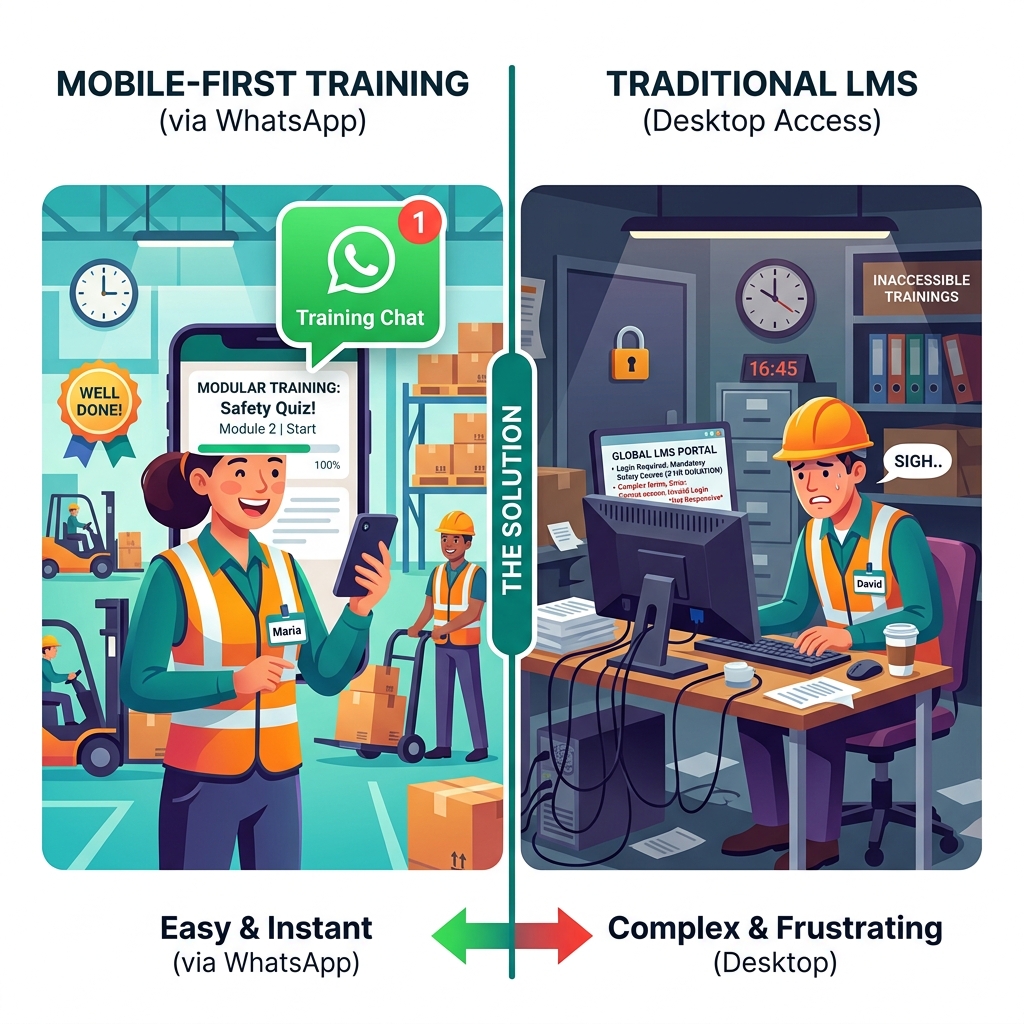
Microlearning consistently achieves higher completion rates. WhatsApp-delivered microlearning modules regularly achieve 85-95% completion rates. The format advantage is straightforward: a 3-minute module delivered on WhatsApp requires no app download, no login, no dedicated training time, and no travel to a training center. It fits into natural breaks during the workday.
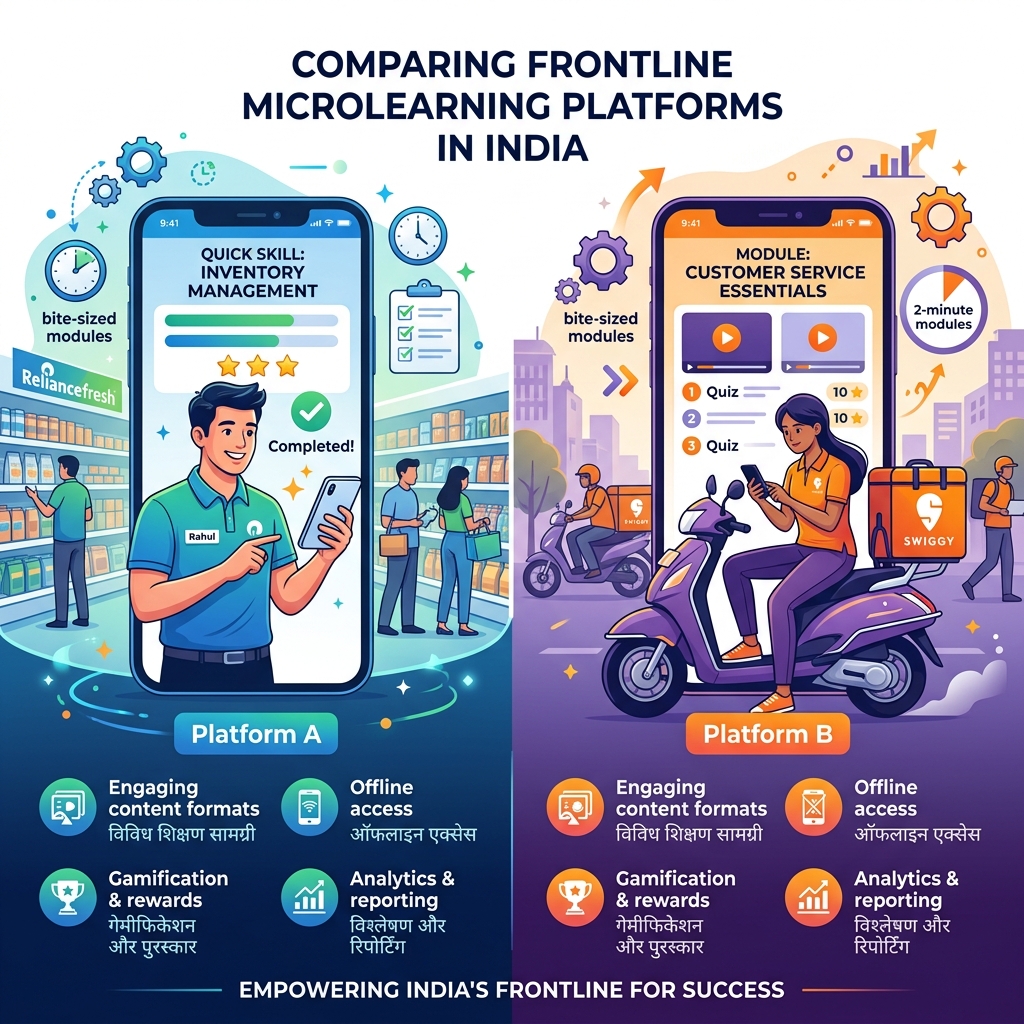
For comparison, 7taps users reported that microlearning modules averaging 10 minutes per topic significantly reduced the time employees spent away from their workstations while maintaining training quality. One logistics company using 7taps reduced total training time from 100.5 hours to 51.25 hours.
For our direct comparison of microlearning platforms, see 7taps vs Leap10x: Honest Microlearning Comparison (2026).
Engagement Quality
Completion rates don't tell the full story. A worker can complete a module without engaging with it. But the engagement signals are different across formats.
Traditional classroom training often achieves high apparent engagement - workers are physically present, looking at the trainer, and occasionally nodding. But passive presence isn't active learning. Research on adult learning consistently shows that lecture-based formats produce the lowest learning transfer among all training methods.
Microlearning designed with interactive elements - scenario questions, decision points, quick quizzes, and visual content - forces active participation. Every 30-60 seconds, the learner must do something: answer a question, watch a short video, or make a choice. This active engagement produces deeper processing and better application.
Traditional training also offers engagement advantages in specific scenarios: hands-on skills practice, group problem-solving, and interpersonal skills development benefit from face-to-face interaction that digital microlearning can't fully replicate.
Cost Per Learner
This is where the comparison becomes decisive for Indian enterprises operating at scale.
Traditional classroom training costs for frontline workers include:
- Trainer compensation (internal or external)
- Venue costs (if training happens off-site)
- Travel costs (for distributed workforces)
- Lost productivity (workers off the floor during training)
- Materials (printed handouts, equipment)
For an Indian manufacturing company training 1,000 workers across 5 plants, a single day of classroom safety training can cost INR 15-25 lakhs when you include all direct and indirect costs.
Microlearning delivered via WhatsApp dramatically reduces cost per learner. There are no venue costs, no travel costs, and minimal lost productivity because training happens in 3-5 minute segments during natural breaks. Content creation costs are lower with AI-assisted module generation. The per-learner economics improve exponentially at scale.
Speed of Deployment
Traditional training requires scheduling coordination, trainer availability, venue booking, and batch management. Rolling out a single training update across 50 locations can take weeks or months.
Microlearning can be deployed to the entire workforce simultaneously within hours. A new product launch training, a safety alert, or a compliance update reaches every worker's WhatsApp within the same day. For Indian businesses operating in fast-moving industries like retail and BFSI, this speed advantage is operationally critical.
Where Traditional Training Still Wins
Microlearning isn't a silver bullet. There are scenarios where traditional formats deliver superior outcomes:
Complex Skill Development
Skills that require extended practice, physical demonstration, or real-time feedback - operating heavy machinery, clinical procedures, complex customer negotiations - need hands-on training that microlearning alone can't deliver.
Team-Based Learning
Skills that depend on group dynamics - teamwork, communication, conflict resolution - benefit from face-to-face interaction where participants practice with each other in real time.
Deep Conceptual Understanding
Some topics require extended, connected explanation that a 5-minute module can't provide. Understanding the full scope of a regulatory framework, the theory behind a quality system, or the principles of a management philosophy requires longer-form content.
Cultural and Behavioural Change
Organizational culture shifts - new values, new ways of working, new leadership expectations - often require the personal connection and discussion that classroom settings provide.
The Hybrid Model: Best of Both Worlds
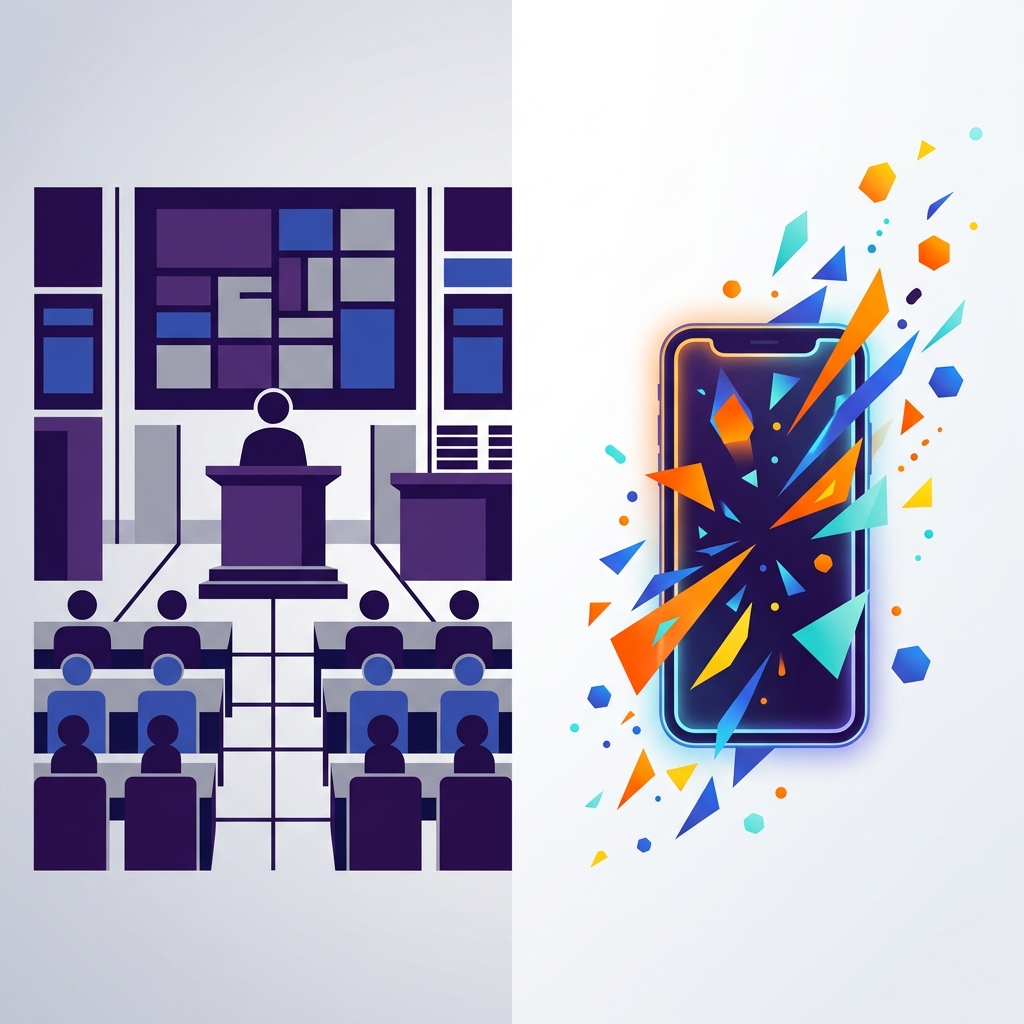
The most effective training architecture for Indian frontline workforces in 2026 isn't microlearning OR traditional training. It's a designed hybrid that uses each format for what it does best.
Use microlearning for:
- Daily knowledge reinforcement
- Product updates and new information
- Compliance refreshers
- Pre-training preparation (before classroom sessions)
- Post-training reinforcement (after classroom sessions)
- Assessment and knowledge checks
- Just-in-time reference content
Use traditional training for:
- Initial hands-on skill development
- Equipment operation practice
- Team-building and communication exercises
- Complex problem-solving workshops
- Leadership development programs
The integration point: Use microlearning to prepare workers before classroom sessions (so class time focuses on practice, not lecture) and to reinforce content after sessions (so knowledge doesn't fade). This "flipped" approach maximizes the value of expensive classroom time while using cost-effective microlearning for knowledge transfer.
For detailed guidance on implementing WhatsApp-based microlearning, see our WhatsApp-Based Training for Employees: Complete 2026 Guide.
For a broader perspective on building learning cultures for frontline workers, check out Building a Culture of Continuous Learning for Frontline Workers.
Making the Decision: A Framework for Indian L&D Leaders
Ask these five questions about each training need:
Most frontline training needs - compliance, product knowledge, safety refreshers, onboarding basics, and SOP training - score heavily toward microlearning delivery. Reserve classroom time for the genuinely hands-on and interpersonal training that can't be replicated digitally.
The Bottom Line
The data is clear: microlearning outperforms traditional training on retention (25-60% better), completion rates (85-95% vs 50-70%), cost per learner (fraction of classroom costs), and deployment speed (hours vs weeks).
For India's frontline workforce - dispersed across locations, speaking multiple languages, working rotating shifts on their smartphones - microlearning isn't just more effective. It's the only training format that consistently reaches and engages the entire audience.
Traditional training still has its place for hands-on skills and team-based learning. But the default training format for Indian frontline teams in 2026 should be microlearning, with classroom sessions reserved for the specific use cases where physical presence adds irreplaceable value.
Ready to see how microlearning transforms your frontline training? Explore Leap10x - WhatsApp-native microlearning that delivers results your classroom sessions can't match.