NBFC Compliance Training via WhatsApp: A Complete Playbook for 2026
Quick answer
India's NBFC sector contributes over 20% of total credit flow in the country.
Why NBFC Compliance Training Can't Wait Until the Next Classroom Session
India's NBFC sector contributes over 20% of total credit flow in the country. That figure keeps climbing as digital lending reaches deeper into Tier 2 and Tier 3 cities. But with growth comes scrutiny - and the Reserve Bank of India isn't slowing down.
In April 2026, the RBI introduced its latest Amendment Directions under the Scale Based Regulation (SBR) framework, tightening governance standards for NBFCs across all layers. From updated branch authorisation rules to stricter KYC/AML obligations under PMLA 2002, the compliance burden on field staff has never been heavier.
Here's the problem: most NBFC field agents - loan officers, recovery agents, verification executives - don't sit at desks. They're on motorcycles, at borrower doorsteps, or moving between branches in semi-urban towns. Asking them to attend a two-hour classroom session on Fair Practice Code updates isn't just impractical. It's a guarantee that training won't happen.
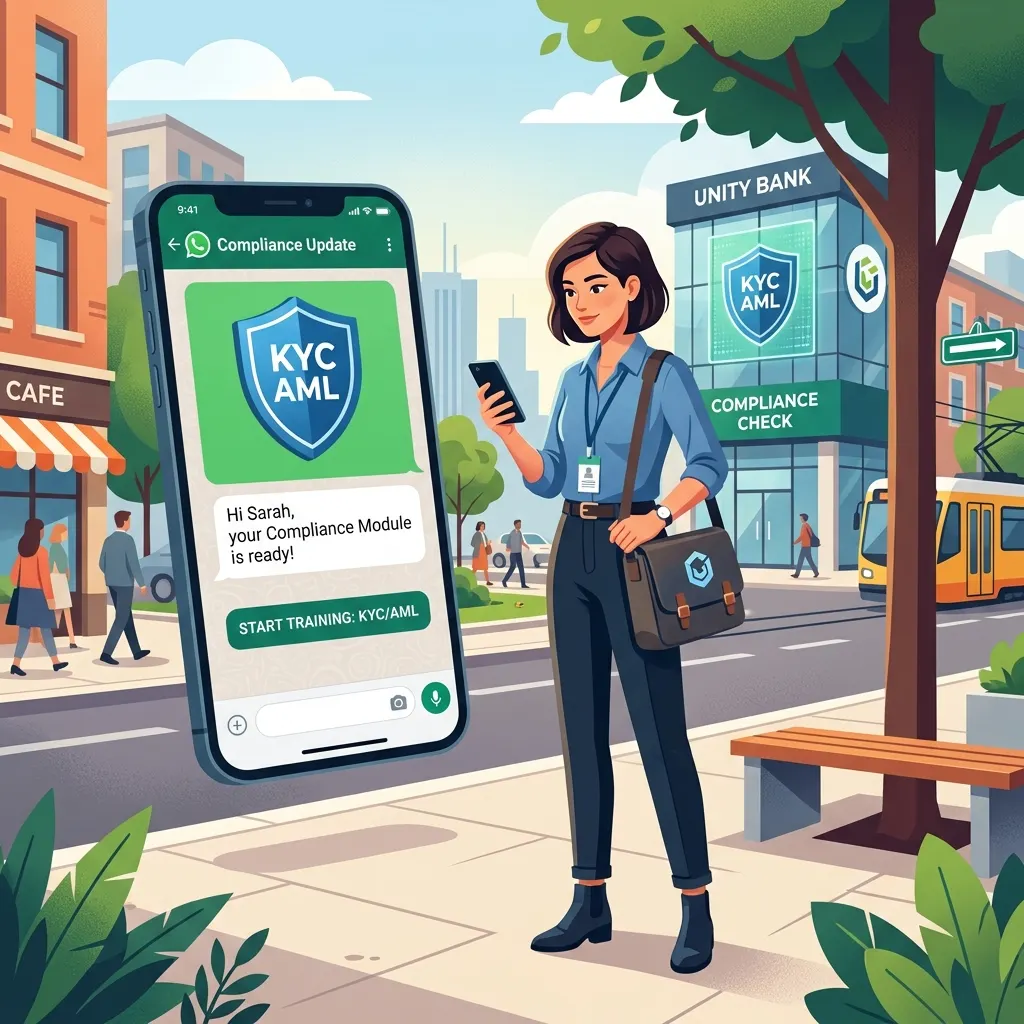
That's where WhatsApp-based compliance training changes the equation. With over 500 million active users in India, WhatsApp is already on every field agent's phone. Delivering compliance training through a channel they use dozens of times a day removes the biggest adoption barrier: access.
If you're building or refreshing your NBFC compliance training program, this playbook walks you through what to train, how to structure it, and why WhatsApp delivery makes compliance stick - not just check a box.
For a broader look at how RBI's recovery agent rules are shaping training requirements this year, check out our RBI 2026 Recovery Agent Training Rules: Compliance Guide.
The 5 Compliance Areas Every NBFC Must Train On in 2026
1. Fair Practice Code (FPC) and Borrower Communication
RBI requires every NBFC to maintain a board-approved Fair Practice Code. Your field agents are the ones who communicate loan terms, repayment schedules, and recovery options face-to-face. If they misrepresent terms or skip mandatory disclosures, the NBFC faces regulatory action.
Key training points:
- Mandatory disclosure of All-Inclusive Cost (AIC) before disbursement
- Key Fact Statement (KFS) requirements under Digital Lending Guidelines
- Prohibited practices during loan recovery - threats, intimidation, or contacting borrowers outside specified hours
- Cooling-off period provisions for digital loans
2. KYC and Anti-Money Laundering (AML)
NBFCs must file Cash Transaction Reports (CTRs) by the 15th of each month for transactions exceeding thresholds, and Suspicious Transaction Reports (STRs) within specified timelines. Field staff performing customer verification need practical training on document authentication, risk indicators, and escalation protocols.
Training focus areas:
- Identifying forged identity documents
- Red flags for shell company loans or layered transactions
- Correct procedures for Aadhaar-based e-KYC
- Reporting obligations to FIU-IND
3. Digital Lending Compliance
Since the updated Digital Lending Guidelines of 2022 (refreshed in 2025), NBFCs lending through apps or Lending Service Providers (LSPs) must ensure full compliance with borrower-facing disclosures and data privacy norms. Agents must understand restrictions on accessing borrower mobile data and the obligation to process loans only through the NBFC's own app or regulated LSP.
4. Data Privacy and Cybersecurity Awareness
The RBI's Master Direction on Information Technology Framework imposes higher standards on NBFCs with assets above ₹500 crores. But even smaller NBFCs must train staff on data handling - particularly field agents who collect sensitive documents and personal information daily.
5. Asset Classification and NPA Reporting
Agents involved in collections need to understand NPA ageing analysis, provisioning requirements, and the escalation process for defaulting accounts. Incorrect classification or delayed reporting can trigger penalties ranging from ₹1 lakh to several crores.
For a deep dive on ethical collection training at scale, read our guide on Collection Training for Fintech Lenders.
Why WhatsApp Beats Classroom Training for NBFC Compliance
Traditional compliance training in NBFCs follows a predictable pattern: a quarterly classroom session in the regional office, a 40-slide PowerPoint presentation, and a sign-off sheet. The problems with this model are well-documented.
Reach is limited. Field agents in rural postings often can't travel to regional offices for training. The agents who need compliance training the most - those working in high-risk lending segments - are the hardest to pull into a classroom.
Retention is poor. Research consistently shows that learners forget about 70% of training content within 24 hours. A single two-hour session on five compliance topics guarantees that agents will retain almost none of the specific procedures they need for their daily work.
Documentation is weak. A sign-off sheet proves someone sat in a room. It doesn't prove they understood the material or can apply it when a borrower disputes a loan term.
WhatsApp-based delivery solves each of these problems:
- 100% reach: Every field agent already has WhatsApp installed. No app downloads, no login credentials, no desktop required. Training reaches agents in their daily workflow.
- Microlearning format: Instead of a two-hour session, deliver compliance training as 5-minute modules spread across a week. One module on FPC disclosures on Monday, KYC red flags on Wednesday, digital lending rules on Friday. Spacing improves retention by up to 70%.
- Vernacular delivery: India's NBFC field force speaks Hindi, Tamil, Telugu, Marathi, Bengali, and dozens of other languages. WhatsApp-based platforms can auto-translate training content, ensuring comprehension regardless of language.
- Built-in assessments: Embed quizzes within WhatsApp conversations to test understanding after each module. Track who passed and who needs remediation - creating audit-ready compliance records.
- Real-time updates: When RBI issues new guidelines (like the April 2026 branch authorisation rules), push an update to every field agent's phone within hours, not weeks.
To understand the full landscape of WhatsApp-based training delivery, see our comprehensive WhatsApp-Based Training for Employees: Complete 2026 Guide.
How to Structure a WhatsApp Compliance Training Program for Your NBFC
Step 1: Map Training to Regulatory Requirements
Start with the RBI compliance calendar for FY 2025-2026. Identify which filings, audits, and regulatory requirements touch your field staff. Then map each requirement to specific training modules.
Example structure for a quarterly cycle:
- Month 1: FPC refresher + KYC/AML updates
- Month 2: Digital lending compliance + data privacy
- Month 3: Asset classification + recovery procedures + quarterly assessment
Step 2: Break Content Into Microlearning Modules
Each module should cover one specific procedure or compliance requirement. Target 3-5 minutes per module. Use a mix of:
- Short video demonstrations (60-90 seconds)
- Visual infographics summarizing key rules
- Scenario-based questions ("A borrower asks you to collect cash at their home. What do you do?")
- Quick reference cards agents can save to their gallery
Step 3: Schedule Delivery Across the Work Week
Don't dump all modules at once. Schedule one module per day during low-activity hours. Most field agents are in transit between 9-10 AM and have brief windows around 1-2 PM. Use these natural breaks for training delivery.
Step 4: Automate Assessments and Escalations
After each module, send a 3-5 question quiz via WhatsApp. Set passing thresholds (typically 80%). Automatically flag agents who fail for remediation - send them a refresher module the next day and re-test.
Step 5: Generate Compliance Reports for Audits
Maintain a centralized dashboard that tracks:
- Module completion rates by branch and region
- Assessment scores by agent
- Time-to-completion metrics
- Failed assessment follow-up completion
This data becomes your audit trail. When the RBI inspector asks about staff training during their next visit, you're not pulling out sign-off sheets - you're showing real-time training analytics with individual assessment records.
Building the Business Case: ROI of WhatsApp Compliance Training
The numbers make the case themselves:
- Reduction in compliance penalties: NBFCs face penalties ranging from ₹1 lakh to ₹10 lakh for violations. A single agent mishandling KYC can trigger a systemic review. Proactive training reduces this risk significantly.
- Lower training costs: Eliminating quarterly classroom sessions saves travel, venue, and lost productivity costs. For an NBFC with 500 field agents across 20 branches, the savings run into lakhs annually.
- Faster regulatory response: When RBI releases new directions, WhatsApp-based updates reach every agent within 24 hours versus the 2-4 weeks it takes to schedule and conduct classroom sessions.
- Higher completion rates: WhatsApp-delivered microlearning consistently achieves 85-95% completion rates versus 60-70% for scheduled classroom training.
Getting Started
If your NBFC is still running compliance training through classrooms and PDFs, 2026 is the year to make the shift. The regulatory environment is getting stricter, your field force is getting more distributed, and the tools to solve this are already on every agent's phone.
Start with your highest-risk compliance area - whether that's KYC/AML, fair practice code, or recovery procedures - and pilot WhatsApp-based delivery with one region. Measure completion rates, assessment scores, and time-to-competency. Then scale what works.
Ready to deliver compliance training that actually reaches your field teams? Book a demo with Leap10x to see how WhatsApp-native training can make your NBFC audit-ready in weeks, not months.
Frontline training
Training software built for deskless teams
Onboarding, SOPs, safety refreshers, and compliance evidence for workers with no corporate email and no company device — tracked by site, role, and shift.