What is WhatsApp-Based Learning? Complete 2026 Guide
Quick answer
WhatsApp-based learning delivers training via WhatsApp links. No app, no login. 85% completion rates vs 20-30% for LMS. Guide for HR leaders with examples.
WhatsApp-based learning is a training delivery method where employees receive bite-sized learning modules, quizzes, videos, and assessments directly through WhatsApp messages or links. Workers tap a link in WhatsApp and access training content instantly on their phone - without downloading a separate app, creating a login, or needing a company email address. Completion data syncs back to a central dashboard for tracking and compliance. It is primarily used for training frontline, blue-collar, and distributed workers who do not have access to traditional LMS platforms.
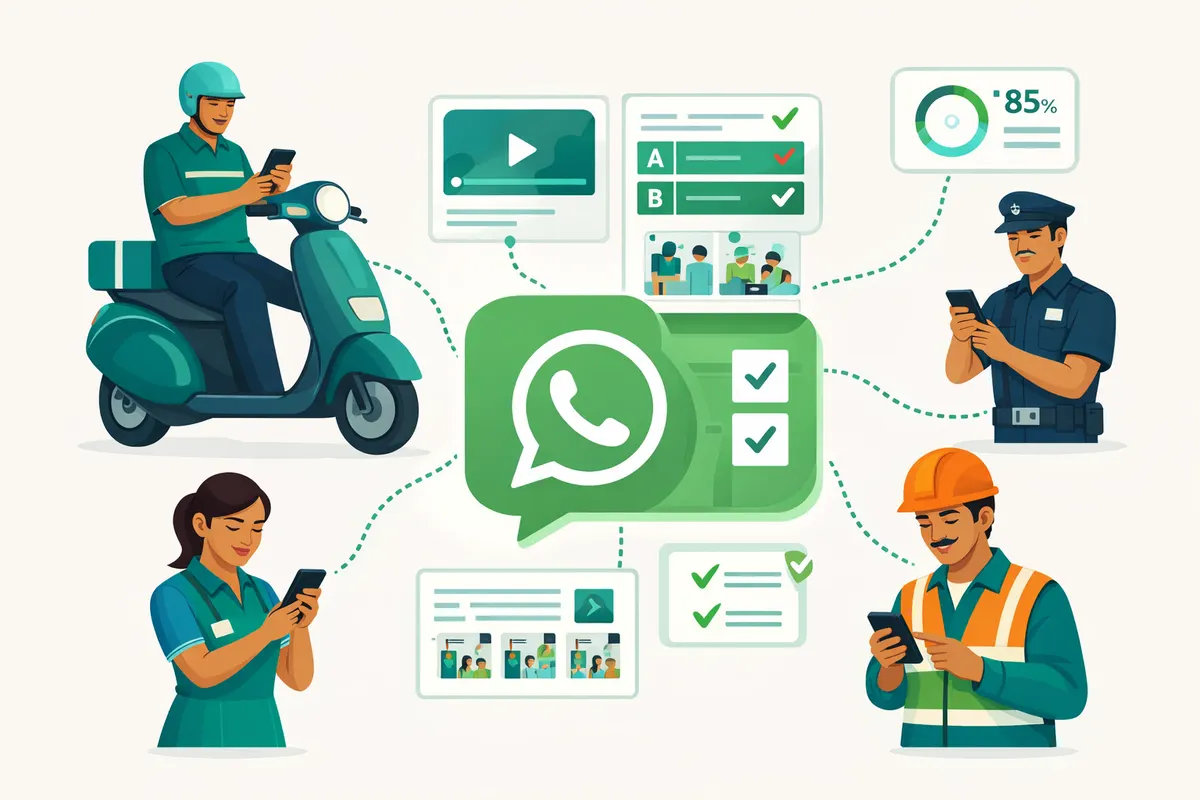
The concept emerged from a simple reality: India has over 700 million WhatsApp accounts. Frontline workers - factory operators, delivery partners, security guards, retail associates, and field agents - check WhatsApp multiple times daily. They do not check their company LMS. Many don't even have access to one.
For HR and L&D leaders responsible for training workforces that span factories, warehouses, client sites, and field locations, WhatsApp-based learning solves the last-mile delivery problem that traditional training infrastructure cannot reach.
This guide explains how WhatsApp-based learning works, where it fits, where it doesn't, and why companies like Siemens, Tata Electronics, FlixBus, and HDFC Bank are using it to train their frontline teams.
How WhatsApp-Based Learning Works
The process has four components:
1. Content creation Training content is created on a platform like Leap10x. Admins upload existing documents - SOPs, manuals, PDFs, PowerPoint decks - or use AI to generate new modules from scratch. Content formats include short videos (60-90 seconds), visual cards with key information, interactive quizzes with instant feedback, step-by-step visual guides, and compliance acknowledgements that workers confirm with a tap.
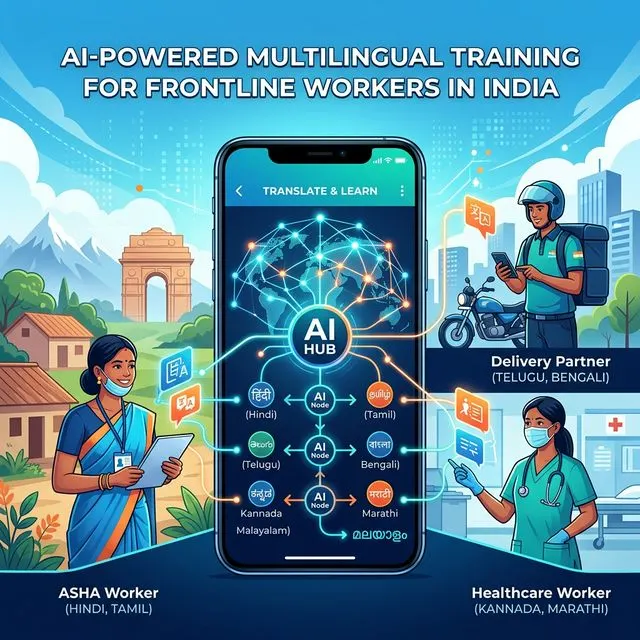
Content creation typically takes 5-10 minutes per module, compared to weeks or months with traditional instructional design. AI can auto-translate content into 70+ languages - Hindi, Tamil, Telugu, Kannada, Marathi, Bengali, Gujarati, Malayalam, Punjabi, Odia, and others.
2. Delivery via WhatsApp The platform sends a WhatsApp message to the worker containing a training link. The worker taps the link and the training opens directly in their mobile browser. No app download. No login screen. No password. No email address required.
The experience feels like tapping a link a friend sent - not logging into enterprise software. This is why completion rates are dramatically higher than LMS-based delivery.
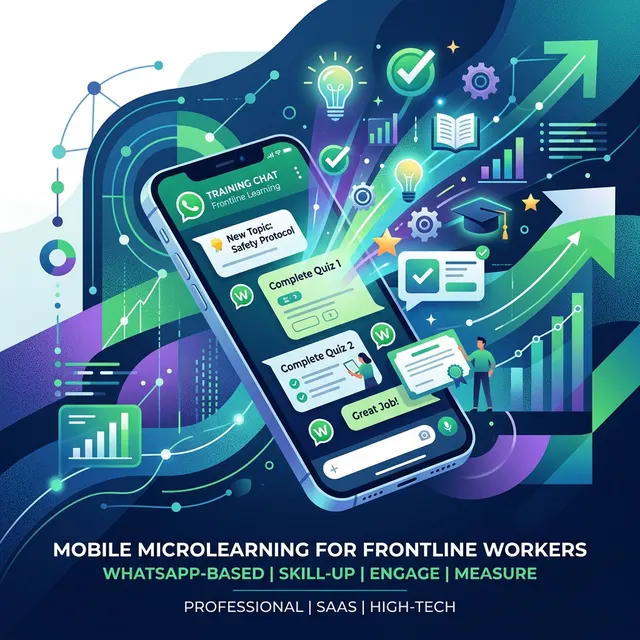
3. Learning experience Each module is designed to be completed in 3-5 minutes. Content is visual-first and optimised for small screens. Workers can complete training during breaks, shift transitions, or commutes. Quizzes provide instant feedback so workers know what they got right and where they need to improve. Workers see their progress and scores throughout.
The content style is closer to social media than traditional eLearning - short-form, engaging, and designed for the attention patterns of people who consume content on smartphones, not desktops.
4. Tracking and compliance Every action is recorded: who received the training, who opened it, time spent on each module, quiz scores, and completion status. This data feeds into compliance dashboards that HR teams use for audits, regulatory reporting, and identifying knowledge gaps across the workforce.
Reports can be filtered by site, role, department, language, or any custom parameter. Data is exportable as PDF or Excel for regulatory submissions, client audits, and Board Report disclosures.
How is WhatsApp-Based Learning Different from Sending PDFs on WhatsApp?
This is the most common misconception. Sending a PDF manual on a WhatsApp group is one-way, untrackable file sharing. You have no idea if the worker opened it, read it, or understood any of it.
WhatsApp-based learning is interactive, tracked, and structured. The differences are significant:
Tracking: PDFs have zero tracking. WhatsApp-based learning logs every interaction - opens, time spent, completions, and scores.
Engagement: PDFs are passive reading that most workers skip entirely. WhatsApp-based learning includes short videos, scenario-based quizzes, and visual cards that workers actively engage with.
Assessment: PDFs cannot test comprehension. WhatsApp-based learning includes quizzes that verify whether the worker understood the content, with scores recorded for compliance documentation.
Languages: A PDF exists in one language. WhatsApp-based learning modules can be auto-translated into 70+ languages and delivered to each worker in their native language.
Reinforcement: PDFs are one-time sends that get buried in chat history. WhatsApp-based learning supports spaced repetition - automated refreshers sent at intervals to reinforce key knowledge over time.
Compliance documentation: A PDF on a WhatsApp group produces no auditable record. WhatsApp-based learning produces timestamped completion records, quiz scores, and digital acknowledgements that hold up in regulatory audits.
Who Should Use WhatsApp-Based Learning?
WhatsApp-based learning is the right fit when your workforce has these characteristics:
- Workers do not have company email addresses
- Workers do not use or have access to LMS platforms
- Workers are distributed across multiple locations - factories, client sites, field routes, retail stores
- Workers speak regional languages and need training in their native language
- You need compliance-ready training records but cannot organise classroom sessions at every location
- High attrition means you are constantly onboarding and re-training new workers
- Workers operate on shifts and cannot be pulled away for extended training sessions
Industries where it works best:
Manufacturing: Siemens, Tata Electronics, and C&S Electric use Leap10x to deliver safety, SOP, and compliance training to factory workers across multiple plants in regional languages.
Logistics and delivery: FlixBus uses Leap10x to train drivers and hosts (conductors) across different regions. Workers access training via WhatsApp in their regional language without any app installation.
Facility management: Housekeeping, security, and maintenance workers deployed across client sites receive site-specific safety and compliance training via WhatsApp.
Retail: Store associates receive product knowledge, customer service, and compliance training - particularly valuable for seasonal staff and high-turnover roles.
BFSI: Field agents, collection teams, insurance advisors, and bank correspondents receive RBI, IRDAI, and SEBI compliance training. HDFC Bank is among the companies using Leap10x.
Construction and hospitality: Workers on job sites and in hotels receive safety induction and service standards training without classroom infrastructure.
When WhatsApp-Based Learning is NOT the Right Fit
Honesty about limitations matters. WhatsApp-based learning is not appropriate for every training need:
Not for long-form certification programs that require 40+ hours of coursework, structured curricula, and formal examination. Professional certifications still need dedicated platforms or in-person programs.
Not for hands-on skills that require physical practice. You cannot learn to weld, operate a CNC machine, or perform CPR by watching a 3-minute video on your phone. However, WhatsApp-based learning can deliver the knowledge component - the theory, safety rules, and procedures - before or after hands-on practice.
Not for desk-based workforces with existing LMS access. If your employees sit at desks, have company email, and already use an LMS with reasonable completion rates, WhatsApp-based learning adds less value. A traditional LMS may be more appropriate for this segment.
Not a replacement for instructor-led training on complex interpersonal skills. Leadership development, negotiation training, and conflict resolution benefit from live interaction, role-play, and facilitator feedback. WhatsApp-based learning can reinforce key concepts before and after these sessions, but shouldn't replace them.
The sweet spot: 3-15 minute modules covering safety, compliance, SOPs, product knowledge, onboarding, and soft skills - for workers who are mobile, distributed, and don't sit at desks.
Completion Rates: WhatsApp vs Traditional Methods
The data tells a clear story:
Traditional LMS for frontline workers: 20-30% completion rates. This is because frontline workers lack email, cannot access desktop platforms, find long courses incompatible with shift schedules, and often don't even know the LMS exists. The LMS was built for desk workers - applying it to frontline teams is a category error.
WhatsApp-based learning: 85%+ completion rates among frontline workers. The reasons are structural: zero friction access (no download, no login), training delivered on a platform workers already check multiple times daily, modules short enough to complete during a 5-minute break, and content available in the worker's own language.
Research confirms this pattern. A 2026 survey of 150 HR leaders found that only 43% of frontline employees consistently receive company communications through existing channels, and 92% of HR leaders say improved mobile communication would boost frontline engagement. WhatsApp-based learning addresses both problems simultaneously - it's communication and training through the one channel that actually reaches workers.
At Leap10x, companies consistently report completion rates above 85% for WhatsApp-delivered training - compared to sub-30% rates for the same content delivered through traditional LMS or app-based platforms.
How WhatsApp-Based Learning Handles Security and Privacy
A common concern from IT and compliance teams: is it safe to deliver corporate training through WhatsApp?
The training content doesn't live on WhatsApp. Workers receive a link on WhatsApp. When they tap the link, the training opens in a secure mobile browser session. The content, quiz data, and completion records are hosted on the platform's servers - not stored in WhatsApp chats. WhatsApp is the delivery mechanism, not the content host.
Platform-level security: Leap10x is ISO 27001:2022 certified - the international standard for information security management. Data is encrypted with AES-256 in transit and at rest. Role-based access controls ensure only authorised admins can view worker data. EU, US and India data residency are available on Enterprise plans, set out in the order and DPA.
WhatsApp Business API compliance: The delivery uses the official WhatsApp Business API, which provides verified sender accounts and is subject to Meta's business communication policies.
No worker data on personal devices: Training completion data syncs to the central platform, not to the worker's phone. If a worker loses their phone or leaves the company, no training data is compromised.
How to Get Started with WhatsApp-Based Learning
Step 1: Choose your first use case. Most companies start with one of three: safety onboarding for new workers, compliance training (POSH, fire safety, regulatory), or new hire induction. Pick the use case where you have the most pain - usually the one where you're currently failing to reach frontline workers consistently.
Step 2: Create or convert content. Upload existing training materials - SOPs, manuals, presentations, or even printed handbooks - to Leap10x. AI converts them into bite-sized modules in minutes. Generate translations in the regional languages your workforce speaks.
Step 3: Pilot with 50-100 workers at one site. Choose a site with a cooperative supervisor and a mix of new and existing workers. Send training via WhatsApp. Measure: completion rates, time-to-complete, quiz scores, and worker feedback.
Step 4: Compare to your current method. You will likely see 2-3x higher completion rates, significantly faster deployment, and auditable records you didn't have before. This comparison data becomes the business case for scaling.
Step 5: Scale to your full workforce. Set up automated flows: new worker joins → receives onboarding sequence automatically. POSH training due → automated reminder sent. Monthly safety refresher → scheduled and delivered without manual intervention. Annual compliance renewal → system tracks deadlines and escalates non-completion.
What Leap10x Offers
Leap10x is a microlearning platform built specifically for WhatsApp-based learning for frontline workers.
For admins: AI-powered content creation in 70+ languages. Upload documents and generate modules in minutes. Automated training sequences for onboarding, compliance, and refreshers. Real-time compliance dashboard with exportable reports.
For workers: Tap a WhatsApp link. Training starts. 3-5 minute modules. Visual-first content. Quizzes with instant feedback. No app download, no login, no password.
Security: ISO 27001:2022 certified. AES-256 encryption. EU, US or India data residency on Enterprise plans. No AI training on customer data.
Customers include: Siemens, Tata Electronics, Reliance Industries, HDFC Bank, FlixBus, Blue Star, C&S Electric, DS Group, Havells, and Selec.
Book a free 30-minute consultation to see WhatsApp-based learning in action for your workforce.
FAQs
Q: What is WhatsApp-based learning?
- A: WhatsApp-based learning is a method of delivering bite-sized training modules directly through WhatsApp messages or links. Workers receive a link on WhatsApp, tap it, and access interactive training content - short videos, quizzes, and visual guides - on their phone. No app download, login, or company email is required. Completion data syncs to a central dashboard for tracking and compliance. It is used primarily for training frontline, blue-collar, and distributed workers.
Q: Is WhatsApp-based learning the same as sending documents on WhatsApp?
- A: No. Sending PDFs or documents on WhatsApp is untracked file sharing with no way to verify comprehension. WhatsApp-based learning uses structured, interactive modules with quizzes, video, and assessments. Every interaction is tracked - opens, completions, and scores. It produces compliance-ready documentation, not just file transfers.
Q: What completion rates does WhatsApp-based learning achieve?
- A: WhatsApp-based learning typically achieves 85% or higher completion rates among frontline workers, compared to 20-30% for traditional LMS platforms. The difference comes from zero-friction access, familiar platform, short module lengths, and delivery in the worker's native language.
Q: Is WhatsApp-based learning secure enough for corporate training?
- A: Yes. Platforms like Leap10x are ISO 27001:2022 certified and use the WhatsApp Business API. Training content is delivered via secure links and hosted on enterprise-grade servers - not stored in WhatsApp chats. Data is encrypted with AES-256, and EU, US or India data residency is available on Enterprise plans.
Q: Can WhatsApp-based learning replace an LMS?
- A: For frontline and deskless workers who never use an LMS, yes. WhatsApp-based learning handles content delivery, assessment, tracking, and compliance reporting - the core functions a training system needs to provide. For desk-based employees who already use an LMS effectively, both can coexist. Many companies use LMS for corporate staff and WhatsApp-based learning for frontline teams.
Q: What types of training work best on WhatsApp?
- A: Safety induction and PPE protocols, compliance training (POSH, fire safety, regulatory), SOP updates and process changes, product knowledge for sales or service roles, onboarding for new hires, and soft skills like customer handling. The sweet spot is 3-15 minute modules. Long-form certifications and hands-on skills training are better suited for other formats.
Q: How many languages does WhatsApp-based learning support?
- A: Leap10x supports content creation and delivery in 70+ languages including Hindi, Tamil, Telugu, Kannada, Marathi, Bengali, Gujarati, Malayalam, Punjabi, and Odia. AI can auto-translate content with one click, making it practical to deliver training in every language your workforce speaks.
Internal Links:
WhatsApp training
Run this training on WhatsApp instead
No app, no login, no password resets. Leap10x delivers courses, quizzes, and certificates in the chat your workforce already opens dozens of times a day — 85% average completion.