WhatsApp vs SMS vs App: The Complete Guide to Frontline Training Delivery Channels
You've spent weeks designing a training program for your frontline workforce. The content is solid. The compliance modules are up to date. The onboarding sequence is mapped out.
Now comes the question that will determine whether your training actually reaches your workers: How do you deliver it?
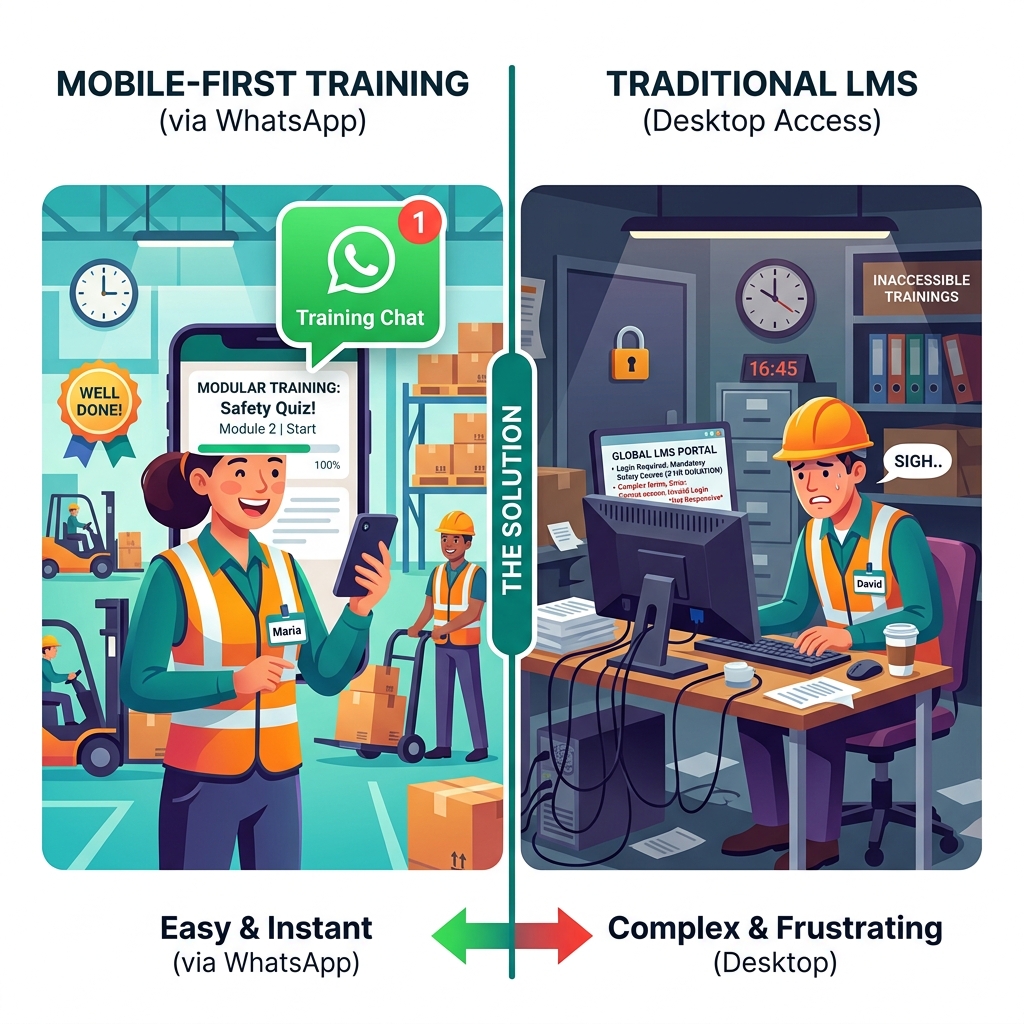
For knowledge workers, the answer is straightforward - push it through the LMS, send an email notification, maybe surface it in Slack or Teams. But for frontline and deskless workers who lack corporate email, desktop access, and often the patience for another app, the delivery channel is everything.
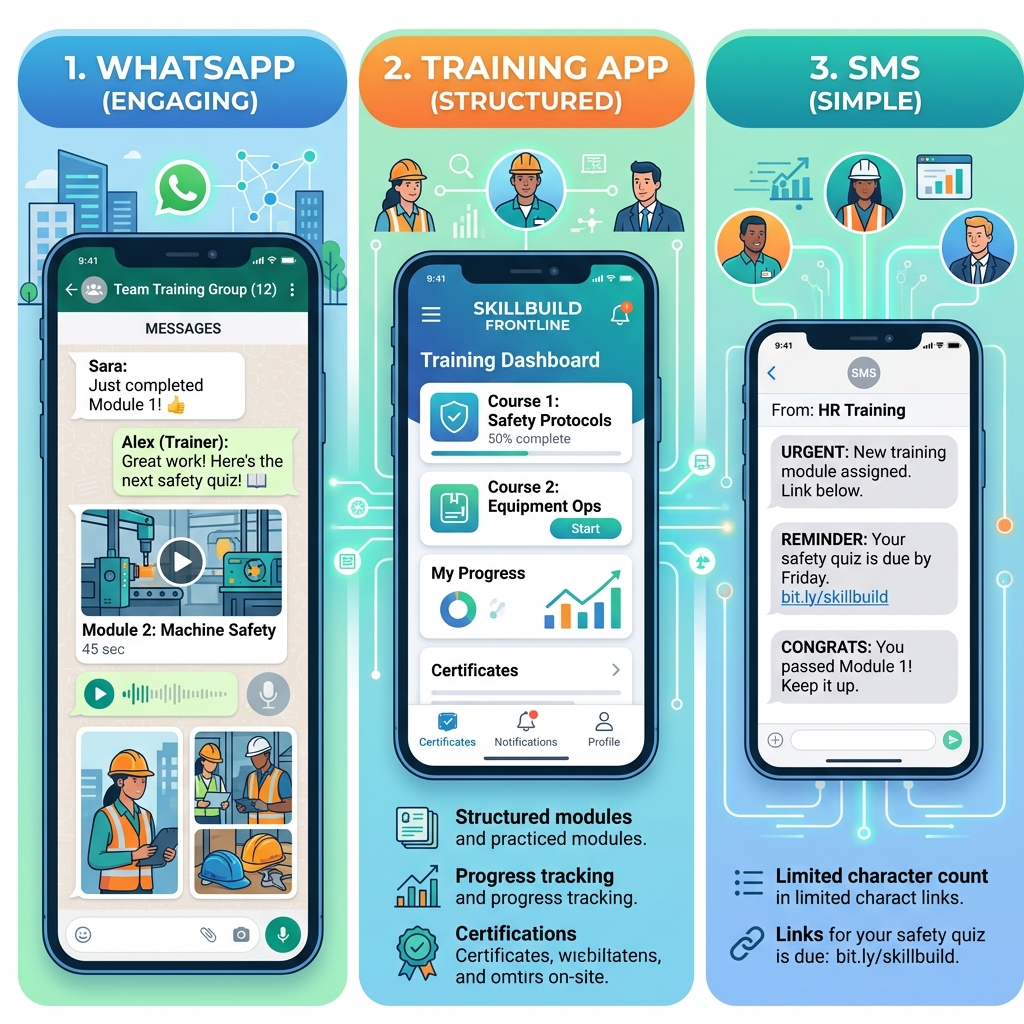
This guide compares the three primary channels for frontline training delivery - WhatsApp, SMS, and dedicated mobile apps - across the metrics that actually matter: reach, engagement, cost, content richness, and scalability.
Channel 1: WhatsApp-Based Training
How It Works
Training content is delivered directly through WhatsApp - the messaging app workers already use daily. Workers receive micro-modules, quizzes, videos, images, and audio content as chat messages. No app download. No login. No separate platform to learn.
Strengths
Reach: WhatsApp has over 2.7 billion monthly active users globally. In India alone, 500+ million people use it. Training delivered here has the highest potential reach of any digital channel.
Engagement: WhatsApp messages have an open rate exceeding 90% - compared to 20-30% for email and 40-60% for app push notifications.
Rich media support: WhatsApp supports text, images, videos (up to 2GB), audio messages, documents, interactive buttons, and list messages.
Vernacular language delivery: AI-powered platforms can generate and deliver training content in 100+ languages natively through WhatsApp.
Zero IT overhead: There's nothing to install, configure, or maintain on the worker's device.
Limitations
Internet dependency: WhatsApp requires a data connection. Messages queue and deliver once connectivity resumes.
Limited interactivity: WhatsApp doesn't support drag-and-drop, complex simulations, or branching scenarios with animation.
Storage concerns: Multiple training videos can consume device storage on budget phones.
Best For
Organizations training large, dispersed frontline workforces - especially in India, Southeast Asia, Africa, and Latin America.
Channel 2: SMS-Based Training
How It Works
Training content is delivered via text messages. Typically limited to text-based content - short quizzes, reminders, links to web-based modules, or brief knowledge nuggets.
Strengths
Universal reach: SMS works on every mobile phone - smartphones and feature phones alike. No internet connection required.
Guaranteed delivery: SMS messages arrive with extremely high open rates (98% according to industry data).
Simplicity: A text message arrives, they read it.
Limitations
Extremely limited content: SMS is restricted to 160 characters per message. You can't send videos, images, or interactive quizzes.
Cost at scale: In India, bulk SMS costs approximately ₹0.15-0.25 per message. Costs accumulate faster than WhatsApp-based delivery.
No engagement tracking within SMS: You can track delivery, but you can't track whether the worker actually completed a quiz.
No conversational capability: SMS is one-directional or very limited in back-and-forth capability.
Best For
Organizations with workers who use feature phones, or as a supplementary channel for training reminders alongside a primary platform.
Channel 3: Dedicated Mobile App
How It Works
Workers download a branded training app. They log in and access courses, videos, quizzes, and learning paths within the app environment.
Strengths
Richest content experience: Apps support complex interactivity - drag-and-drop, branching scenarios, video role-plays, gamification with leaderboards and badges.
Offline access: Most well-designed training apps allow workers to download content for offline consumption.
Deep analytics: In-app tracking provides granular data - time spent per module, question-level performance, engagement patterns.
Branding and customization: Apps provide full brand control.
Limitations
Download friction is the biggest killer. Industry data shows that app-based training programs lose 30-50% of potential users at the download stage alone.
Ongoing maintenance: Apps require updates, bug fixes, and compatibility testing across hundreds of Android device models.
Notifications get buried: Push notification open rates (15-40%) are significantly lower than WhatsApp (90%+).
Cost of development and maintenance: Building a custom training app costs $50,000-200,000+ plus ongoing maintenance.
Best For
Organizations with a tech-savvy workforce, strong IT support, and training needs requiring complex interactivity or offline access.
The Comparison Matrix
Making the Right Choice for Your Workforce
The decision shouldn't start with technology. It should start with your workers.
Ask these questions:
For most organizations training large frontline workforces in India and emerging markets, the answer increasingly points to WhatsApp as the primary channel - supplemented by SMS for edge cases and app-based solutions for specific training needs requiring complex interactivity.
The best training platform isn't the one with the most features. It's the one your workers actually use.
CTA: Leap10x delivers training through the channel your workers already love - WhatsApp. Start your free trial and see completion rates your LMS never achieved.