AI-Powered Content Localization: How to Create Training in Hindi, Tamil, and 100+ Languages in Minutes
Here's a scenario that plays out weekly at Indian enterprises operating across multiple states:
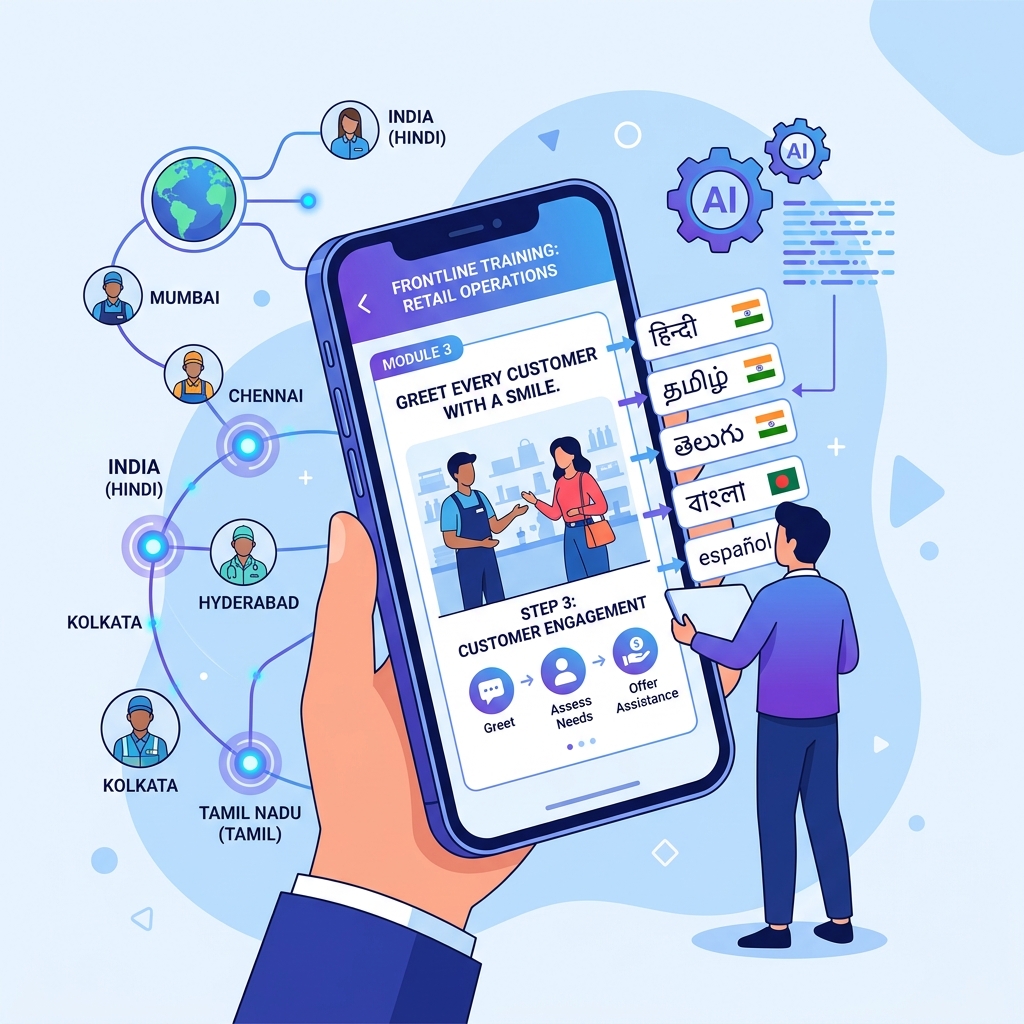
Your L&D team creates a product training module in English. The content is excellent. Now you need it in Hindi, Tamil, Telugu, Marathi, Kannada, Bengali, and Malayalam for your frontline teams across 12 states.
The traditional path: send it to a translation agency. Wait 2-3 weeks. Pay ₹3-5 per word across 7 languages. Receive translations that may be technically accurate but culturally tone-deaf.
Total time: 3-4 weeks. Total cost: ₹2-5 lakh per module. And you have 50 more modules to localize.
This bottleneck has kept India's multilingual workforce trapped in English-first training for decades. AI-powered content localization is finally breaking it open.
The Scale of India's Language Challenge
India has 22 officially recognized languages and over 19,500 dialects. Only about 10-12% of the population is comfortable with English. Yet the vast majority of corporate training content is created in English first.
For India's major enterprises, the language matrix is daunting:
- A retail chain in 15 states needs content in 8-10 languages minimum
- A manufacturing company with plants across states needs at least 5 language versions of every safety module
- A banking network with rural business correspondents needs content in regional dialects
How AI Content Localization Works - Beyond Simple Translation
1. Contextual Translation, Not Literal Translation
AI language models understand context, idiom, and register. The AI generates the natural, colloquial phrase a worker would actually use - not formal literary language that feels awkward.
2. Cultural Adaptation of Examples and Scenarios
AI localization doesn't just translate. It regenerates scenarios with culturally relevant context: "A customer returns a Diwali gift set saying the packaging was damaged" instead of a US-centric example.
3. Audio and Voice Narration in Regional Languages
AI text-to-speech technology generates natural-sounding narration in Hindi, Tamil, Telugu, Bengali, Marathi, and Kannada - critical for workers with limited reading proficiency.
4. Visual Content That Transcends Language
AI generates visual training content - infographics, step-by-step image guides, annotated diagrams - that communicates procedures visually with minimal text.
The AI Localization Workflow: English to 10 Languages in Hours
Step 1: Create the Source Module
Upload training content in English (or any source language).
Step 2: AI Content Structuring
AI breaks content into logical sections, generates quiz questions, and creates scenario prompts.
Step 3: Simultaneous Multilingual Generation
All target language versions are created simultaneously - not sequentially. Each adapted for cultural context.
Step 4: Audio Narration
AI generates voice narration for each language version with natural speech patterns.
Step 5: Quality Review
A human reviewer does a quick check - the AI provides 90-95% deployment-ready content.
Step 6: Deploy via WhatsApp
Language versions are automatically routed to workers based on their preference. No manual routing required.
Total time: Hours, not weeks. Total cost: A fraction of traditional translation.
Best Practices for Multilingual Training Content
Let Workers Choose Their Language. Don't assume. Let workers select during onboarding.
Use Mixed-Language Approaches. A POS training module might use English for technical terms while explaining procedures in Hindi - mirroring how workers actually communicate.
Prioritize Audio for Low-Literacy Audiences. Use audio narration as primary delivery with visual support.
Test Comprehension, Not Just Completion. Track quiz scores by language version to identify where translations need refinement.
Update All Languages Simultaneously. When content changes, use AI to update all versions at once.
The Business Case for Vernacular Training
- Higher completion rates - training feels designed for workers, not translated as an afterthought
- Better knowledge retention - learning in one's strongest language reduces cognitive load
- Faster onboarding - no language barrier on top of learning the role
- Improved safety outcomes - procedures understood clearly are applied consistently
- Stronger employer brand - workers who feel respected through vernacular training are more loyal
Stop Treating Language as a Barrier
India's language diversity isn't a training problem. It's a workforce reality. The organizations that embrace it - by meeting workers in their language - will build more capable, engaged, and loyal frontline teams.
CTA: Create training in Hindi, Tamil, Telugu, and 100+ languages in minutes - not weeks. Try Leap10x free and see AI content localization in action.