AI Literacy Training for Frontline Workers in India
AI Is Already on Your Factory Floor - Your Workers Just Don't Know It
AI isn't a future concern for frontline workers. It's a present reality that most Indian enterprises haven't addressed through training.
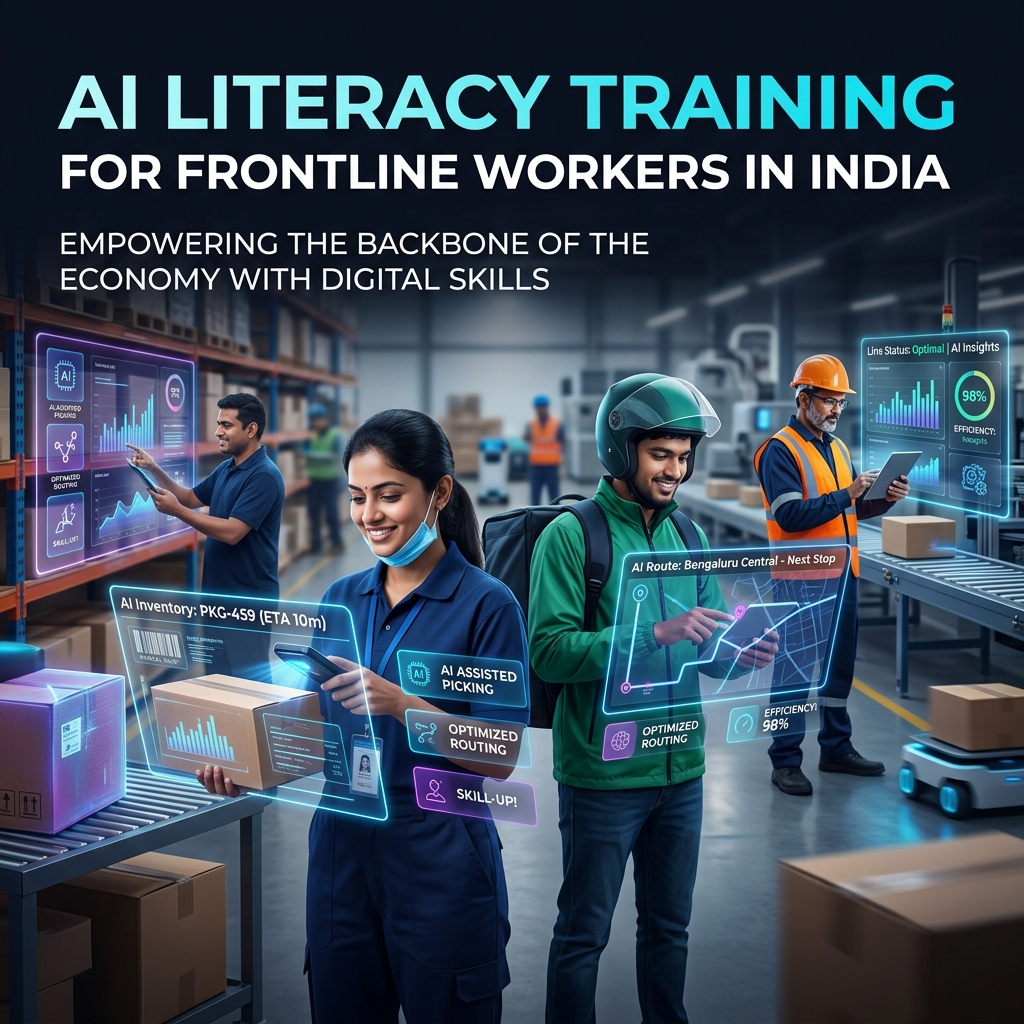
Think about what's already happening: Warehouse management systems use machine learning to optimize picking routes. Retail POS systems deploy AI for demand forecasting. Manufacturing quality inspection uses computer vision. BFSI field agents interact with AI-powered loan origination systems daily. Even scheduling tools like Workday and Deputy use algorithms to assign shifts.
Yet according to a 2026 study cited by Savia Learning, 80% of frontline workers say their employers don't clearly communicate how AI is being used in their workplace. And only 14% of frontline workers have received any AI-related training, even though 86% believe they need it.
This gap is expensive. When workers don't understand the AI tools embedded in their workflows, they misuse them, distrust them, or ignore their outputs entirely. The productivity gains that leadership expected from AI investments evaporate on the shop floor.
The solution isn't sending every warehouse operator to a machine learning bootcamp. It's building practical AI literacy programs that help frontline workers understand, interact with, and question the AI systems they already use - delivered in a format that actually reaches them.
What AI Literacy Means for Frontline Workers (It's Not What You Think)
AI literacy for knowledge workers means understanding prompts, evaluating outputs, and using tools like ChatGPT or Copilot. For frontline workers, the skill set is fundamentally different.
Frontline workers don't choose to adopt AI tools. AI features are built into the platforms their employers require them to use. They encounter AI as a feature of existing software, not as a standalone tool. This distinction shapes what they actually need to learn.
The Five Practical AI Skills for the Frontline
1. Recognizing AI in Their Workflow
Most frontline workers can't identify which parts of their daily tools are AI-powered. A delivery driver following an optimized route doesn't know algorithms are making routing decisions. A factory operator reviewing an automated quality flag doesn't realize computer vision triggered it. The first skill is simply awareness - knowing where AI sits in their workflow.
2. Understanding AI Suggestions vs. AI Decisions
Some AI systems suggest actions (recommended next steps in a CRM). Others make autonomous decisions (automated shift scheduling, predictive maintenance alerts). Workers need to understand the difference because it determines their role: accept and execute, or evaluate and decide.
3. Knowing When to Override
AI systems are wrong sometimes. A quality inspection camera might flag a perfectly good part. A scheduling algorithm might create impossible shift rotations. Frontline workers need the confidence and judgment to know when AI output doesn't match ground reality - and the protocol for escalating.
4. Providing Good Input
AI systems are only as good as their input data. When a warehouse worker scans items carelessly or a field agent enters approximate data into a loan application, the AI downstream produces unreliable outputs. Training workers on data quality isn't traditionally considered AI training, but it directly affects AI system performance.
5. Communicating About AI to Customers
Frontline workers in retail, healthcare, and BFSI increasingly need to explain AI-driven decisions to customers. "The system flagged your loan application for additional review" is a conversation that a field agent needs to handle with both technical accuracy and empathy.
Why Traditional Training Methods Fail for AI Literacy
The standard corporate approach to AI training - a 60-minute e-learning module on a desktop LMS - fails spectacularly for frontline workers. Here's why:
Access barriers are immediate. Frontline workers in Indian factories, warehouses, and retail stores don't have dedicated training time on desktop computers. The average frontline worker has as little as 24 minutes per week available for formal learning. An hour-long AI module simply won't get completed.
Abstraction doesn't connect. Generic AI awareness content that discusses machine learning concepts and neural networks is irrelevant to a warehouse picker who needs to understand why the WMS route changed. Training must be grounded in specific tools and specific workflows.
Language creates a second barrier. Most AI training content is in English. India's frontline workforce operates predominantly in Hindi, Tamil, Telugu, Marathi, and other regional languages. Delivering AI concepts in English to a Kannada-speaking factory operator guarantees poor comprehension.
One-time training doesn't stick. AI tools in the workplace change frequently - updates, new features, interface changes. A single training event becomes outdated within weeks. AI literacy needs ongoing reinforcement, not a one-and-done session.
For context on how India's government is approaching workforce digital skills, our piece on India's Skill India 2.0 covers the national framework.
Building an AI Literacy Program That Actually Works
Step 1: Audit AI Touchpoints in Frontline Workflows
Before designing training, map exactly where your frontline workers encounter AI. Walk through their daily workflows and identify:
- Which tools use AI features (even embedded, invisible ones)?
- Where does AI suggest vs. decide?
- What data do workers input that feeds AI systems?
- Where do AI outputs affect customer-facing interactions?
This audit is essential because it determines what to train. A generic "What is AI" module helps nobody. A specific module on "How the quality camera works and when to override its flag" helps everyone.
Step 2: Design Role-Specific Microlearning Modules
Organize training by role, not by AI concept. A factory operator, a delivery driver, and a retail associate all encounter AI differently. Build separate module sequences for each role.
Structure each module as:
- Awareness (2 minutes): What AI does in this specific tool
- Interaction (3 minutes): How to work with AI suggestions/outputs correctly
- Judgment (3 minutes): Scenarios for when to trust, question, or override AI
- Assessment (2 minutes): Quick scenario-based quiz
Keep each module under 5 minutes. Use video, visual examples from actual workplace tools, and scenario-based questions. Avoid technical jargon - explain concepts in the worker's language using their tools as examples.
Step 3: Deliver Through Channels Workers Already Use
The delivery channel determines whether training reaches your workforce. For India's frontline, that means mobile-first - and ideally WhatsApp-native.
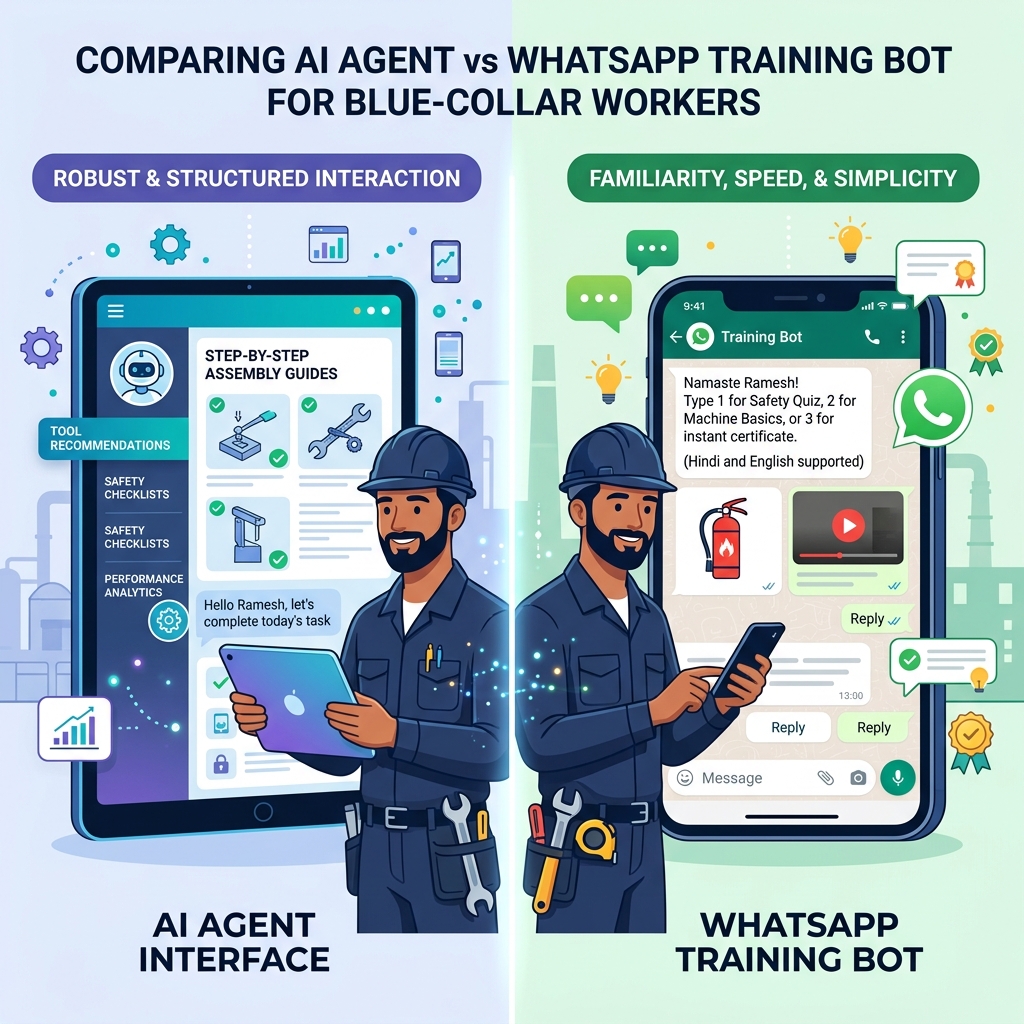
Delivering AI literacy modules through WhatsApp eliminates download friction, login barriers, and the need for dedicated training time. Workers receive a 3-minute video on their phone explaining how the new scanning AI works, followed by two quick questions to check understanding. It fits between tasks, during breaks, or during the commute.
Our WhatsApp-Based Training for Employees guide covers the delivery mechanics in detail.
Step 4: Deliver in Vernacular Languages
AI concepts don't need to be explained in English. In fact, they shouldn't be. When you explain to a Hindi-speaking quality inspector that "yeh camera ek AI system hai jo defects automatically detect karta hai" - they understand instantly. The same concept in English creates a comprehension barrier that undermines the entire training.
Auto-translation of AI literacy content into 20+ Indian languages isn't a luxury. It's the difference between a workforce that understands AI and one that fears it.
Step 5: Build Ongoing Reinforcement, Not One-Time Events
AI tools change. New features roll out. Algorithms get updated. Your AI literacy training needs a refresh cadence:
- Monthly micro-refreshers: 2-3 minute modules covering updates or reinforcing key concepts
- Quarterly scenario drills: New situations where workers practice AI judgment calls
- Just-in-time support: Reference cards or quick-access guides workers can pull up when they encounter an unfamiliar AI output
This ongoing approach is what separates a checkbox exercise from genuine workforce capability building.
Real-World Signals: Why This Matters Now
The global momentum behind frontline AI literacy is accelerating. In March 2026, the U.S. Department of Labor launched "Make America AI-Ready" - a free AI literacy course delivered entirely over text message, designed for workers without laptops. The course delivers bite-sized content and daily challenges over seven days, requiring just 10 minutes per day.
Microsoft partnered with North America's Building Trades Unions to deliver no-cost AI literacy courses specifically for skilled trades workers - carpenters, electricians, plumbers. BCG published research showing that GenAI's four highest-impact applications for frontline workers are simplifying scheduling, making training accessible, real-time troubleshooting, and curating compliance information.
In India, the EY AIdea Report from 2025 estimates over 38 million jobs in the organized sector will be transformed by 2030, requiring new competencies around AI literacy, process automation, and digital decision-making. Companies that start building AI literacy in their frontline workforce now will have a multi-year advantage over those that wait.
The Business Case
McKinsey research highlights the gap starkly: companies spend an estimated $9,100 annually per employee on software tools but only $1,200 on training. When expensive AI-powered tools sit unused or misused because workers weren't trained to use them, the ROI on technology investments collapses.
Conversely, organizations that invest in frontline AI skills see measurable returns. One mining company trained frontline employees to use AI-based production tools and increased output by over 60% while cutting costs by 20%. Manufacturing firms using connected worker platforms with AI coaching report faster onboarding, fewer errors, and stronger compliance documentation.
The frontline worker isn't the last to benefit from AI. They might be the primary beneficiary - if the training catches up to the technology.
The Bottom Line
AI literacy for frontline workers isn't about teaching machine learning theory. It's about giving workers the practical skills to recognize, interact with, and question the AI systems already embedded in their daily tools.
The most effective programs deliver role-specific, scenario-based microlearning through channels workers already use - in their language, in their workflow, in formats they can consume in under five minutes.
Indian enterprises that build this capability now will unlock the productivity gains their AI investments promised. Those that don't will keep wondering why expensive technology isn't delivering results on the shop floor.
Want to build AI literacy training that actually reaches your frontline? Explore Leap10x - WhatsApp-native microlearning that delivers training in every language your workforce speaks.