The L&D Leader's Guide to Training Gig Workers and Contractual Staff in India
Quick answer
India's gig economy has grown from a niche labour segment to a structural force in the economy.
India's Gig Workforce Is Massive - And Mostly Untrained
India's gig economy has grown from a niche labour segment to a structural force in the economy. NITI Aayog estimates 7.7 million workers were part of the gig and platform economy as of their latest assessment, and that number is projected to reach 23.5 million by 2029-2030. The broader contractual workforce - including temporary staff hired through staffing agencies, fixed-term contract workers, and project-based labour - adds tens of millions more.
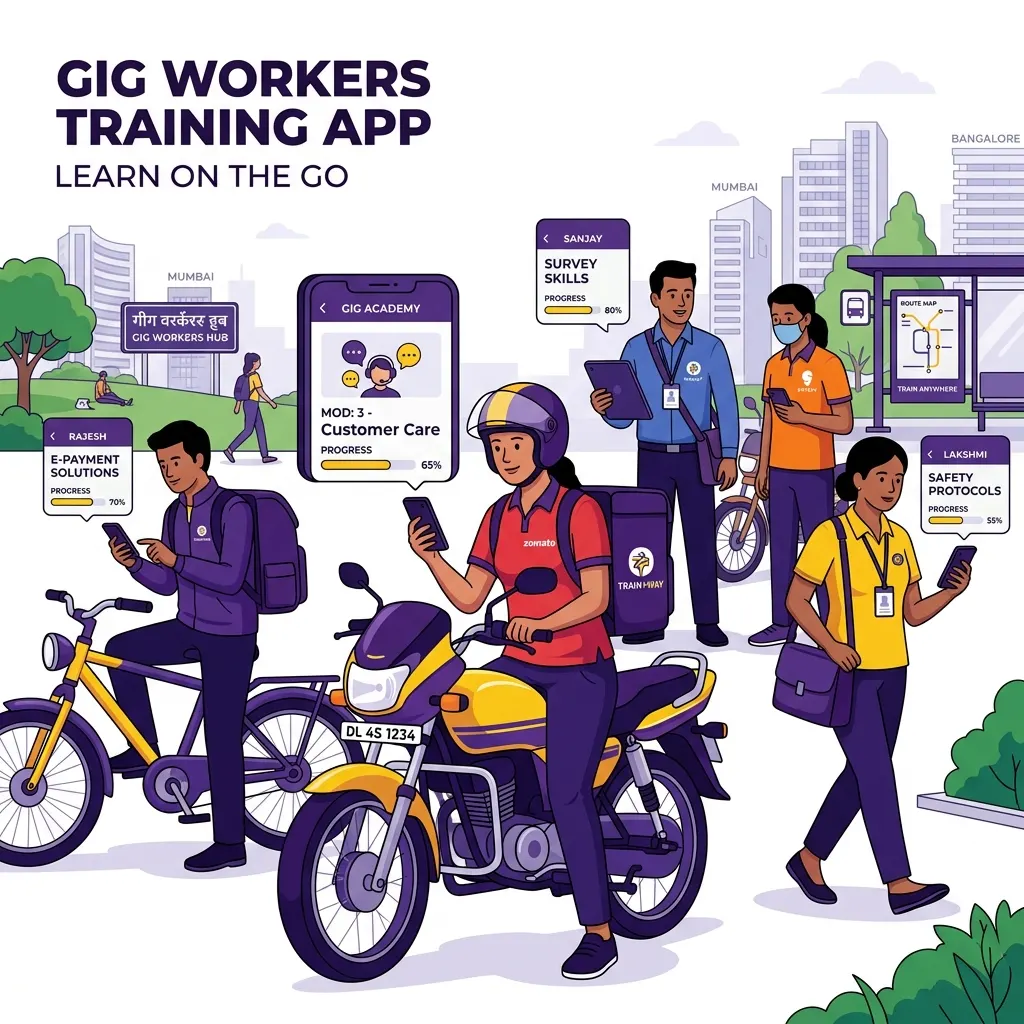
These workers power critical operations. Delivery riders fulfil millions of orders daily for Swiggy, Zomato, Blinkit, and Amazon. Contractual factory workers staff production lines at automotive plants. Staffing agency hires operate warehouses during seasonal peaks. Temporary retail associates cover festive season demand.
Yet the training infrastructure for this workforce is almost non-existent. Most gig and contractual workers receive minimal onboarding - a brief app walkthrough, a safety video on Day 1, or a buddy-system introduction that varies wildly in quality. Ongoing skill development is rare. Compliance training is often skipped entirely.
The result: inconsistent quality, higher safety incident rates, customer service gaps, and regulatory exposure - all traced back to a workforce that was asked to perform but never properly prepared.
For L&D leaders at companies that rely heavily on non-permanent labour, this guide covers the practical challenges of training gig and contractual workers and the strategies that actually work.
The Unique Training Challenges of Non-Permanent Workers
Challenge 1: No Long-Term Relationship
Traditional training programs assume an ongoing employer-employee relationship. You invest in training because the worker will apply those skills over months or years. With gig and contract workers, the relationship might last weeks or a single season. The ROI calculus is different, which often leads to the conclusion: "Why invest in training someone who's leaving soon?"
This reasoning is flawed. An untrained contract worker on your factory floor creates safety risks today. An untrained delivery rider damages your brand with every customer interaction. The cost of not training is immediate, even if the worker's tenure is short.
Challenge 2: No Company Infrastructure Access
Gig workers typically don't have company email, intranet access, or login credentials for corporate systems. They operate on personal devices using their own data plans. Any training solution that requires corporate infrastructure access automatically excludes this workforce.
Challenge 3: High Turnover Means Constant Onboarding
In gig-heavy operations, workers cycle in and out continuously. A delivery fleet might see 30-40% monthly turnover. A warehouse during peak season might onboard hundreds of temporary workers in a single week. The training system must handle continuous, high-volume onboarding without creating bottlenecks.
Challenge 4: Diverse Skill and Literacy Levels
Gig and contractual workers come from highly diverse backgrounds. A delivery rider might be a college student earning part-time income or a first-generation smartphone user from a rural area. Training must accommodate this full range of digital literacy and educational background.
Challenge 5: Regulatory Grey Areas
The legal obligations for training gig workers are evolving. The Social Security Code 2020 extends certain protections to gig and platform workers, but implementation varies. The Occupational Safety, Health and Working Conditions Code applies to contract workers in certain establishment categories. L&D teams must navigate these requirements while regulations are still being clarified.
Why WhatsApp Is the Only Viable Channel
For gig and contractual workers in India, the delivery channel debate is settled. WhatsApp is the only training channel that consistently reaches this audience because:
- 100% penetration: Every gig worker in India has WhatsApp installed. It's the primary communication tool for platform companies, staffing agencies, and informal labour networks.
- Zero additional adoption: No app download, no account creation, no learning curve. The worker receives training as a WhatsApp message and engages with it in a familiar interface.
- Works on budget devices: WhatsApp runs on the most basic Android smartphones. No high-spec hardware required.
- Low data consumption: WhatsApp microlearning modules consume minimal data compared to video-heavy LMS platforms.
For the complete framework of WhatsApp-based training, see our WhatsApp-Based Training for Employees: Complete 2026 Guide.
Building a Training Program for Non-Permanent Workers
Layer 1: Day-Zero Onboarding (Before First Shift)
Gig and contract workers need to be productive from their very first shift. Design a pre-start training sequence that covers essentials before they walk through the door:
For delivery/logistics gig workers:
- App navigation and order management basics
- Safety fundamentals (road safety, load handling)
- Customer interaction standards (communication, escalation)
- Company policy essentials (uniforms, conduct, prohibited behaviours)
For contract factory workers:
- Plant safety orientation (PPE, emergency exits, hazard zones)
- Machine-specific safety briefing for assigned area
- Quality standards for their production role
- Shift procedures (clock-in, breaks, reporting)
For temporary retail staff:
- Brand and product basics
- POS system operation
- Customer service standards
- Store policies (returns, escalation, theft prevention)
Deliver these as a 4-6 module WhatsApp sequence over 1-2 days before the worker's first shift. Each module: 3-5 minutes, with a scenario question at the end to verify comprehension. Include an assessment at the end - the worker must pass before starting.
Layer 2: First-Week Reinforcement
The first week on the job is where knowledge meets reality. Workers encounter situations that training didn't cover. They forget procedures they learned two days ago. They develop bad habits from copying experienced workers.
During Week 1, send daily reinforcement modules:
- Day 2: Quick refresher on the most critical safety/quality procedure
- Day 3: Common mistakes new workers make (and how to avoid them)
- Day 4: Customer scenario practice (for customer-facing roles)
- Day 5: First-week assessment to identify knowledge gaps
Layer 3: Ongoing Compliance and Updates (For Longer-Term Contract Workers)
Contract workers who stay beyond the initial period need the same compliance training as permanent staff. Structure monthly compliance modules covering:
- Safety refreshers and incident prevention
- POSH awareness (mandatory regardless of employment type)
- Quality standard updates
- New procedure rollouts
For POSH-specific compliance delivery, see our guide on POSH Compliance Training via WhatsApp.
Layer 4: Skill Development (For Conversion Pipeline Workers)
Some contract workers become permanent employees. Identify high-potential gig and contractual staff and offer development tracks that prepare them for permanent roles:
- Leadership fundamentals for future supervisors
- Digital skills for technology-enabled roles
- Cross-functional knowledge modules
- Certification preparation aligned with Skill India or NSDC frameworks
This approach creates a talent pipeline while demonstrating that your organization values all workers, regardless of employment type.
For how India's Skill India 2.0 program creates opportunities for this approach, see our Skill India 2.0 guide.
Measuring Training Impact for Non-Permanent Workers
The metrics framework for gig worker training focuses on operational impact within short timeframes:
- First-shift readiness score: What percentage of new gig/contract workers pass the pre-start assessment on their first attempt?
- Safety incident rate (first 30 days): Are trained gig workers having fewer incidents than historically untrained cohorts?
- Customer complaint rate: For delivery and customer-facing gig roles, are trained workers generating fewer complaints?
- Contract-to-permanent conversion rate: Are workers who complete development tracks more likely to convert to permanent roles?
- Time-to-productivity: How quickly do trained contract workers reach full operational speed compared to untrained peers?
Navigating the Regulatory Landscape
Indian regulations around gig worker obligations are evolving:
- Social Security Code 2020: Extends social security provisions to gig and platform workers. While training isn't explicitly mandated yet, the Code establishes a framework that may include skill development obligations.
- Occupational Safety Code: Applies to contract workers in factories and certain establishments. Safety training obligations apply regardless of employment type.
- POSH Act: Applies to all workers at the workplace, including contractual and temporary staff. POSH training is mandatory regardless of employment status.
- State-specific rules: Some states have additional requirements for contract labour training in hazardous industries.
Smart enterprises don't wait for regulations to mandate training. They train proactively because the operational benefits - fewer accidents, better quality, lower complaints, stronger compliance posture - justify the investment regardless of regulatory requirements.
The Bottom Line
India's gig and contractual workforce is too large, too critical, and too exposed to remain untrained. The companies that figure out how to onboard, train, and develop non-permanent workers quickly, consistently, and at scale will have a structural advantage in quality, safety, compliance, and brand experience.
The training approach must match the workforce: mobile-first, WhatsApp-delivered, multilingual, designed for high-turnover continuous onboarding, and structured to create value even within short-tenure relationships.
The gig economy isn't going back to traditional employment models. Training infrastructure needs to catch up.
Need to train your gig and contractual workforce - fast, at scale, on WhatsApp? Explore Leap10x - frontline training that reaches every worker, every language, from Day Zero.