Blue-Collar Safety Training on Mobile: How to Deliver Compliance via WhatsApp in Manufacturing & Construction

Every safety manager knows the dilemma. Your workers need regular safety training to stay compliant and stay alive. But pulling them off the production line for classroom sessions costs productivity. Sending them to a computer lab for e-learning courses costs even more — most of them don't have computer access in the first place.
So safety training becomes an annual checkbox. A half-day session crammed with regulations, followed by a signature on a form that proves "training was completed." Never mind that workers forget 70% of the content within a week. Never mind that the guy who most needs the LOTO refresher was on a different shift the day training happened.
This approach isn't just ineffective — it's dangerous. The National Safety Council estimates the total cost of work injuries in the United States at $176.5 billion annually. According to the University of Tennessee, one of the primary underlying factors of workplace accidents is the lack of appropriate employee training.
The gap is even more severe in emerging markets. Only 52% of blue-collar workers in the US have received formal training. In India, that number drops to a staggering 4.7%.
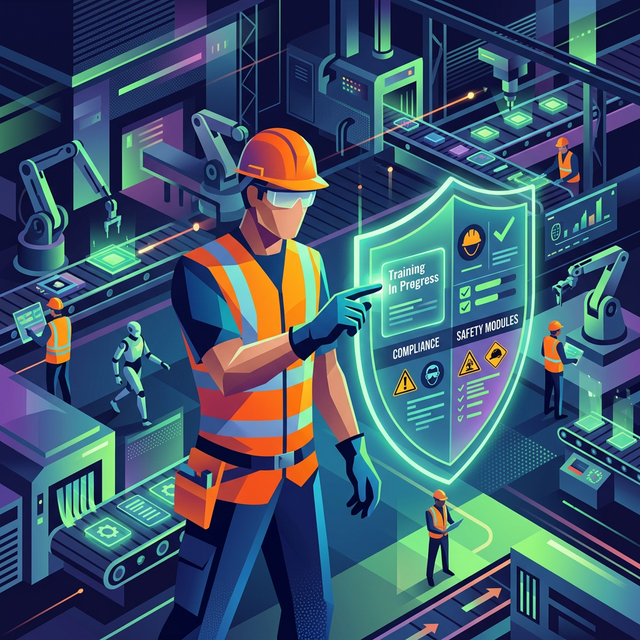
WhatsApp-based safety training offers a way to close this gap without disrupting operations.
Why Mobile Safety Training Works Better
Mobile safety training through WhatsApp works because it aligns with how frontline workers actually operate:
Training in the gaps. Workers don't have dedicated training hours, but they do have natural breaks. A 3-minute WhatsApp safety module fits perfectly into these windows.
Just-in-time relevance. A confined space entry refresher delivered the morning before a worker enters a confined space is infinitely more useful than the same content delivered six months earlier.
Visual and practical format. Safety training is inherently visual. WhatsApp supports video, images, and interactive content natively.
Vernacular delivery. In India, a single manufacturing plant might employ workers speaking Hindi, Tamil, Kannada, and Bengali. Safety instructions that a worker can't fully understand won't be followed.
Building a WhatsApp Safety Training Programme
Module 1: Daily Safety Awareness (Ongoing)
Daily micro-touchpoints keep safety top of mind. One short safety touchpoint per day at shift start — a quick comms nudge when it's just information, or a magic link that opens a 60-second tap-through card when a check or quiz is involved.
Examples:
- Monday — PPE Check: Confirm your PPE before starting
- Tuesday — Spot the Hazard: Photo of a workstation — "What safety violation do you see?"
- Wednesday — Quick Quiz: Test knowledge of a specific safety procedure
- Thursday — Safety Tip: One-way advisory message
- Friday — Weekly Safety Score: Team performance update
Module 2: Hazard-Specific Training Tracks
Different roles face different hazards. WhatsApp training should be segmented:
- Chemical Safety Track: MSDS reading, proper storage, spill response, PPE requirements, emergency first aid
- Electrical Safety Track: Lockout/Tagout procedures, arc flash awareness, de-energisation
- Working at Heights Track: Fall protection, harness fitting, scaffold safety, ladder rules
- Machine Safety Track: Guarding requirements, emergency stops, maintenance protocols
Each track consists of 8-12 micro-modules delivered over 2-3 weeks.
Module 3: Emergency Response Training
WhatsApp can reinforce emergency preparedness far more effectively than an annual drill alone through pre-drill preparation, post-drill reinforcement, and scenario-based training.
Module 4: Incident Reporting Training
Under-reporting of incidents is a persistent problem. WhatsApp training tackles this from two sides: training that teaches workers what to report and how, and a Communication Hub that makes the actual reporting effortless.
Compliance Documentation
WhatsApp-based training platforms provide comprehensive audit trails:
- Timestamped delivery records — proof each worker received each training module
- Individual completion records — which modules each worker completed
- Assessment scores — quiz results for every worker on every safety topic
- Acknowledgement receipts — worker confirmations of policy updates
- Exportable reports — compliance-ready documentation for regulatory audits
This documentation is generated automatically with every training interaction. When an inspector asks "can you prove that Worker X completed confined space training?" the answer is an instant PDF with timestamps, quiz scores, and acknowledgements.
Implementation Considerations
Phone-free zones. Many manufacturing floors are designated phone-free zones. Design WhatsApp safety training for pre-shift, break times, and post-shift — never for use while operating equipment.
Union and worker council engagement. Involve worker representatives early. Position WhatsApp training as a worker benefit.
Supervisor involvement. Supervisors should reference WhatsApp training content in toolbox talks.
Measurement beyond completion. Track your incident rate (TRIR), near-miss reports, and safety observation data alongside training metrics.
Deliver safety training that actually protects your workers. Leap10x helps manufacturing and construction companies push safety SOPs, compliance training, and hazard awareness directly to workers' WhatsApp — in 15+ languages, with full audit trails. Start your free pilot today.