How to Measure Frontline Training ROI: A Data-Driven Framework for Blue-Collar Workforces
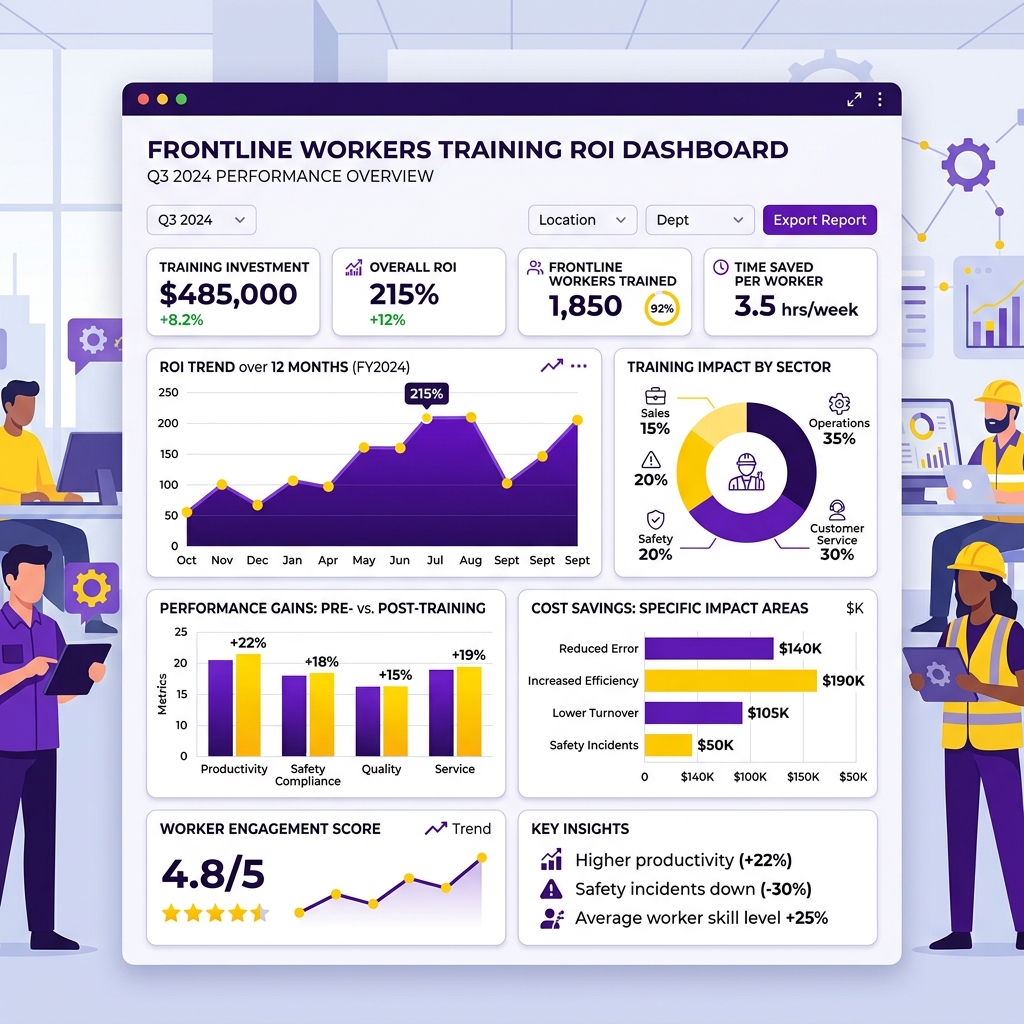
Ask an L&D leader if their frontline training is working, and you'll hear about completion rates. "We achieved 78% completion on the safety module."
Ask a CFO the same question, and they'll want to know something entirely different: "Did it reduce turnover? Did it prevent safety incidents? Did it make new hires productive faster? What's the return on our training investment?"
Completion rates are a training metric. ROI is a business metric. And the gap between the two is where most frontline training programmes lose executive support.
This guide provides a practical framework for measuring the actual business impact of frontline training — specifically designed for blue-collar workforces in manufacturing, retail, logistics, and hospitality.
Why Traditional Training Metrics Fall Short
The metrics most L&D teams report are inputs and outputs, not outcomes:
- Hours of training delivered (input)
- Number of workers trained (input)
- Completion rates (output)
- Average quiz scores (output)
- Satisfaction ratings (output)
These metrics tell you whether training happened. They don't tell you whether training worked. The only metrics that matter for ROI are those that connect training activity to business outcomes.
The Frontline Training ROI Framework
This framework connects training investment to four measurable business outcome categories:
Outcome 1: Turnover Reduction
Replacing a frontline worker costs approximately 40% of their annual salary (Gallup). Employees who receive adequate training are significantly more likely to stay — companies with structured onboarding improve retention by up to 82%.
Organisations implementing structured WhatsApp-based training typically see 15-25% reductions in frontline turnover within the first year.
Example calculation:
- 5,000 frontline workers at 60% turnover = 3,000 departures/year
- Cost per departure = ₹3,50,000 ($4,200)
- A 15% reduction = 450 fewer departures
- Annual savings = 450 × ₹3,50,000 = ₹15.75 crore ($18.9M)
Outcome 2: Safety Improvement
Workplace injuries are extraordinarily expensive. The National Safety Council estimates the total cost of work injuries in the US at $176.5 billion annually. Organisations implementing continuous WhatsApp-based safety training report 30-40% reductions in recordable incidents.
Example calculation:
- Baseline: 50 recordable incidents per year
- Average cost per incident: ₹5,00,000 ($6,000)
- A 35% reduction = 17-18 fewer incidents
- Annual savings = 17 × ₹5,00,000 = ₹85 lakh ($1.02M)
Outcome 3: Productivity Acceleration
Every day a new hire operates below full productivity is a day of diminished output. WhatsApp-based onboarding gets workers floor-ready faster. Expected improvement: 20-30% reduction in time-to-full-productivity.
Outcome 4: Training Delivery Cost Reduction
Traditional classroom-based training carries substantial direct costs including trainer salaries, venue costs, materials, travel, opportunity cost, and LMS licensing. Expected improvement: 40-60% reduction in per-worker training delivery costs.
Building the ROI Model
Combine all four outcome categories:
Total Annual Savings = Turnover savings + Safety savings + Productivity savings + Delivery cost savings
Total Annual Investment = Platform licensing + Content conversion + Admin time + Change management
ROI = (Total savings - Total investment) / Total investment × 100
For most frontline-heavy organisations, this calculation yields ROI ratios of 300-800%, meaning every rupee invested in WhatsApp training returns ₹3-8 in measurable savings.
Presenting ROI to Leadership
- Lead with the problem, not the solution — start with the current cost of turnover, safety incidents, and slow onboarding
- Use conservative estimates — under-promise and over-deliver
- Show the timeline — demonstrate that returns begin during the pilot phase
- Propose a measurable pilot — don't ask for full commitment upfront
The Measurement Infrastructure
To calculate ROI, you need three data sources:
- Training data from your WhatsApp training platform (completion rates, assessment scores, engagement metrics)
- HR data from your HRIS (turnover rates, time-to-productivity, training costs)
- Operations data from your EHS and ops systems (safety incidents, quality metrics, customer satisfaction)
Beyond the Numbers
ROI is the language of business cases. But the impact of effective frontline training extends beyond what spreadsheets capture. Workers who feel supported and developed are more engaged. Engaged workers treat customers better. Better customer experiences drive revenue. It's a virtuous cycle, and it starts with training that actually reaches the people who need it most.
Prove the ROI of your frontline training. Leap10x provides real-time analytics connecting training completion to operational outcomes — turnover, safety, productivity, and cost savings. Build the business case with real data. Start your free pilot today.