The Grey-Collar Workforce: Why India's Fastest-Growing Job Category Breaks Your Training Model
Quick answer
Grey-collar workers - technicians, riders, lab staff, retail tech roles - are India's fastest-growing job category. Why they break traditional training models and what works.
HR has spent a century sorting workers into two boxes: white-collar (desk, laptop, email, LMS) and blue-collar (floor, machine, noticeboard, toolbox talk). India's job market has spent the last decade quietly creating an enormous third category that fits neither box - and most enterprises are still trying to train it with tools built for the other two.
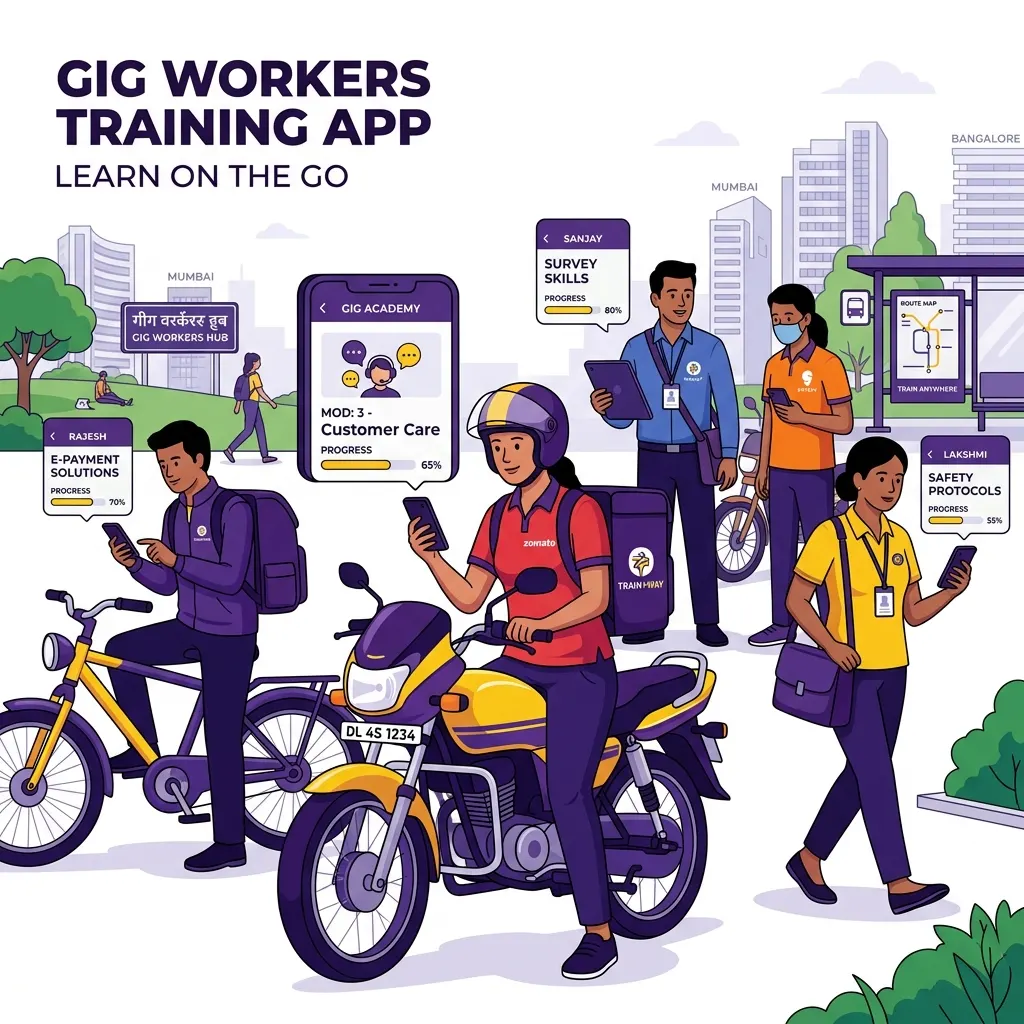
Meet the grey-collar worker: the field service technician who diagnoses an AC fault with a multimeter and an app; the quick-commerce rider navigating routing algorithms and customer-experience scripts; the phlebotomist following clinical protocol on a home visit; the solar installer; the EV service advisor; the CCTV technician; the lab assistant; the drone operator on a farm. Work that mixes manual skill with technical knowledge, customer interaction, and - increasingly - software.
These are not "unskilled" jobs, and they're not desk jobs. They're skilled, mobile, tech-mediated, and customer-facing all at once. And they may be the fastest-growing segment of India's workforce, driven by exactly the sectors expanding hardest: renewable energy, EVs, home services, diagnostics and home healthcare, quick commerce, telecom infrastructure, and appliance servicing.
What makes grey-collar work different
Four traits define the category - and each one breaks an assumption embedded in traditional training:
1. Knowledge changes constantly. A field technician's product knowledge has a shelf life measured in months: new models, new diagnostic flows, new safety protocols. Blue-collar training assumed stable skills (a lathe is a lathe); grey-collar work assumes continuous updates.
2. They work alone, at the customer's location. No supervisor nearby, no peer to ask, no noticeboard. The company's entire support system has to fit in their pocket. They're also the brand's only human touchpoint - a technician's conduct in a customer's living room is the brand.
3. They're judged on both competence and communication. A rider who delivers fast but argues at the door fails. A technician who fixes the fault but can't explain the invoice fails. Grey-collar performance is technical skill × soft skill - which is why we argue soft skills training for blue-collar workers is chronically underfunded.
4. Many aren't your employees. Franchised service networks, gig platforms, third-party staffing - the grey-collar workforce is heavily extended-enterprise. They're not in your HRMS, they don't have your email domain, and your LMS licence model has no idea what to do with them.
Why your current training stack misses them
Run the standard tools against those four traits:
- The corporate LMS assumes email logins, desk time, and 45-minute modules. Grey-collar workers have none of the three. Completion rates for frontline portal training sit at 20–30% - and that's for on-roll staff. (The full argument: why your LMS fails frontline workers.)
- Classroom academies can't keep pace with monthly knowledge churn, can't reach franchise networks economically, and cost a day of billable field time per session.
- The buddy system ("shadow Ramesh for a week") transfers habits - good and bad - and collapses under attrition and network growth.
- PDF circulars in WhatsApp groups reach phones but train nobody: unread, unverified, unmeasurable.
The irony is that grey-collar workers are the most digitally reachable workforce India has ever had - smartphone-native, app-comfortable, on WhatsApp all day - and the least served by digital training.
What a grey-collar training system looks like
Design for their actual day: mobile, solo, between jobs, multilingual.
Continuous micro-updates, not annual courses. Product and protocol knowledge delivered as 2–3 minute modules on WhatsApp - no app, no login, enrollment by phone number (which solves the extended-enterprise problem in one stroke). New model launched? The whole network is quiz-verified on it within the week. This is the mechanic behind training dealers and channel partners on WhatsApp, applied to service networks.
Just-in-time support, not just training. Half of a field worker's knowledge needs are momentary: "what's the torque spec?" "what does error E4 mean?" An AI assistant trained on your manuals, answering inside the same chat (this is what Leap10x's Assist does), converts your documentation from shelf-ware into a colleague. QR codes on equipment linking to the right module close the loop.
Scenario and roleplay practice for the human half. De-escalation at the doorstep, explaining charges, upselling honestly - rehearsed via scenario quizzes and AI roleplay rather than read about in a PDF.
Verification that follows the worker. Quiz-verified completions, scores, and certificates per person - exportable evidence for clients, franchisors, and regulators, and portable across a workforce that changes vendors more often than careers.
Vernacular by default. One master module, auto-translated into 70+ languages - because India's grey-collar boom is a tier-2/3 story, and training in the worker's language is the difference between comprehension and compliance theatre.
Why this matters to the business, not just HR
Grey-collar workers sit directly on revenue and brand: first-time-fix rates, delivery NPS, installation quality, repeat purchase. Every point of knowledge gap shows up in a customer's home. And the retention math is brutal in growth sectors - trained workers with visible skill paths stay longer (94% say they'd stay longer at a company investing in their learning), while replacing one costs 50–200% of annual salary. The sectors winning the grey-collar talent war are the ones treating training as infrastructure, not induction.
India's skilling ecosystem - ITIs, Skill India, apprenticeships - feeds the pipeline's front end. But the eleven months a year after certification belong to employers. That's the gap a continuous, WhatsApp-native training system fills; it's the same thesis behind our future of blue-collar jobs in India analysis.
FAQ
Q: What exactly is a grey-collar worker?
A worker whose job blends manual/field work with technical knowledge and customer interaction - field technicians, service engineers, riders with tech-mediated workflows, lab and healthcare field staff, installers. Neither desk-based white-collar nor traditional assembly-line blue-collar.
Q: Is "grey-collar" just a rebrand of blue-collar?
No - the defining differences are knowledge churn, solo customer-facing work, and tech mediation. A 1990s machine operator and a 2026 EV service technician need fundamentally different training systems.
Q: Where should an enterprise start?
Audit one grey-collar role: what did they learn at induction, and what has reached them since? If the answer is "PDFs in a group," start with a monthly micro-update cadence plus an AI knowledge assistant - both live within days.
Call to Action
If your technicians, riders, or field staff are trained annually but judged daily, the model is upside down. See how a WhatsApp-native training system fits grey-collar work - book a Leap10x demo at leap10x.in or start free at leap10x.in/signup.
Frontline training
Training software built for deskless teams
Onboarding, SOPs, safety refreshers, and compliance evidence for workers with no corporate email and no company device — tracked by site, role, and shift.