Beyond Completion Rates: How to Measure If Frontline Training Is Actually Working

Your LMS dashboard shows 95% completion. Your compliance team files the report. Everyone exhales.
Then a safety incident happens and the worker involved is in the "completed" group. Or a customer complaint reveals the "trained" agent gave completely wrong product information.
The uncomfortable truth: completion tells you a worker was exposed to content. It tells you nothing about whether they understood it, can apply it, or will change their behaviour.
The Completion Rate Trap
When completion becomes the primary KPI, the entire system optimises for completion. L&D teams design shorter, easier courses. Workers learn to click through quickly. The metric improves; the learning doesn't.
Only 36% of L&D professionals use performance reviews to measure business impact. Only 34% use employee productivity indicators. The majority still rely on completion rates.
The 4-Level Frontline Training Measurement Framework
Level 1 - Delivery and Access (Did the Training Reach Them?)
Key metrics: Delivery rate, access rate, completion rate, time to completion.
Why it matters for frontline: In desk-based environments, delivery can be assumed. For frontline workers, delivery itself is a significant variable. WhatsApp delivery provides delivery receipts, read receipts, and completion timestamps - creating a more granular funnel than traditional LMS.
Level 2 - Knowledge Acquisition (Did They Learn?)
Key metrics: Quiz scores, recall scores (spaced assessment), conversational assessment scores.
The comprehension verification gap: Multiple-choice quizzes test recognition (selecting the correct answer). Conversational assessment tests recall (producing the answer from memory). These are fundamentally different cognitive processes.
Leap10x Converse calls workers and asks them to explain procedures in their own words. The AI evaluates semantic accuracy against a rubric.
Related reading: How to Assess 10,000 Frontline Workers Without a Single Test Paper (or App)
Level 3 - Behaviour Change (Are They Doing Things Differently?)
Key metrics: Manager observation data, process adherence rates, customer interaction scores, safety behaviour compliance.
Practical approach: Build manager checklists aligned to training objectives. After a safety training module, the manager's floor walk checklist should include specific observable behaviours.
Level 4 - Business Impact (Is the Training Moving Business Metrics?)
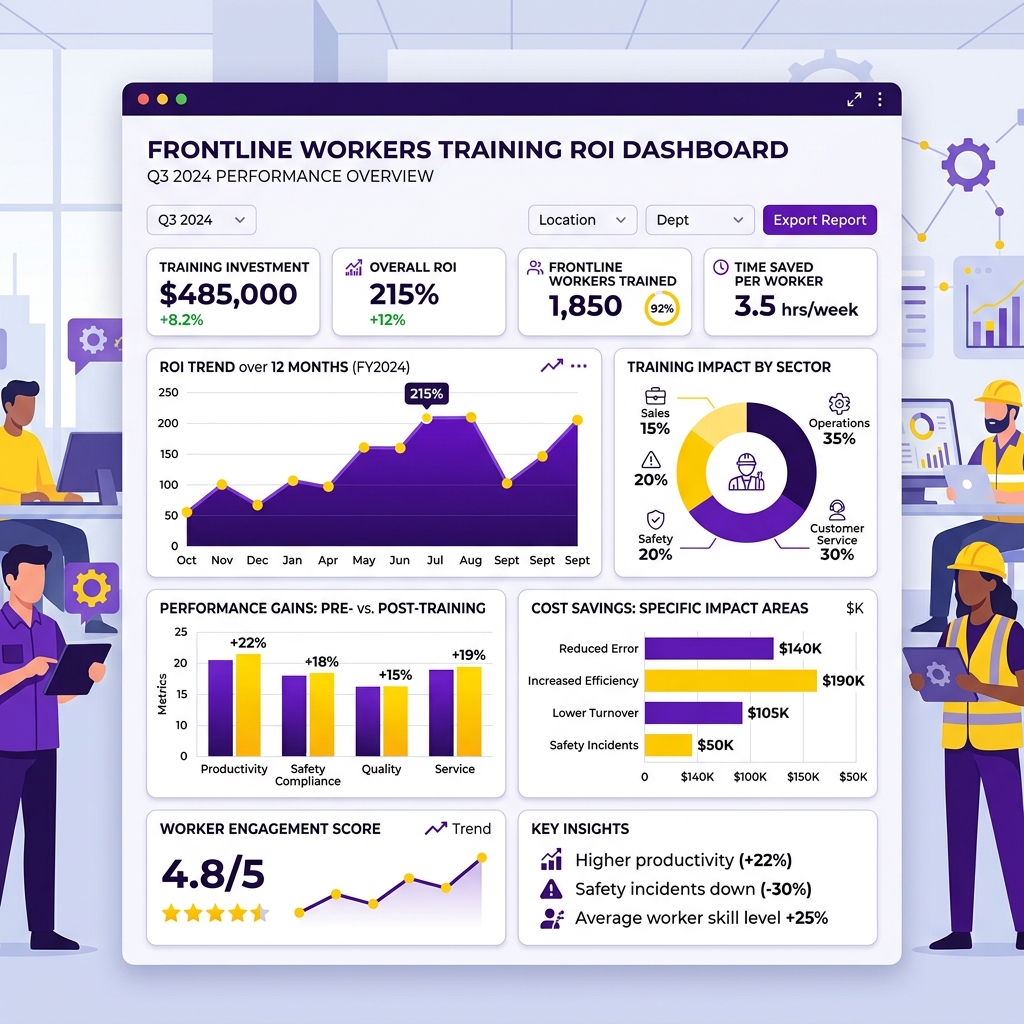
Key metrics: Safety incident rate, compliance audit scores, customer satisfaction, sales performance, attrition rate, onboarding time-to-productivity.
This is the level that earns L&D a seat at the executive table.
Related reading: Microlearning ROI: Proving the Business Impact of Bite-Sized Frontline Training
The Measurement Maturity Journey
Level 1 only → "Training is an admin function"
Levels 1-2 → "Training produces knowledgeable workers"
Levels 1-3 → "Training changes how people work"
Levels 1-4 → "Training drives business results"
Most frontline L&D teams are stuck at Level 1. Moving to Level 2 (adding comprehension verification) is the single highest-impact step - and it's now feasible at scale through conversational AI assessment.
The Bottom Line
The deployment problem has been solved - AI generates content in minutes, WhatsApp delivers it instantly. The new challenge is proving that training produces actual results.
The organisations that crack this measurement challenge will transform L&D from a cost centre to a strategic function.
Measure what matters - not just what's easy. Leap10x tracks the full training funnel: WhatsApp delivery → completion → quiz scores → spaced retention → conversational verification.
→ Start your free trial or book a measurement framework demo.