Microlearning ROI: Proving the Business Impact of Bite-Sized Frontline Training
Every L&D leader who's ever proposed a new training initiative has heard the same question from the CFO: "What's the return on this?"
It's a fair question. Training budgets compete with marketing, technology, and operations for limited resources. And historically, L&D has been one of the weakest functions at quantifying its impact. Course completion rates and learner satisfaction scores sound nice in a quarterly review, but they don't answer the question the business actually cares about: did this training make us money, save us money, or reduce our risk?
Microlearning - especially for frontline workforces - is uniquely positioned to demonstrate clear ROI because its outcomes are directly tied to operational metrics. When a retail associate completes a product training module and sells more the next day, that's traceable. When a factory operator finishes a safety refresher and the incident rate drops, that's measurable.
This article provides the framework, data points, and practical methodology for proving microlearning ROI to your stakeholders.
The Three Dimensions of Microlearning ROI
1. Cost Reduction (Spend Less)
Development costs drop dramatically. Learning expert Ray Jimenez, PhD, estimates that microlearning enables businesses to develop learning programmes up to 300% faster while cutting development costs in half. When AI generates micro-courses from existing SOPs in minutes rather than instructional designers building SCORM modules over weeks, the cost per training hour falls by an order of magnitude.
Delivery costs approach zero. A WhatsApp-delivered micro-module costs the same to send to 50 workers or 50,000 workers.
Translation costs collapse. Manual translation into five Indian languages might cost ₹2-5 lakhs and take weeks. AI auto-translation into 70+ languages happens in minutes at near-zero marginal cost.
2. Revenue Enhancement (Earn More)
Faster onboarding = faster productivity. Companies using microlearning for frontline onboarding report reducing time-to-productivity by 40-80%.
Better product knowledge = higher sales. Retail associates who receive regular micro-training on new products consistently outperform those relying on outdated training.
Improved customer experience = higher retention. Trained frontline workers deliver better service, driving customer loyalty and repeat revenue.
3. Risk Mitigation (Lose Less)
Compliance failures are expensive. Poor compliance training can lead to average error costs of approximately $62,000 per incident.
Safety incidents have direct costs. A single workplace injury can cost lakhs in medical expenses, compensation, equipment damage, and production downtime.
Attrition is the hidden cost killer. Companies lose an average of $13.5 million per 1,000 employees annually due to insufficient training.
Related reading: Reduce Frontline Attrition with Better Training: Data Guide
The Data That Makes the Business Case
- Completion rates: Microlearning modules see 80%+ completion rates versus 20-30% for traditional LMS courses among frontline workers.
- Engagement uplift: 85% of employees found well-designed microlearning more engaging than traditional training.
- Effectiveness advantage: Microlearning is 17% more effective than traditional methods.
- Speed of development: Microlearning content can be developed 300% faster than traditional e-learning. With AI content generation, the speed advantage is even greater.
- Knowledge retention: Gamified microlearning boosts knowledge retention by 15-20% versus traditional formats.
How to Measure Microlearning ROI (A Practical Framework)
Level 1 - Training Efficiency Metrics
- Completion rate: Target 80%+
- Time to completion: Benchmark 3-5 minutes per module
- Content creation time: Benchmark with AI: <10 minutes
- Cost per trained worker: Total cost divided by number of workers who completed training
Level 2 - Knowledge Metrics
- Quiz scores: Average assessment scores and pass rates per module
- Knowledge retention: Scores on follow-up assessments days or weeks after initial training
- Conversational assessment results: Percentage of workers who can articulate key concepts in their own words
Related reading: How to Assess 10,000 Frontline Workers Without a Single Test Paper (or App)
Level 3 - Behavioural Metrics
- Safety incident rate: Compare pre and post-training incident data
- Compliance audit scores: Track regulatory audit performance
- Customer feedback scores: Monitor CSAT or NPS changes
- Process adherence rate: Measure SOP compliance through quality audits
Level 4 - Business Impact Metrics
- Revenue per trained worker: Compare sales performance of trained vs. untrained cohorts
- Attrition rate changes: Track whether training correlates with reduced turnover
- Cost of non-compliance avoided: Calculate fines, penalties, or remediation costs prevented
- Onboarding cost reduction: Compare total onboarding costs pre and post-microlearning
Building the ROI Presentation for Leadership
Part 1 - The Current Cost of the Status Quo
Quantify what poor training currently costs your organisation: incident costs, revenue lost from poorly trained staff, compliance penalties, attrition costs.
Part 2 - The Pilot Results
Share concrete data from your microlearning pilot: completion rates, worker feedback, early operational improvements, cost comparison.
Part 3 - The Projected Impact at Scale
Extrapolate pilot results to the full workforce using conservative estimates. Under-promise and over-deliver beats the reverse.
The Bottom Line
The microlearning market is projected to grow from $2.96 billion in 2025 to $5.49 billion by 2030 precisely because organisations are measuring real returns and doubling down.
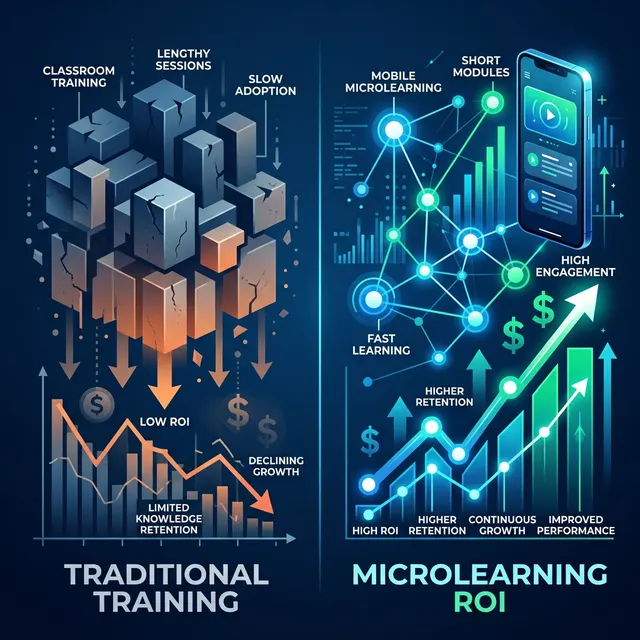
For frontline workforces, the ROI equation is especially compelling because the gap between traditional LMS performance (20-30% completion) and microlearning performance (85%+ completion) is so dramatic. You're not arguing for a marginal improvement - you're arguing for a fundamentally different outcome.
Related reading: How Investing in Workers Drives Business Growth
Want to see what 85%+ completion rates actually look like? Run a free Leap10x pilot with your frontline team and measure the difference yourself.
→ Start your free trial or book a 30-minute ROI consultation.