Multilingual Training for Frontline Workers | 70+ Languages
Quick answer
Create frontline training in Hindi, Tamil, Telugu, Kannada, and 70+ languages using AI. No translation agency. Deploy via WhatsApp in minutes.
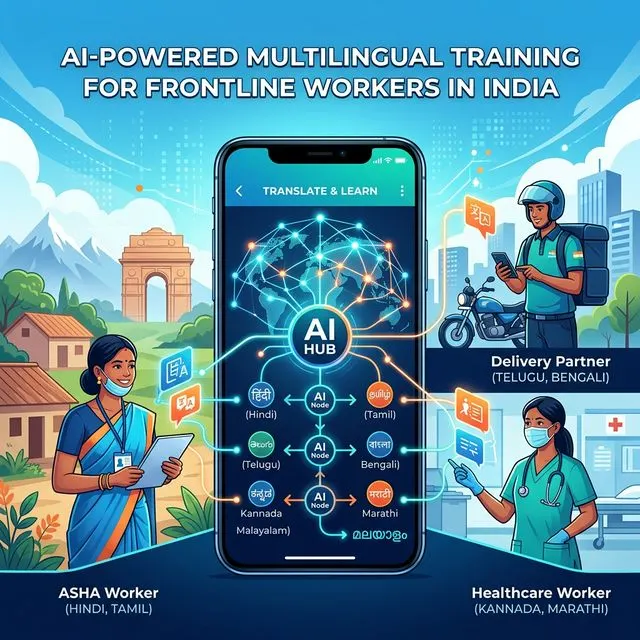
India has 22 official languages and over 19,500 dialects. Your factory floor in Tamil Nadu speaks Tamil. Your warehouse in Uttar Pradesh speaks Hindi or Bhojpuri. Your security team in Karnataka speaks Kannada. Your delivery fleet in West Bengal speaks Bengali.
But your training content? Probably only exists in English. Maybe Hindi.
This is the single biggest reason frontline training fails in India. When a worker receives safety training in a language they don't fully understand, the training becomes a checkbox exercise - completed but not absorbed. The worker signs a form. The company records a completion. And when something goes wrong on the floor, everyone discovers that "trained" didn't mean "understood."
Creating multilingual training for frontline workers used to mean hiring translation agencies, waiting weeks for each language, paying per word, and then manually formatting content for each version. For a 10-module safety course in 5 languages, you'd spend months and lakhs.
AI has changed this completely. Platforms like Leap10x can now generate and translate training content into 70+ languages in minutes - not months. This guide explains how it works, where it makes the biggest impact, and how companies like FlixBus and C&S Electric are using it.
The Language Problem No One Talks About
Here's what typically happens when a manufacturing company rolls out a new safety protocol:
- The safety team writes the SOP in English.
- It gets translated into Hindi (maybe).
- A trainer reads it to a classroom of workers, some of whom understand Hindi well, some partially, some barely.
- Everyone signs the attendance register.
- The company declares "100% training completion."
What actually happened: workers who were comfortable in Hindi understood 60-70% of the content. Workers from other language backgrounds caught maybe 30-40%. And the nuance - the specific PPE procedure, the exact sequence for lockout-tagout, the precise steps for emergency evacuation - got lost.
According to a 2026 analysis of e-learning failures in Indian companies, content available only in English creates a significant barrier for frontline workers, factory teams, and customer service staff in non-metropolitan areas. The recommendation is consistent: critical training should be available in at least 3-4 regional languages in addition to English.
Yet most companies don't do this. Not because they don't want to - but because the cost and time of translation make it impractical.
What Multilingual Training Looks Like When It Works
Effective multilingual training for frontline workers isn't just translation. It's localization - adapting the content so it feels native, not foreign.
Translation vs. Localization:
- Translation: Converting "Wear PPE before entering the production area" from English to Tamil, word by word.
- Localization: Rewording the instruction in Tamil using phrasing that's natural for a Tamil-speaking factory worker, with visual references to PPE types used at that specific plant.
Good multilingual training has these characteristics:
1. Language choice matches the worker, not the company. The worker doesn't choose which language to learn in - the system detects or assigns the appropriate language based on their location, profile, or the admin's configuration. A worker in Coimbatore automatically receives Tamil content. A worker in Nagpur receives Marathi.
2. Visual-first content reduces language dependence. For procedural training like machine operation or safety protocols, visual content - photos, illustrations, short demo videos - communicates more clearly than text in any language. The best multilingual training uses visuals as the primary medium and text as supporting context.
3. Quizzes in the worker's language. Assessment is where language gaps cause the most damage. A worker who understood the training in Tamil but is tested in Hindi will fail not because of knowledge but because of language. Quizzes must match the language of instruction.
4. Audio/video narration in regional languages. For workers with lower literacy levels - common among blue-collar and contract workers - audio narration in their native language dramatically improves comprehension. A 90-second video narrated in Bengali will be understood far better than a three-page document translated into Bengali.
How AI-Powered Multilingual Training Works
Here's the process for creating a safety training module in 5 languages using Leap10x:
Step 1: Create in one language (5-10 minutes) Upload your SOP document, PDF, or presentation. Or simply describe the training topic to the AI. Leap10x generates a structured microlearning module - cards, quizzes, and key takeaways.
Step 2: Translate with one click (2-3 minutes per language) Select the target languages. AI generates translated versions that aren't just word-for-word translations but contextually adapted content. Currently supported: Hindi, Tamil, Telugu, Kannada, Marathi, Bengali, Gujarati, Malayalam, Punjabi, Odia, and English - with more being added.
Step 3: Review and deploy (5 minutes) A language-fluent reviewer (often a site supervisor who speaks the language) does a quick review. Make any edits. Then deploy to workers via WhatsApp.
Total time: Under 30 minutes for 5 language versions of a training module.
Compare this to the traditional process: 2-3 weeks for translation agency turnaround, Rs 2-5 per word per language, separate formatting for each version, and no ability to make quick updates when the content changes.
Where Multilingual Training Makes the Biggest Impact
Manufacturing across multiple states. A single manufacturing company with plants in Gujarat, Maharashtra, Tamil Nadu, and Karnataka needs training in at least 4 languages. When Tata Electronics deploys safety training across its facilities, workers access content in their regional language through Leap10x - without waiting for translation agencies.
Facility management with multi-site operations. Facility management companies deploy housekeeping, security, and maintenance workers across client sites in different cities. Each city has a different primary language. A centralized training program that only works in English or Hindi leaves workers in South and East India underserved.
Logistics and delivery networks. FlixBus used Leap10x to train their drivers and hosts (conductors) across different regions in regional languages. The training was delivered directly via WhatsApp without any app installation or change management - reaching workers who would have been unreachable through English-only platforms.
BFSI field force. Insurance agents, collection agents, and bank correspondents in rural and semi-urban India need product training and compliance training in the language their customers speak. An agent selling crop insurance in Andhra Pradesh needs training in Telugu - not English.
The Cost Comparison
Traditional multilingual training:
- Translation agency: Rs 2-5 per word × 5,000 words per module × 5 languages = Rs 50,000-1,25,000 per module
- Turnaround time: 2-4 weeks per language
- Formatting and QA: Additional 1-2 weeks
- Updates when content changes: Repeat the entire process
AI-powered multilingual training (Leap10x):
- Content creation: Included in platform
- Translation: AI-generated in minutes, included in platform cost
- Turnaround time: Same day
- Updates: Edit once, re-translate with one click
One Leap10x customer reduced content creation time by 50% and content creation cost by 75% compared to their previous process - and that was before factoring in the multilingual advantage.
Getting Started with Multilingual Training
- Audit your current language coverage. Map your workforce by language. If you have workers in 5 states, you likely need content in at least 4-5 languages.
- Start with your highest-risk training. Safety and compliance training is where language gaps cause the most damage. Begin there.
- Pick your pilot languages. Choose the 2-3 languages that cover the largest percentage of your workforce beyond Hindi/English.
- Create one module and test. Use Leap10x to create a single safety module in multiple languages. Deploy to 50-100 workers. Compare completion rates and quiz scores across languages.
- Scale. Once you see the improvement in comprehension (you will), expand to all training content.
Book a demo to see AI-powered multilingual content creation in action.
FAQs
Q: How accurate is AI translation for technical training content?
- A: AI translation for Indian languages has improved dramatically. For training content - which uses practical, action-oriented language rather than literary prose - AI translation accuracy is high enough for deployment with a brief human review. Leap10x recommends having a language-fluent supervisor do a quick 5-minute review before publishing, especially for safety-critical content.
Q: Can I create content in languages that don't use the Latin script?
- A: Yes. Leap10x supports all major Indian scripts - Devanagari (Hindi, Marathi), Tamil script, Telugu script, Kannada script, Bengali script, Gujarati script, Malayalam script, and Gurmukhi (Punjabi). Content is rendered natively in the correct script.
Q: What if my workforce speaks a dialect that's different from the standard language?
- A: AI-generated content uses standard versions of each language that are widely understood across dialect groups. For highly specialized or region-specific terminology, you can edit the generated content to include local terms. This is still significantly faster than creating content from scratch in each dialect.
Q: Do workers need to select their language preference?
- A: No. Admins assign language at the user or group level. If you know your Chennai team speaks Tamil, you configure that once. Workers simply receive content in their language automatically - they don't need to navigate any settings.
Q: Can I mix languages within a single training program?
- A: Yes. Some companies deliver safety training in regional languages but keep brand-specific terminology in English. Leap10x supports this flexibility - you can choose which elements to translate and which to keep in the original language.
Internal Links:
- WhatsApp-Based Training for Employees: Complete 2026 Guide
- Compliance Training for Manufacturing Workers: 2026 Guide
- Retail Employee Training via WhatsApp
- How to Train Frontline Workers Without Disrupting Operations
- Manufacturing Training Solutions
- Safety & Compliance Training Use Case
- Employee Onboarding Microlearning
Frontline training
Training software built for deskless teams
Onboarding, SOPs, safety refreshers, and compliance evidence for workers with no corporate email and no company device — tracked by site, role, and shift.