Retail Employee Training via WhatsApp: Microlearning Guide
Quick answer
Train retail store associates 10x faster with WhatsApp-based microlearning. Product knowledge, customer service, and compliance - all on their phone.
Retail has a training problem that no amount of classroom sessions will fix.
Your store associates are the face of your brand. They're the ones who turn a browser into a buyer, who handle complaints that can destroy or save a customer relationship, and who execute every product launch at the shelf level. Yet in Indian retail, these associates turn over at rates exceeding 60% annually. Every quarter, you're training a fresh batch of people — and by the time they're competent, a significant portion have already left.
Meanwhile, product launches happen weekly. Seasonal collections change. Promotions rotate. Customer expectations rise. And your training system — if you have one — involves flying a trainer to each city, booking a conference room, and hoping associates remember what they learned three weeks later.
WhatsApp-based microlearning changes this equation. Instead of training events, you have a training habit. Instead of regional trainers, you have a platform. Instead of hoping associates remember, you have data showing exactly who knows what.
This guide covers how retail L&D heads and area managers can use WhatsApp-delivered microlearning to train store teams faster, cheaper, and more consistently.
The Retail Training Crisis
The numbers paint a clear picture of why traditional retail training can't keep up:
- Attrition exceeds 60% annually in Indian organized retail. By the time a new associate is fully trained (usually 4–6 weeks), there's a meaningful chance they won't be around for the next quarter. Your training system needs to handle constant onboarding, not occasional orientation sessions.
- Product knowledge gaps cost sales. When a customer asks about a feature, a material, or a comparison with a competing product, an associate who doesn't know the answer loses the sale. This happens every day, in every store, and it's invisible in your sales data — you just see lower conversion.
- Inconsistent customer experience across stores. Your flagship store in a metro city delivers a different experience than your store in a tier-2 town. The difference is usually training — or the lack of it. Area managers can't be in every store every day.
- Compliance requirements are growing. POSH training, food safety (for food retail), fire safety, anti-theft protocols — these aren't optional, and they need documentation for audits.
Why Traditional Retail Training Fails
Most retail training still follows a model designed for a different era:
- Classroom sessions require travel. Flying a trainer to 30 cities or pulling associates to a regional hub takes time and money. By the time you've trained everyone, product information has already changed.
- CBT (computer-based training) completion rates are below 30%. Retail associates don't sit at computers. They stand at counters, walk aisles, and interact with customers. An LMS portal they need to log into during their break doesn't get opened.
- One-size-fits-all content. A store associate selling electronics has different training needs than one selling apparel. But most training programs deliver the same generic modules to everyone.
- No reinforcement after the session. A single training session on customer service techniques creates awareness but doesn't build habits. Without reinforcement, the techniques aren't used, and the training investment is wasted.
The Microlearning Solution for Retail
WhatsApp-based microlearning solves each of these problems with a different structural approach:
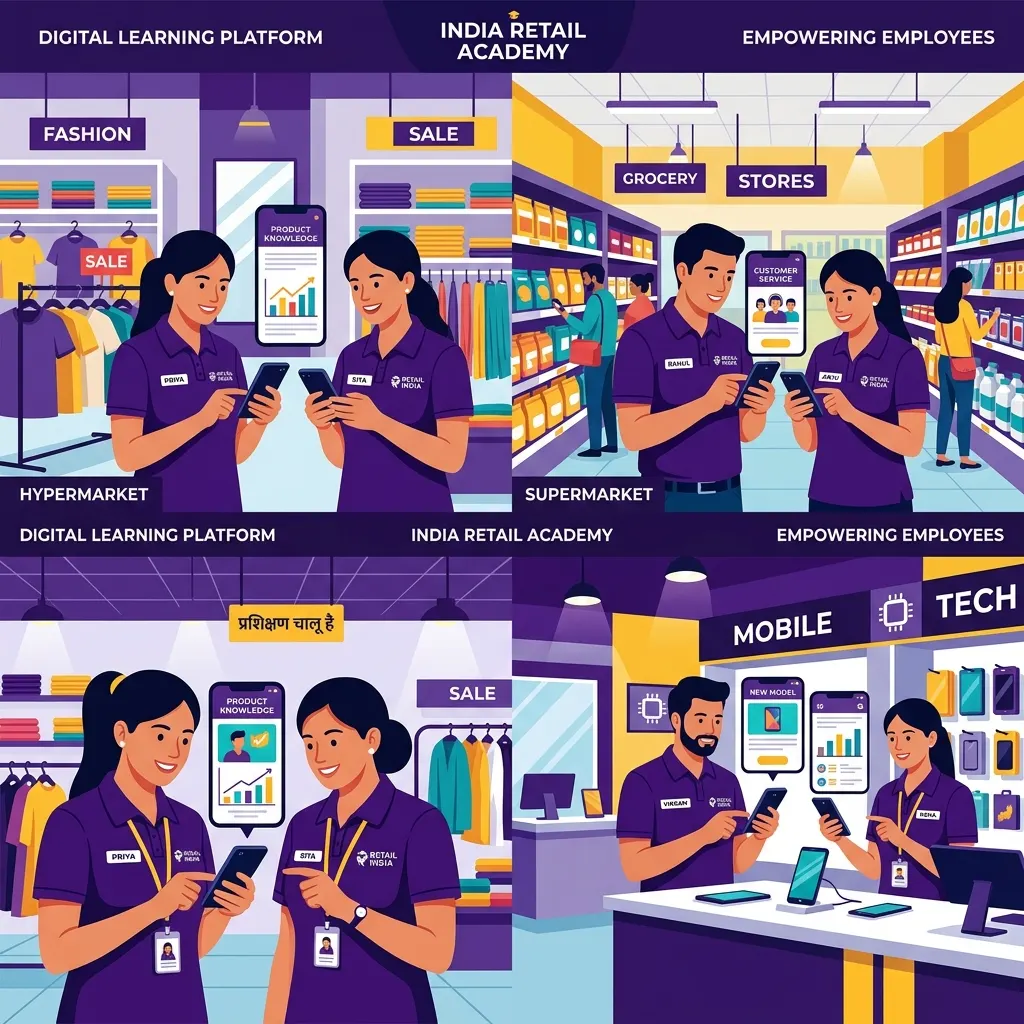
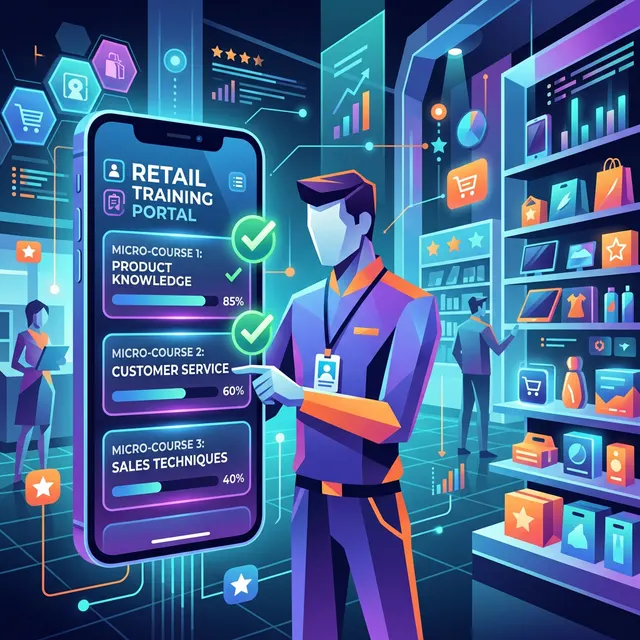
5-minute product knowledge updates instead of day-long sessions. When a new product launches, a 4-minute module with product features, key selling points, competitive comparison, and a quick quiz reaches every associate's WhatsApp before the store opens. No travel. No classroom. No production loss.
Visual SOPs for store standards. Visual merchandising guidelines, store layout standards, and display setup instructions delivered as annotated images on WhatsApp. Associates reference them on the floor while setting up — they don't need to remember what was covered in a training session three months ago.
Daily quizzes that build knowledge over time. Instead of cramming product knowledge into a single session, short daily quizzes on WhatsApp reinforce learning through spaced repetition. Associates get a 2-minute quiz during their morning briefing, and managers can see who's keeping up and who needs help.
Training pushed to personal devices. Associates receive modules on the same WhatsApp they use for personal and work communication. No app download, no login, no IT setup. Training reaches them whether they're at the flagship store or the newest outlet in a tier-3 city.
5 Retail Training Use Cases for WhatsApp Microlearning
1. Product launches
The old way: Regional trainer travels to 15 cities over 3 weeks. Associates in city 15 learn about the product 2 weeks after it's on the shelf.
The WhatsApp way: A 4-minute product module — features, benefits, common customer questions, pricing — hits every associate's WhatsApp the day before launch. A follow-up quiz on day 3 confirms who's ready and who needs a refresher.
2. Seasonal onboarding
The old way: During festival season or sale periods, temporary staff join for 2–3 months. Most receive a half-day orientation and then learn on the job — inconsistently.
The WhatsApp way: A 5-module onboarding kit (store basics, POS operations, customer greeting script, exchange/return policy, loss prevention basics) is sent to each new temp's WhatsApp on day one. They complete it over their first 3 days, alongside on-floor mentoring.
3. Customer service scripts and soft skills
The old way: A role-play session in a conference room. Associates nod along. Back on the floor, they revert to their existing habits.
The WhatsApp way: Daily micro-scenarios on WhatsApp: "A customer says the product is cheaper online. What do you say?" Associates select from response options and get immediate feedback. Over 4 weeks, they've practiced 20+ customer scenarios — more than any single role-play session could cover.
4. Compliance training (POSH, food safety, fire safety)
The old way: Annual classroom session. Sign-off sheet collected. Filed in a folder. Reviewed when an auditor asks.
The WhatsApp way: Compliance modules delivered monthly in short bursts. Quiz scores tracked per individual. Audit-ready reports with completion timestamps. Refreshers auto-sent to anyone who scored below the threshold.
5. Loss prevention and anti-theft awareness
The old way: Covered briefly during orientation. Rarely revisited. Shrinkage remains a persistent problem.
The WhatsApp way: Monthly 3-minute modules covering common theft methods, red flags to watch for, correct reporting procedures, and store closing checklists. Delivered to all associates including new hires, keeping awareness current.
Results: What WhatsApp-Based Retail Training Delivers
Companies using Leap10x for retail employee training see measurable improvements in several areas:
- Faster onboarding: New associates receive training from day one via WhatsApp, reducing the time from hire to floor-ready. No waiting for the next classroom session.
- Consistent knowledge across stores: Every associate — whether in Mumbai or Mysuru — receives the same training content, in their language, with the same quality standards.
- Trackable compliance: Every module completion, quiz score, and certification is documented and exportable. No more chasing paper sign-off sheets across 50 stores.
- Reduced training logistics cost: No trainer travel. No venue bookings. No printed materials. Training delivery cost drops dramatically when content goes directly to workers' phones.
See the retail training solution →
See the Retail Training Solution
If your retail training is stuck in the classroom-and-LMS model while your workforce turns over every 6 months, the math doesn't work. Training needs to be continuous, instant, and delivered where your associates already are — on WhatsApp.
Leap10x is built for exactly this. Product launches in 4 minutes. Onboarding on day one. Compliance tracking that auditors accept.
See pricing for your team size →
FAQs
- Q: How do you train retail employees effectively with high turnover?
A: Build a continuous onboarding system, not an annual training program. With platforms like Leap10x, new hires receive a structured onboarding kit on WhatsApp from day one — store basics, POS operations, customer service scripts, compliance modules — completed over their first 3–5 days. This means onboarding isn't dependent on scheduling classroom sessions or waiting for a trainer's availability. - Q: What is the best training platform for retail store associates?
A: It depends on your workforce. For Indian retail chains with high turnover, multilingual teams, and associates who don't use laptops, Leap10x is purpose-built — delivering training via WhatsApp in 70+ languages. For large North American retail with existing L&D infrastructure, platforms like Axonify or YOOBIC may be better suited. The best platform matches your associates' devices, languages, and daily habits. - Q: Can you deliver product launch training to all stores at once?
A: Yes. With WhatsApp-based microlearning, a product module can reach every associate across all stores simultaneously — the day before or the day of launch. No travel, no scheduling, no delays. Associates complete a 4-minute module with product features and a quiz, and you can see completion rates per store before doors open. - Q: How do you track retail training compliance across multiple stores?
A: Platforms like Leap10x track every module completion with timestamps and quiz scores, organized by store, region, and individual associate. This data is exportable for compliance audits. Area managers can see at a glance which stores have completed required training and which haven't — without calling each store manager to ask. - Q: Is WhatsApp-based training suitable for retail customer service skills?
A: Yes. WhatsApp-based micro-scenarios — where associates respond to simulated customer situations — build practical customer service skills through repeated practice. Instead of a single role-play session, associates practice 20+ scenarios over several weeks, with immediate feedback on each response. This spaced practice builds habits more effectively than one-time classroom exercises. - Manufacturing Training Solutions
- Safety & Compliance Training Use Case
- Employee Onboarding Microlearning