What Should a Plant HR Head Look For in a Frontline Training Platform? A 2026 Decision Guide for Multi-Shift Factories
Quick answer
A decision guide for plant HR heads: the eight questions that separate frontline training platforms that work on a three-shift factory floor from ones that don't.
The short answer
A plant HR head should look for a frontline training platform that reaches every shift and every contract worker on the phones they already carry, delivers three-to-five-minute modules in every language spoken on the floor, turns an existing SOP into a course fast enough to matter, produces timestamped per-worker completion and quiz evidence an auditor will accept, handles shared devices and QR access for stations where personal phones are not allowed, lets supervisors manage their own teams, and connects to the HRMS and any existing LMS rather than replacing them. WhatsApp-first platforms score well on the first six because there is nothing to install or log into; check the last two carefully.
Why the factory is the hardest case for any training platform
A plant combines every difficulty a training platform can face.
Three shifts, so any classroom session misses two-thirds of the workforce or runs three times. Contract labour that changes weekly, often not on the company HRMS at all, and legally your responsibility for safety induction regardless. Six or more languages on a single floor in many Indian plants. Workers who are not permitted to carry personal phones in some zones. Statutory training under the Factories Act, the OSH Code, and sector rules, with inspectors and buyer auditors who want evidence per worker. And a production line that does not stop so that someone can attend a two-hour course.
Roughly 80% of the world's workers are deskless; the factory floor is the purest version. The Leap10x home page puts the LMS problem bluntly: you paid for an LMS, your workers never log in. Axonify's Deskless Report found only 39% of frontline employees rate workplace communication as very helpful, and that figure is not better in manufacturing.
So the decision is not "which LMS has the most features". It is "which platform gets a three-minute lockout-tagout refresher to 1,400 operators across three shifts, in Hindi, Odia and Bengali, with proof, by Friday".
Eight questions, in the order they will bite you
1. Does it reach the C shift?
The night shift is where training programmes go to die. Trainers are asleep, supervisors are thin, and anything that requires a scheduled session gets skipped. Our night shift blind spot piece covers the wider problem.
What to check: can training be sent to a worker's phone at the start of their shift, whenever that is, and completed in the canteen or at the bus stop? Does the platform schedule by shift roster? Does completion tracking split by shift so you can see that A shift is at 92% and C shift at 41% before the audit does?
WhatsApp delivery answers the first part by default: the message arrives when scheduled, the worker opens it when free. Ask about the roster scheduling and shift-level reporting specifically.
2. Does it reach contract labour who are not in my HRMS?
Most plants have a permanent workforce on the HRMS and a contract workforce on a contractor's payroll. The contract workers change often, arrive at the gate on Monday morning, and must be inducted before they touch anything. Their data is not in your system.
What to check: can a site supervisor or security office add a worker by phone number on the spot, assign the induction, and see completion within the hour? Can completion be tied to a gate pass? Can the contractor's supervisor be given a view of their own workers only?
Any platform that requires an HRMS record or an IT-provisioned login before training can start fails this test. Our contractor safety induction guide describes the pattern that works: supervisor enrols by number, induction arrives on WhatsApp or via QR at the gate, pass issued on completion.
3. Does it work in the six languages on my floor?
Translation on the box is not the question. The questions are: is translation one click or a services ticket; does it cover the languages your workers actually speak (Odia, Assamese, Bhojpuri are not always on the list); does it narrate audio in those languages for workers who read slowly; and can a worker send a question back in their language and get an answer?
Leap10x generates and translates content in 70+ languages including Hindi, Tamil, Telugu, Kannada, Marathi, Bengali, Gujarati, Malayalam, Punjabi and Odia, with text-to-speech narration; the Assist knowledge assistant takes voice-note questions in regional languages and replies in kind. Our guide to multilingual training in Indian manufacturing has more detail. Test with your two least-common languages, not Hindi.
4. Can I turn an SOP into training before the next shift starts?
Plants change. A machine is modified, a procedure updated, an incident triggers a new control. The training has to follow within hours, not after a two-week instructional-design cycle.
What to check: upload the SOP PDF (with its tables and diagrams), get a short course with a quiz, translate, send. Time it in the demo with one of your own SOPs. Leap10x's AI course generator does this from PDFs, PowerPoints, documents and links; customers report creating a module in under ten minutes. Our piece on AI-generated SOP training in manufacturing shows what good output looks like and where to check it.
5. Will it survive the audit?
Buyer audits (for garment, electronics, auto components), ISO surveillance, Factories Act inspections and internal EHS audits all ask the same question in different forms: show me that this worker was trained on this, when, and that they understood it.
What to check: per-worker records with timestamps for delivery, completion and quiz score; certificates generated on passing; reports filterable by site, shift, contractor and topic; export to Excel and PDF; records that cannot be edited after the fact. Quiz evidence is stronger than a completion tick, and auditors increasingly know it.
Leap10x logs every send, open, completion and quiz response with a timestamp, generates certificates automatically, and exports reports in one click; Enterprise adds custom reports, API export and ESG compliance reports. The EHS guide to proving training completion without an LMS goes into what auditors accept.
6. Does it work without a personal phone at the station?
Some zones prohibit personal phones: clean rooms, hazardous areas, certain assembly lines. Some workers do not own a smartphone. Neither should exclude them from training.
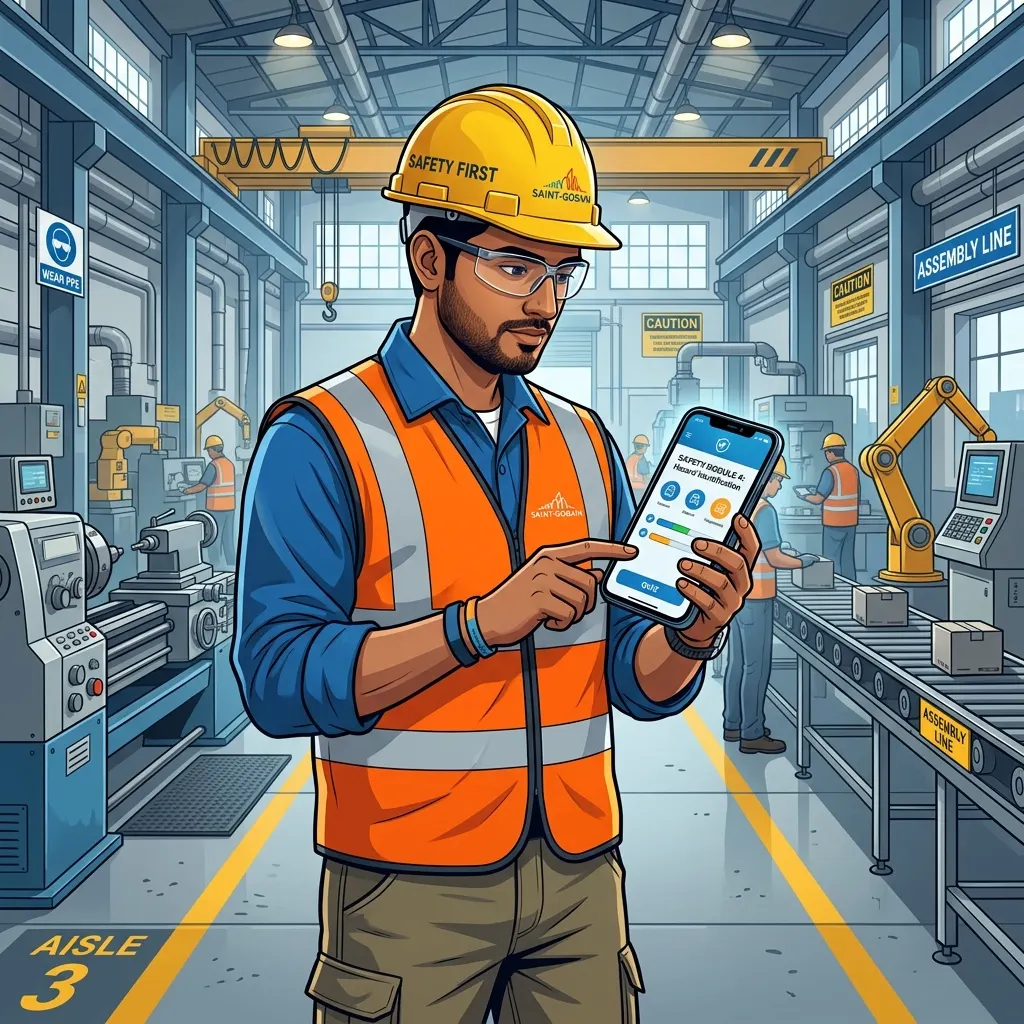
What to check: QR codes at the station or in the canteen that open the module on any device; shared tablets or a supervisor's phone where each worker still authenticates individually; an audio-only path. Blue Star's factory workers open compliance courses via WhatsApp or a QR code on the floor without installing another app; the QR path is what makes phone-restricted zones workable. Our guide to training workers who share a phone covers shared-device design.
7. Can supervisors run it without calling HR?
A plant HR team of three cannot manage training for 2,000 workers. Supervisors have to own their teams: see who is outstanding, nudge them, add new joiners, mark practical sign-offs.
What to check: role-based access that gives a supervisor their team and nothing else; a daily "who is outstanding" list on their phone; the ability to add a worker by number; automated reminders so the supervisor is not the reminder. If the platform needs a laptop and an admin login for any of this, supervisors will not use it. Our span-of-control piece is about why this matters more in plants than anywhere.
8. Does it replace my LMS or sit beside it?
Most plants have a corporate LMS that head office uses and the floor does not. Ripping it out is politically expensive and often unnecessary.
What to check: can the frontline platform connect to the LMS so completions appear in one place; can it sync learners from the HRMS (Leap10x integrates with SAP SuccessFactors, Darwinbox and Keka, with API and webhooks for others); can head-office staff stay on the LMS while the floor moves to WhatsApp? The LMS vs LXP vs Training OS piece frames the architecture; when WhatsApp training is the wrong choice is honest about the programmes that should stay in the LMS or the classroom, such as hands-on equipment certification.
The programmes to start with
Do not start with "everything". Start with the three programmes where the gap between requirement and reality is widest.
Contractor safety induction. Highest legal exposure, highest churn, most often done with a signature sheet. Move it to phone-number enrolment at the gate, a 10–15 minute WhatsApp or QR induction in the worker's language, quiz, certificate, gate pass. Lockout-tagout training and fire safety are natural follow-ons.
Toolbox talks and safety refreshers. Weekly, every shift, every language, with a two-question check. Our 30 toolbox talk topics with digital delivery is the template.
SOP changes. Every procedure change becomes a three-minute module the same day, pushed to affected roles, with completion tracked. This is where the AI authoring pays for itself and where SOP adherence actually improves.
Then expand: 5S, skill matrix maintenance, behaviour-based safety observations, onboarding journeys for permanent hires.
A 60-day plant rollout
Days 1–10: One programme, one shift, one site. Pick contractor induction. Export the current induction PPT, generate the course, translate into the floor's languages, review with the EHS head. Enrol one shift's contractors by phone number at the gate. Measure time-to-complete and quiz scores.
Days 11–20: All shifts, same site. Add the roster schedule. Give supervisors their team view. Add QR at the gate for workers without WhatsApp. Compare shift-level completion.
Days 21–40: Add toolbox talks and SOP changes. Weekly cadence. Train two supervisors per shift to add workers and read the outstanding list.
Days 41–60: Second site, HRMS sync, audit dry run. Connect the HRMS so permanent hires enrol automatically. Pull the report an auditor would ask for and check it against a sample of workers in person.
Customer-reported outcomes for this kind of rollout include compliance training reaching 2,000 warehouse workers in three days against an estimated three months on the previous LMS, and onboarding time cut by 80% at a Tier-1 manufacturer. Treat those as the ambition, and measure your own.
Red flags in a vendor demo
A polished demo is designed to hide the eight questions above. Watch for these.
The demo learner has an email address. Ask the presenter to enrol a learner using only a name and a phone number, live, and send them a module. If that requires a workaround, the platform was built for offices.
The demo runs on the presenter's laptop. Ask to see the learner experience on a phone, ideally an older Android, over mobile data. Then ask to see it on a second phone with a different learner, to confirm records are individual.
"Translation is available." Ask them to translate the demo module into Odia and Bengali now, and play the audio. If the answer is "we send that to our services team", budget for the services team.
The SOP they convert is their own. Hand them yours: the ugliest PDF you have, with tables. Time the conversion and check the quiz it generates.
The completion report is a summary. Ask to see one worker's full record: every module, version, timestamp, score, certificate. Then ask to filter site-level completion by shift and by contractor. Then ask whether any of it can be edited afterwards.
"Supervisors can use the admin portal." Ask to see what a supervisor sees on their phone. If it is the same admin portal with fewer buttons, supervisors will not use it.
Integration is "on the roadmap". Ask which HRMS connectors exist today, which customers use them, and whether integration work is included or scoped separately.
No mention of what it does not do. A vendor who cannot name a training programme their platform is wrong for has not thought hard about the ones it is right for. Leap10x, for what it is worth, is not the tool for hands-on equipment certification or forty-hour courses, and says so; when WhatsApp training is the wrong choice is the long version.
Bring a supervisor and a shift worker to the demo. Their reaction to the phone experience is worth more than the HR team's reaction to the dashboard.
FAQ
Our IT team says personal phones are a security risk.
Training content goes to the worker; responses come back to the platform; nothing sensitive sits on the device beyond the message. Check the platform's certifications (Leap10x: ISO 27001:2022, AES-256 at rest, TLS 1.2+ in transit, no customer content used to train public AI models) and use QR/shared devices in zones where personal phones are prohibited anyway.
Can hands-on training like forklift operation be done this way?
The theory and refreshers, yes. The practical assessment, no; it needs an assessor with the equipment. The platform should capture the assessor's sign-off and schedule re-certification.
How do we handle workers who leave and come back?
Identity is the phone number. History persists; re-activate and the record is intact.
What about workers who read slowly?
Audio narration in their language, video, and voice-note responses. See audio-first learning.
Related reading
- Contractor Safety Induction Training
- Compliance Training for Manufacturing Workers
- Multilingual Training in Indian Manufacturing
- Safety Training Requirements Under the Factories Act and OSH Code
- Skill Matrix for Factory Workers
- The Night Shift Blind Spot
- Leap10x for Manufacturing
CTA: Bring your contractor induction deck and the list of languages on your floor. In 30 minutes we'll turn the deck into a live WhatsApp induction in those languages and send it to your phone. Book a demo.
Frontline training
Training software built for deskless teams
Onboarding, SOPs, safety refreshers, and compliance evidence for workers with no corporate email and no company device — tracked by site, role, and shift.