QSR Training in 2026: How Quick-Service Restaurants Use WhatsApp to Cut Training Time by 60%
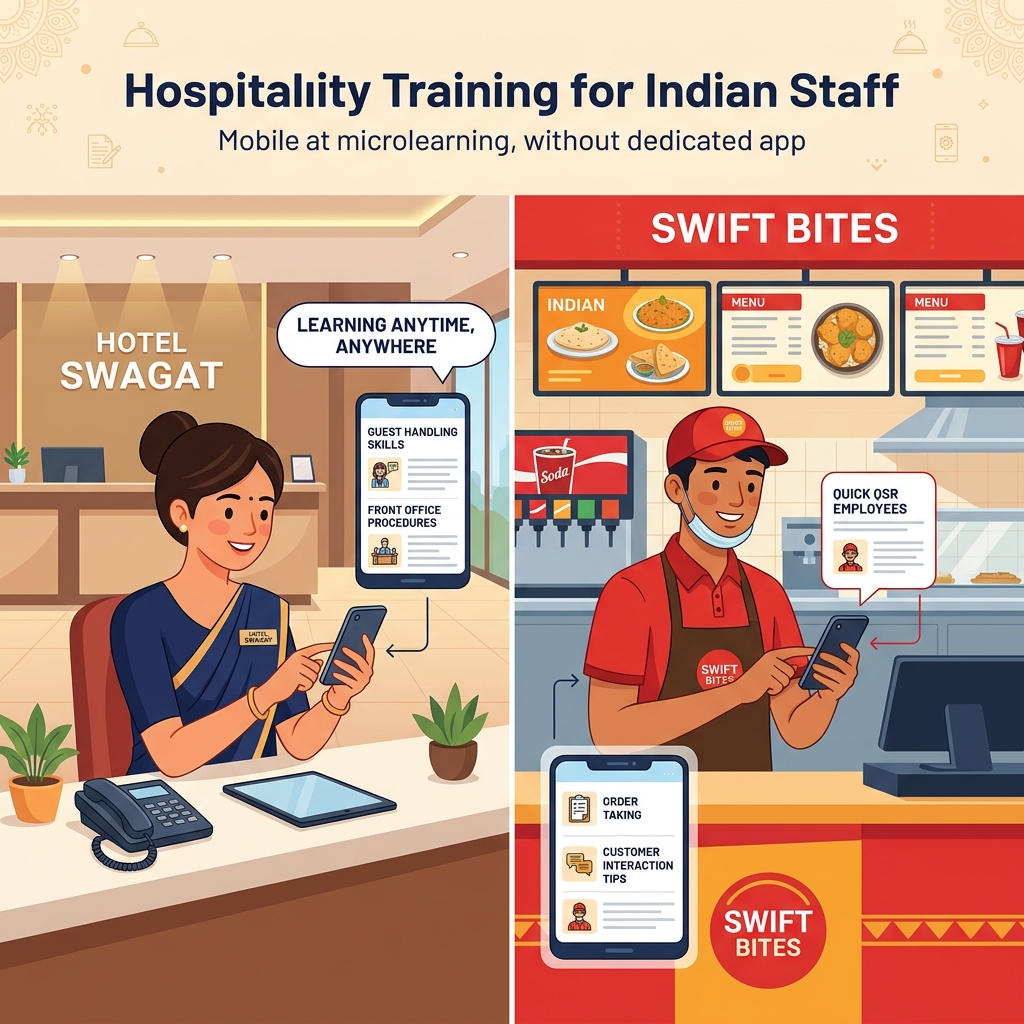
Quick-service restaurants operate in a world of razor-thin margins, brutal turnover, and relentless customer expectations. When your average employee tenure is measured in months rather than years, and your turnover rate exceeds 130% annually, your training programme isn't just important — it's the only thing standing between consistent operations and chaos.
Yet most QSR training is stuck in a model that was designed for a workforce that no longer exists. Long orientation videos. Thick procedure manuals. Classroom sessions that pull workers off the line during prep hours. Training apps that Gen Z workers download, open once, and delete to free up storage.
The numbers tell the story: 39.6% of restaurant workers are under 25. These are digital natives who communicate through chat, learn through short-form content, and have zero patience for clunky corporate platforms. They check WhatsApp 25 times a day. They haven't opened your training app since onboarding.
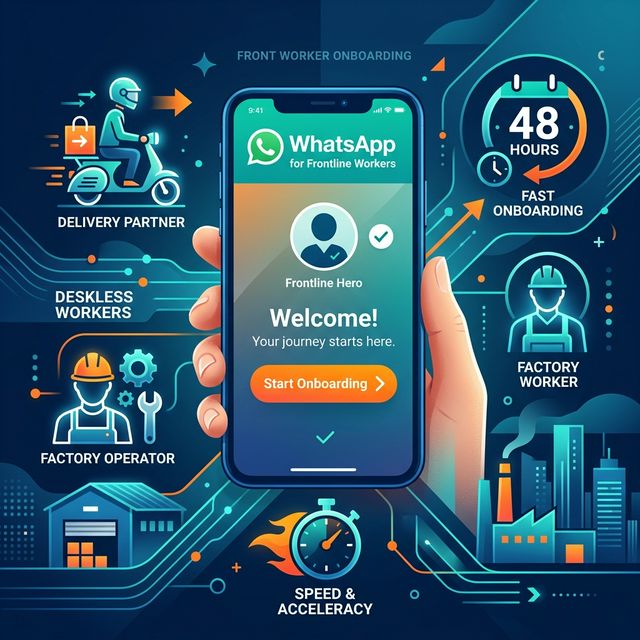
Forward-thinking QSR operators are meeting this workforce where they already are — on WhatsApp — and the results are transforming how quickly they can get new hires productive, how consistently they maintain food safety standards, and how much they spend on training per employee.
The QSR Training Challenge
Quick-service restaurants face training challenges that other industries simply don't:
Extreme speed requirements. A new hire at a QSR needs to be functional within days. During peak hours, a single untrained worker on the line can slow the entire operation.
Constant menu changes. Limited-time offers, seasonal items, and menu refreshes happen monthly or even weekly. Every change requires every worker to understand new products and preparation methods.
Multi-station complexity. A single QSR worker might need to operate the fryer, assemble burgers, manage the drive-through, and run the POS system — sometimes in the same shift.
Franchise consistency. For franchised operations, training consistency across independently owned locations is a perpetual battle.
Language diversity. QSR workforces are among the most linguistically diverse in any industry.
The WhatsApp QSR Training Model
Here's how WhatsApp-based training addresses each of these challenges:
Pillar 1: Rapid Onboarding (Days 1-3)
Traditional QSR onboarding means watching a 2-hour orientation video and hoping it sticks. WhatsApp onboarding delivers structured micro-modules directly to the new hire's phone — covering essentials before they even touch the line.
Total time invested by the worker: approximately 45 minutes across 3 days, completed in 5-minute segments. Total time invested by trainers: close to zero for content delivery, freeing them to focus on hands-on coaching.
Pillar 2: Food Safety Compliance (Ongoing)
WhatsApp food safety training makes compliance continuous:
- Daily micro-checks: Temperature verification questions at shift start
- Weekly focus modules: One food safety area per week
- Monthly compliance assessment: Documented proof of ongoing training
- Instant protocol updates: Updated training reaches every worker within hours
Pillar 3: Menu Knowledge and LTOs (Campaign-Driven)
Every limited-time offer or menu change is a training event. WhatsApp delivers menu training with speed and precision — LTO launch modules covering product description, ingredients, allergens, preparation steps, and selling phrases — delivered 3-5 days before launch.
Pillar 4: Operational Standards (Station-Based)
Each QSR station has its own procedures. WhatsApp training delivers station-specific content based on the worker's current assignment — including procedure updates when preparation methods change.
Pillar 5: Customer Service and Drive-Through Excellence
Scenario-based training for common QSR complaints, drive-through communication, and natural upselling techniques.
The 60% Training Time Reduction
WhatsApp cuts training time through three mechanisms:
- Elimination of classroom logistics — no scheduling sessions, booking rooms, or pulling workers off the line
- Pre-training before hands-on — workers arrive at station training already knowing the basics, so a 30-minute hands-on session replaces what used to take 90 minutes
- Continuous reinforcement instead of retraining — targeted 2-minute quizzes refresh what a 2-hour classroom would re-teach
Franchise-Wide Consistency
For franchised QSR brands, WhatsApp training provides something nearly impossible through traditional methods: uniform training quality across every independently owned location. Corporate creates the training content once. Every franchisee's workers receive identical modules. Franchise compliance teams monitor completion and scores by location automatically.
Getting Started
- Start with food safety — universally required, easily measurable, compliance documentation alone justifies the investment
- Pilot at 3-5 locations — compare completion rates, quiz scores, and food safety audit results
- Expand to onboarding — measure time-to-productivity and 30-day retention
- Add menu and operations training — build LTO training templates
- Scale to all locations — with location-level dashboards and automated compliance reporting
The QSR industry's training problem isn't going to be solved by better classroom sessions or shinier training apps. It's going to be solved by delivering the right content to the right worker at the right moment through a channel they actually use.
Train your QSR teams faster, cheaper, and more consistently. Leap10x delivers restaurant training through WhatsApp — onboarding, food safety, menu knowledge, and operations — across every location, in every language. Start your free pilot today.