Shift-Based Training: How to Upskill Workers Who Only Have 5 Minutes Between Customers
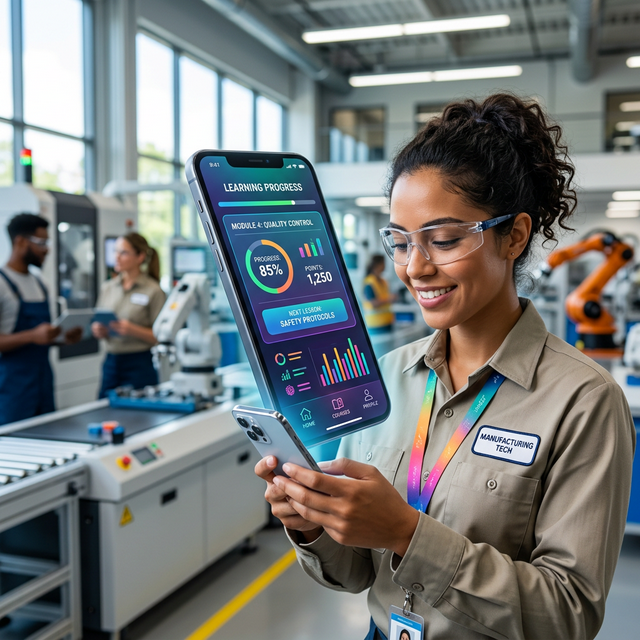
A retail associate finishes serving a customer. The next one hasn't approached yet. There's a 4-minute window before the rush hits again.
In that window, she could scroll Instagram. She could chat with a colleague. Or she could complete a 3-minute training module on her phone that teaches her how to handle the new return policy rolling out next week.
Which option she chooses depends entirely on whether your training programme was designed for her reality or for someone else's.
Most training programmes were designed for someone else's. They assume dedicated learning time, classroom availability, and the ability to focus for 30-60 minutes. For workers whose days are measured in 5-minute intervals between customers, patients, orders, and tasks, these assumptions aren't just wrong — they're disqualifying.
80% of frontline workers say their schedules leave little time for training. Yet 91% want learning to be accessible directly on their smartphones. The desire is there. The time is there — scattered in tiny fragments throughout the day. What's missing is training designed to fit those fragments.
This is shift-based training: learning that's built for the 5-minute window, not the 50-minute workshop.
The Time Reality of Frontline Workers
Understanding when and how frontline workers can learn requires mapping their actual day — not the idealised version that training departments imagine.
A retail associate's available windows:
- Before the store opens: 5-10 minutes during setup
- Between customers: 2-5 minutes (unpredictable)
- During break: 15-20 minutes (but they need to actually rest)
A restaurant server's available windows:
- Before service: 5-10 minutes during pre-shift prep
- During break: 15-20 minutes (legally mandated rest)
- After service: 5-10 minutes during side work
A warehouse worker's available windows:
- Before shift: 5-10 minutes during huddle
- Between tasks: 1-3 minutes
- During break: 15-20 minutes
The common thread: available time exists, but it comes in fragments of 2-10 minutes, at unpredictable intervals, always in competition with rest, socialising, and personal phone use. Training designed for these windows must be absurdly concise, immediately engaging, and obviously valuable — or it won't happen.
The Principles of Shift-Based Training Design
Principle 1: One Module = One Idea = One Action
Every training module should teach exactly one thing and connect it to exactly one action the worker can take on their next task. Instead of a 15-minute module covering "Customer Service Excellence," a 3-minute module that teaches one specific technique the worker can try immediately.
Principle 2: Question First, Information Second
Start every module with a question, not a lecture. Questions activate curiosity and create a knowledge gap that the learner wants to fill. The question-first approach produces dramatically better retention because the worker's brain is actively engaged before receiving information.
Principle 3: Make It Feel Like a Message, Not a Module
Frontline workers don't want to "complete training." They do want to learn things that help them do their job better. WhatsApp's chat format naturally supports conversational learning — training that reads like a message from a knowledgeable colleague lands completely differently than corporate compliance requirements.
Principle 4: Respect the Recovery Window
Frontline work is mentally and physically demanding. Break time is recovery time. Design shift-based training for voluntary completion during natural transition moments, not for mandatory completion during breaks.
Principle 5: Make Completion Visible and Rewarding
In a 5-minute window, a worker needs to feel that completing the module was worth their time. Instant feedback, progress visibility, practical payoff, and social recognition all drive engagement.
Shift-Based Training in Practice
Retail: Push one product knowledge module per day to floor associates, arriving 15 minutes before store opening. Associates review during setup, arriving with freshly reinforced knowledge about the featured item.
Food Service: Deliver a single food safety question to every kitchen worker at shift start. Over a month, workers answer 20+ safety questions covering every critical protocol.
Manufacturing: Send a safety micro-module during the 10-minute handover gap between shifts, specific to the equipment on that shift's production line.
Healthcare: Send brief infection control reminders to nursing staff between patient rounds, covering one specific protocol each time.
Building Your Shift-Based Programme
- Map Available Windows — survey frontline workers and supervisors to identify when genuine micro-learning windows exist
- Design Micro-Modules (3 Minutes Max) — take existing content and break it into the smallest possible standalone units
- Schedule for Context — deliver modules at the moment they're most relevant
- Make It Optional but Irresistible — progress badges, team competition, practical tips that help workers do their job better
- Measure and Iterate — track completion by time of day, day of week, and module topic
The 5-Minute Advantage
Every 5-minute window currently wasted on idle scrolling is a potential training moment. Over a month, twenty 3-minute modules equal a full hour of training — delivered without pulling a single worker off the floor, without scheduling a single classroom, and without losing a single minute of productivity.
Your frontline workers have the time. They have the device. They have the desire to learn. They just don't have training that fits their reality.
Training that fits between customers. Leap10x delivers 3-minute microlearning modules through WhatsApp — designed for the shift-based reality of frontline workers. No classrooms. No long sessions. Just training that works in the windows your workers actually have. Start your free pilot today.