Ramp to Proficiency: How Microlearning Cuts New Hire Time-to-Productivity
Quick answer
Every day a new hire spends in the "learning phase" is a day they are consuming resources without contributing at full capacity.
Every day a new hire spends in the "learning phase" is a day they are consuming resources without contributing at full capacity. Ramp to proficiency - the time it takes a new employee to perform their role independently - is one of the most important metrics in frontline operations.
What Is Ramp to Proficiency (RTP)?
Ramp to proficiency refers to the journey from a new hire's first day to the point where they perform their role at the expected standard without continuous supervision. Some organizations call it "time to productivity" or "ramp to professionalism" - the terminology varies, but the concept is the same.
For frontline roles, RTP typically ranges from 2 weeks (for simple repetitive tasks) to 90 days (for complex customer-facing or technical roles).
Why Traditional Onboarding Extends RTP Unnecessarily
Information overload. Cramming everything into a 3-day orientation overwhelms new hires. They retain maybe 20%.
Delayed hands-on experience. Classroom training before any practical work creates a gap between knowledge and application.
One-size-fits-all pacing. Experienced hires sit through the same program as complete newcomers.
No reinforcement mechanism. After onboarding ends, the training stops. Knowledge decays rapidly.
How Microlearning Compresses Ramp to Proficiency
Day-One Access
Microlearning starts the moment someone is hired - not when the next training class is scheduled. A WhatsApp message on Day 0 with the first micro-module means learning begins before the worker even arrives.
Structured Learning Journeys
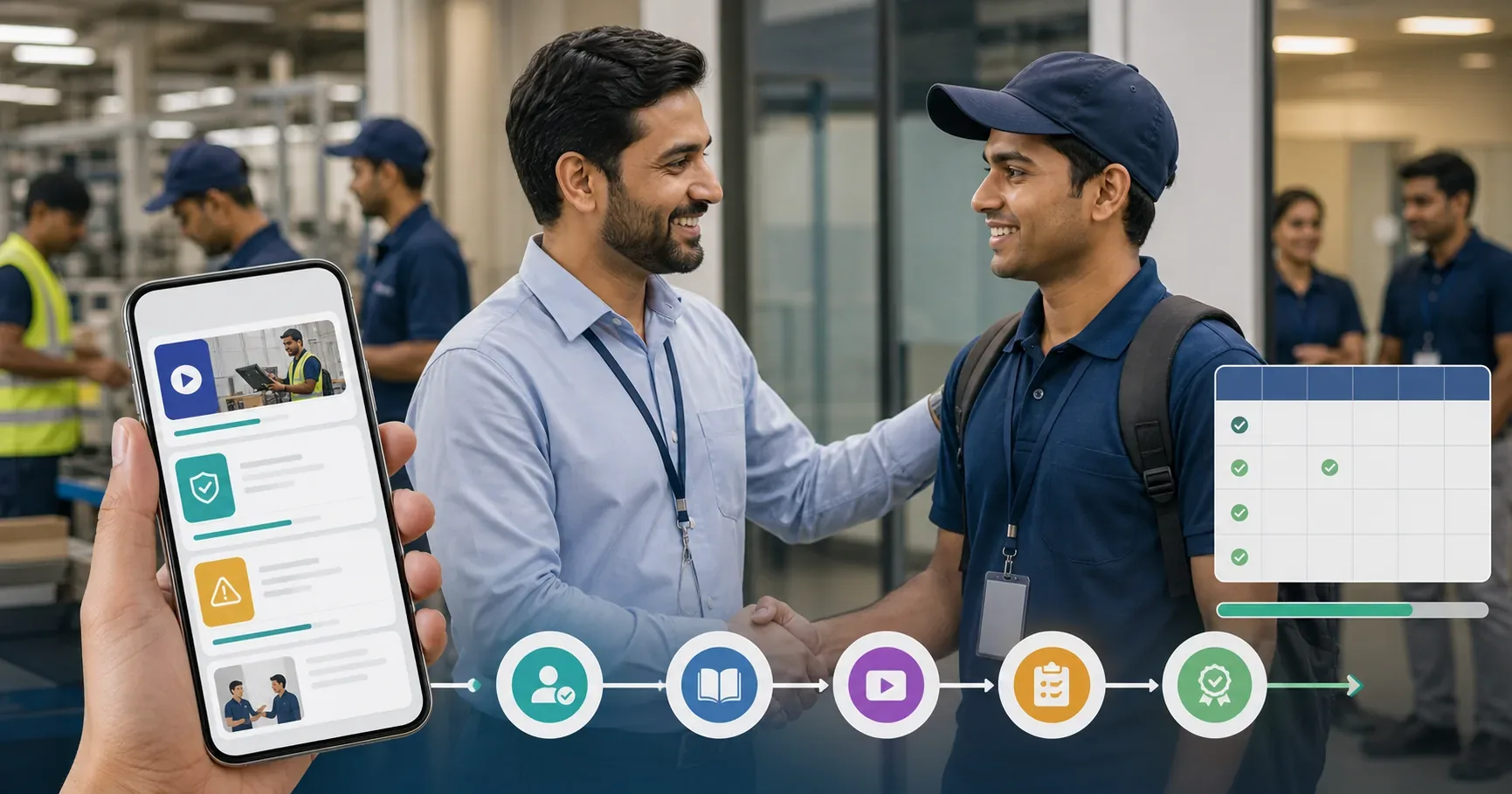
Instead of one massive orientation, microlearning delivers knowledge in structured sequences: essential safety on Day 1, role basics on Days 2-3, key procedures on Days 4-7.
Spaced Reinforcement
Critical information is re-tested at intervals: Day 3, Day 7, Day 14, Day 30. This combats the forgetting curve and builds long-term retention.
Parallel Learning and Working
Instead of "train then work," microlearning enables "learn while working." New hires start productive work on Day 1 and receive progressive training alongside their actual responsibilities.
Measuring Ramp to Proficiency
| Milestone | Metric | Target |
|---|---|---|
| Basic orientation complete | Module completion rate | Day 1-3 |
| Safety certified | Quiz score ≥ 80% | Week 1 |
| Core procedures demonstrated | Supervisor sign-off | Week 2 |
| Independent task completion | Error rate below threshold | Week 3-4 |
| Full proficiency | Performance meets standard | Week 4-8 |
Case Study
A mobility company used microlearning-based onboarding to achieve: 23% improvement in onboarding time, 10% reduction in onboarding cost, 3% improvement in customer satisfaction.
Accelerate Ramp-to-Proficiency with Leap10x
Leap10x automates frontline onboarding via WhatsApp. New hires receive structured micro-modules from Day 1, in their preferred language, with zero technology barriers. Ramp up new workers 2x faster.
Cut your time-to-proficiency with Leap10x →
The faster your new hires become productive, the faster your investment in them pays off.
Microlearning
Turn your SOPs into 3-minute modules
Upload a PDF, deck, or video and Leap10x's AI builds micro-modules with quizzes and spaced-repetition schedules — delivered where your frontline already is.