WhatsApp Onboarding for Frontline Workers | 48-Hour Guide
Quick answer
Onboard new frontline hires via WhatsApp in under 48 hours. No app, no classroom. Structured onboarding that cuts ramp-up time by 23% with real examples.
Only 12% of employees say their company does onboarding well, according to Gallup. For frontline workers - delivery partners, factory operators, security guards, retail associates - that number is likely far worse.
Here's why: most onboarding programs were designed for people who sit at desks. They assume new hires have a company laptop, an email address, and a calendar invite for orientation day. Frontline workers have none of these. They show up at a site, get a 30-minute verbal briefing, and are expected to figure out the rest on their own.
The cost of this approach is brutal. Research from SHRM shows 20% of all turnover happens within the first 45 days. For hourly and frontline workers, that number is even higher - some industries see 43% of new hires leaving within 90 days. Every one of those exits represents wasted recruiting cost, lost productivity, and a team scrambling to cover gaps.
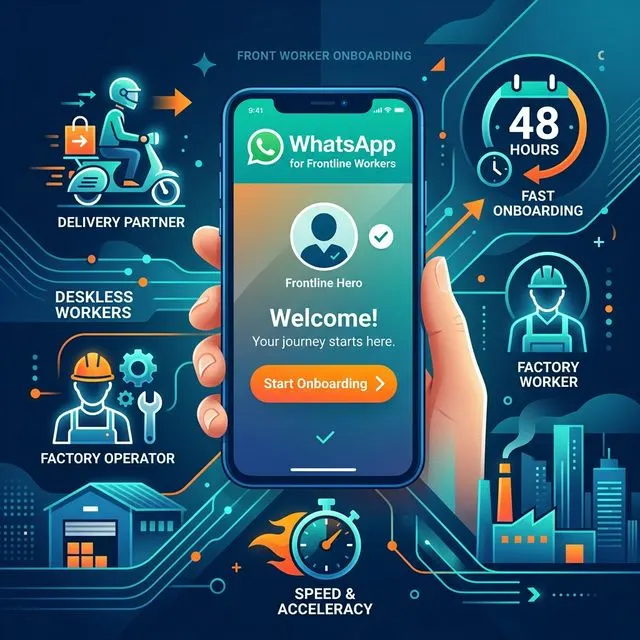
WhatsApp onboarding for frontline workers solves this by delivering structured, bite-sized induction training through the one app every worker already uses. No classroom required. No app to download. And the new hire can start before they even arrive on site.
Why Frontline Onboarding is Broken
Standard corporate onboarding doesn't translate to frontline environments. The problems are structural:
The classroom bottleneck. You can't onboard a new warehouse worker until you have enough new hires to justify booking a trainer and a room. So workers wait - sometimes days - doing nothing productive while waiting for the next "batch." During peak hiring, this creates a backlog. During lean periods, it means a single new hire sits through a session designed for twenty.
The information dump. Even when onboarding happens, it's usually a four-hour session covering company policy, safety rules, reporting structure, tool training, and compliance - all in one sitting. Research consistently shows that people retain only 10-20% of information from lecture-style training after 24 hours. For a worker who's also dealing with first-day anxiety, new surroundings, and an unfamiliar team, retention is even lower.
No follow-up. After the initial session, there's no reinforcement. The worker gets a thick manual (which they won't read) and is told to "ask your supervisor if you have questions." Supervisors are busy. Questions go unasked. Mistakes happen. The worker feels incompetent. They quit.
Language gaps. In India, a manufacturing plant in Gujarat may hire workers from Rajasthan, Madhya Pradesh, and Uttar Pradesh. Each speaks a different primary language. A Hindi-only onboarding session excludes workers who are more comfortable in Marwari, Bhojpuri, or Gujarati. And English-based materials are nearly useless on the factory floor.
No documentation trail. When an auditor asks "can you prove this worker received safety training before operating machinery?", most companies can only point to a sign-in sheet from a classroom session - if they even have that. There's no record of what was covered, whether the worker understood it, or whether they passed any assessment.
What 48-Hour WhatsApp Onboarding Looks Like
Here's a practical framework for onboarding a new frontline worker in 48 hours using WhatsApp-based microlearning:
Before Day 1 (Pre-boarding)
As soon as the worker is confirmed, send a WhatsApp message with a welcome video from their site manager - 60 seconds, in their regional language. Include a link to a 3-minute "What to expect on your first day" module covering: where to report, what to bring, who to ask for, and what the first week looks like.
This single step reduces day-one anxiety and significantly cuts the number of no-shows. Companies using structured preboarding report that 84% of new hires found pre-day-one communications beneficial in building early connection with their employer.
Day 1: Essential knowledge (30 minutes total, spread across the shift)
Break the first day into four micro-modules of 5-7 minutes each, delivered via WhatsApp at timed intervals:
- Module 1 (Morning): Site safety rules and PPE requirements. Short video + 3-question quiz.
- Module 2 (Mid-morning): Reporting structure and who to contact for what. Visual org card.
- Module 3 (After lunch): Key SOPs for their specific role. Step-by-step visual guide.
- Module 4 (End of day): Compliance acknowledgements - POSH policy, code of conduct, emergency procedures. Read + confirm.
Total screen time: about 25-30 minutes. But spread across an 8-hour shift, it never pulls the worker away from their actual work for more than 7 minutes at a stretch.
Day 2-7: Role-specific deepening
Over the next week, send one module per day covering:
- Day 2: Equipment or tool training specific to their role
- Day 3: Quality standards and common mistakes to avoid
- Day 4: Customer interaction guidelines (for customer-facing roles)
- Day 5: Company culture, values, and team introduction
- Day 6: Quick assessment to check understanding
- Day 7: Feedback form - ask the new hire how the first week went
Day 8-30: Reinforcement and check-ins
Send weekly micro-refreshers on key safety and process topics. Share a "Did you know?" tip every few days. At day 30, run a knowledge assessment to verify the worker is fully onboarded.
The Results: What Companies Are Actually Seeing
A leading mobility company used Leap10x to restructure onboarding for their drivers and hosts (conductors). Workers receive onboarding modules via WhatsApp in their regional language, starting before their first day of service.
The results compared to their previous classroom-based process:
- 23% improvement in onboarding time - workers reached productive capacity faster
- 10% reduction in onboarding cost - eliminated trainer travel, venue booking, and printed material expenses
- 3% improvement in customer satisfaction - better-trained workers delivered better service from day one
These numbers matter because in high-attrition industries (logistics, facility management, retail), you might onboard the same role 3-4 times per year. A 23% time reduction across thousands of workers translates to significant operational savings.
At FlixBus, Leap10x enabled training delivery across different regions in regional languages, with workers accessing training via WhatsApp without any app install or change management process.
How Leap10x Makes This Work
Leap10x is a microlearning platform built specifically for frontline worker onboarding and training via WhatsApp.
For the admin creating onboarding content:
- Upload existing SOPs, manuals, or documents. AI converts them into bite-sized modules in minutes.
- Generate content in 70+ languages with one click - Hindi, Tamil, Telugu, Kannada, Marathi, Bengali, and more.
- Set up automated onboarding sequences: Day 1 modules, Day 2 modules, weekly reinforcements - all scheduled in advance.
For the new hire:
- Receives a WhatsApp link. Taps it. Training starts.
- No app download. No login. No password.
- Content is designed to be completed in 3-5 minutes per module - between tasks, during breaks, or on their commute.
For compliance:
- Every completion is logged with timestamps.
- Quiz scores and assessment results are stored.
- Dashboard shows real-time status: who completed onboarding, who's in progress, who hasn't started.
- Exportable reports for audits under Labour Codes 2026.
Get Your Onboarding Under 48 Hours
If your current onboarding takes a week (or worse, happens inconsistently depending on when someone remembers to schedule a session), here's how to start:
- Map your current onboarding content to a 7-day micro-module sequence.
- Identify the 4-5 topics that are absolutely essential for Day 1 safety and productivity.
- Upload those materials to Leap10x and generate modules in your workers' languages.
- Run a pilot with your next batch of 20-50 new hires.
- Compare time-to-productivity, completion rates, and 30-day retention against your previous process.
Book a free consultation to see how WhatsApp onboarding works for your industry.
FAQs
Q: Can onboarding start before the worker's first day?
- A: Yes. As soon as a worker's WhatsApp number is confirmed, pre-boarding modules can be sent - welcome messages, what-to-expect guides, and safety pre-reads. This reduces day-one anxiety and no-shows.
Q: How is this different from just sending PDF manuals on WhatsApp?
- A: Sending a PDF is one-way and untrackable. WhatsApp-based microlearning delivers interactive modules - short videos, quizzes, visual cards - and tracks who opened it, completed it, and how they scored. You get compliance-ready documentation, not just file sharing.
Q: What if workers don't have smartphones?
- A: Leap10x also supports SMS-based delivery for feature phone users. However, in India, smartphone penetration among blue-collar workers has increased significantly - over 800 million smartphone users nationwide as of 2025. In practice, 95%+ of frontline workers we onboard already have WhatsApp-capable phones.
Q: Can I customise onboarding for different roles at the same site?
- A: Yes. Onboarding sequences can be configured by role, department, site, or any custom parameter. A forklift operator and a packing associate at the same warehouse can receive different Day 2-7 modules while sharing the same Day 1 safety training.
Q: How quickly can we set up a WhatsApp onboarding program?
- A: Most companies go from first conversation to live pilot in under two weeks. If you have existing onboarding materials (even PowerPoint decks or printed manuals), Leap10x's AI can convert them into mobile-ready modules in minutes.
Internal Links:
- How to Train Contract & Gig Workers at Scale - No App, No Email
- Reduce Frontline Attrition with Better Training
- Why Workers Leave: Top 5 Reasons for Attrition
- WhatsApp-Based Training for Employees: Complete 2026 Guide
- Manufacturing Training Solutions
- Safety & Compliance Training Use Case
- Employee Onboarding Microlearning
Frontline training
Training software built for deskless teams
Onboarding, SOPs, safety refreshers, and compliance evidence for workers with no corporate email and no company device — tracked by site, role, and shift.