Train Contract & Gig Workers at Scale | No App Needed
India's gig workforce has grown to 12 million workers in FY 2025, up 55% from 7.7 million in FY 2021, according to the Economic Survey 2025-26. By 2030, NITI Aayog projects 23.5 million gig workers across the country.
But here's the problem most HR and operations leaders face: how do you train contract and gig workers who don't have company email, don't use your LMS, and might leave in 60 days?
Traditional training methods assume workers have desks, laptops, and time to sit through hour-long modules. Contract and gig workers have none of these. They work across multiple sites, rotate frequently, and often speak regional languages that your English-only training materials don't cover.
This guide breaks down why standard training approaches fail for contract workers, what actually works, and how companies like FlixBus and Tata Electronics are using WhatsApp-based microlearning to train thousands of third-party workers without requiring a single app download.
Why Traditional Training Fails for Contract and Gig Workers
The India Labour Codes 2026 - which came into full effect from April 1, 2026 - now formally recognise gig and platform workers under the Code on Social Security. This means companies have new obligations around training, safety compliance, and documentation for their extended workforce.
But the practical reality is harsh:
- No company email: Most contract workers don't have corporate email addresses. LMS platforms that require email-based login are immediately inaccessible.
- No app tolerance: Training completion rates for app-based platforms hover around 40-50% for gig workers, according to platform onboarding data. Workers skip downloads, forget passwords, and abandon onboarding flows.
- Language barriers: India has 22 official languages. A security guard in Chennai, a delivery partner in Lucknow, and a housekeeping worker in Pune all need training - but not in the same language.
- High attrition: Platforms report spending Rs 2,000-3,000 acquiring each new worker, only to lose them within 60 days. If your training takes two weeks to set up, the worker has already moved on.
- Scattered locations: Contract workers are spread across factories, client sites, warehouses, and routes. Pulling them into a classroom isn't just expensive - it's operationally impossible.
The net result: most contract workers receive either no formal training, or a rushed classroom session on day one that they forget by day three.
What Contract Worker Training Actually Needs to Look Like
Effective training for contract and gig workers has five non-negotiable requirements:
1. Zero friction access Workers should receive a link on WhatsApp or SMS and start training with a single tap. No app download. No sign-up form. No password. If a worker needs to create an account before accessing training, you've already lost half of them.
2. Bite-sized, not marathon Contract workers can't sit through 45-minute modules between shifts. Training needs to be 3-5 minutes per module - short enough to complete during a break, specific enough to be useful immediately.
3. Regional language delivery Training in Hindi won't work for a worker in Tamil Nadu. Content needs to be available in the language the worker actually speaks - not just English and Hindi, but Tamil, Telugu, Kannada, Marathi, Bengali, and others depending on your workforce geography.
4. Compliance tracking built in Under the new Labour Codes, companies need documentation that contract workers have received safety training, compliance briefings, and role-specific induction. "We did a classroom session" without completion records doesn't hold up in an audit.
5. Works for the trainer too The person creating training content is usually an HR manager or site supervisor, not an instructional designer. Content creation needs to be fast - minutes, not weeks. If it takes longer to build the training than the worker stays at the job, the economics don't work.
How WhatsApp-Based Training Solves the Contract Worker Problem
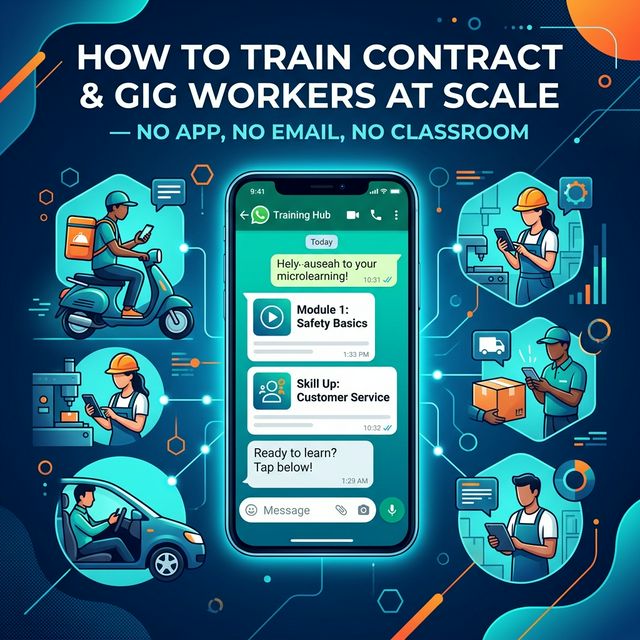
WhatsApp-based microlearning works for contract and gig workers because it meets them where they already are. India has over 700 million WhatsApp accounts. Even workers in Tier 3 cities and rural areas use WhatsApp daily.
Here's how it works in practice:
Step 1: Upload your content. Take your existing SOPs, safety manuals, or product guides. Upload them to the platform. AI converts them into bite-sized cards, short videos, and quizzes - in the language you need.
Step 2: Send via WhatsApp. Workers receive a link on WhatsApp. They tap it and start the training immediately. No app store, no login screen, no onboarding flow.
Step 3: Track completion. Every interaction is recorded - who opened the training, who completed it, who passed the quiz, who didn't. This data feeds into compliance dashboards that are ready for audits.
Step 4: Repeat and reinforce. When regulations change, when a new safety protocol is introduced, when a new batch of workers joins - push updated training in minutes, not weeks.
Companies using this approach report measurable results. A leading mobility company trained its high-attrition workforce of drivers and hosts using microlearning via Leap10x, achieving a 23% improvement in onboarding time compared to their previous classroom-based process, a 10% reduction in onboarding cost, and a 3% improvement in customer satisfaction scores.
What Types of Training Work Best for Contract Workers
Not all training topics are equally suited for WhatsApp delivery. Here's what works and what doesn't:
Works well on WhatsApp:
- Safety induction and PPE protocols (short video + quiz)
- Compliance acknowledgements (read + confirm)
- SOP updates and process changes (visual cards)
- Product knowledge for sales or service roles (micro-modules)
- Soft skills like customer handling and etiquette (scenario-based)
- POSH awareness training (mandatory compliance)
- ESG and sustainability awareness (regulatory requirement)
Better suited for in-person or blended:
- Hands-on equipment operation (needs physical practice)
- Emergency response drills (needs physical participation)
- Complex certification programs (needs extended assessment)
The most effective approach is blended: use WhatsApp for the knowledge transfer and compliance documentation, then supplement with on-site demonstrations for hands-on skills.
Industries Where Contract Worker Training Matters Most
Facility Management: Companies managing housekeeping, security, and maintenance workers across multiple client sites. Workers rotate frequently, often come through staffing agencies, and need consistent safety and service training regardless of which site they're deployed to.
Logistics and Delivery: Delivery partners, warehouse packers, and last-mile workers. Attrition rates in this sector can exceed 100% annually. Training needs to happen on day one - because there may not be a day thirty.
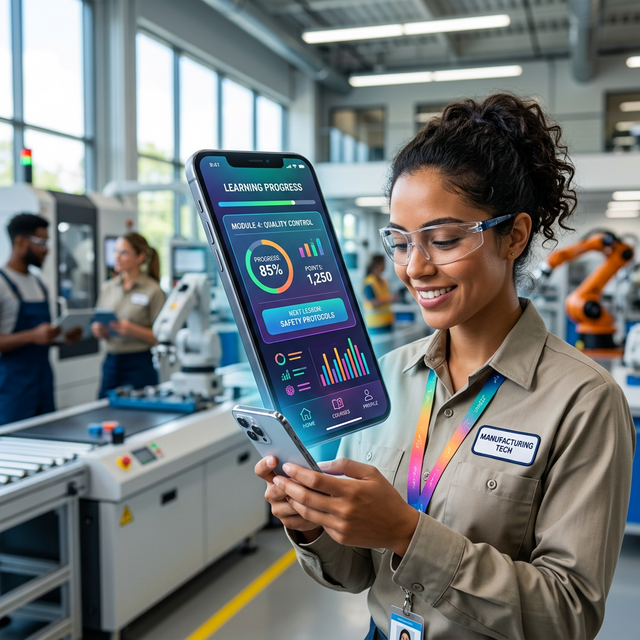
Manufacturing: Contract workers on factory floors who need safety training, machine operating procedures, and quality protocols. Companies like Siemens and Tata Electronics use Leap10x to deliver this training in regional languages across distributed factory networks.
Retail: Temporary staff hired for seasonal peaks, store associates who need product training, and franchise employees who need brand-standard training without being on the company payroll.
BFSI: Field agents, collection teams, and insurance advisors who are often third-party contractors. RBI, IRDAI, and SEBI all require documented training for field staff - even if they're not direct employees.
How to Get Started
If you're training 100 or 10,000 contract workers, the setup process is the same:
- Identify your most urgent training need. Usually it's safety induction, compliance, or onboarding - whichever is causing the most operational pain or audit risk right now.
- Upload your existing material. You don't need to create content from scratch. Existing SOPs, manuals, or PowerPoint decks can be converted into microlearning modules using AI.
- Run a pilot with one site or one team. Pick 50-100 workers. Send training via WhatsApp. Measure completion rates, quiz scores, and time-to-complete.
- Scale based on results. Once you see 80%+ completion rates (compared to the 40-50% you were getting with app-based or classroom methods), expand to your full workforce.
Leap10x is built specifically for this use case. No app download required. Training delivered via WhatsApp and SMS. AI-powered content creation in 15+ languages. Compliance-ready tracking with audit trails. Companies like FlixBus, Blue Star, and Reliance Industries use Leap10x to train their extended workforce.
Book a free 30-minute consultation to see how it works for your team.
FAQs
Q: Can contract workers access training without downloading an app?
- A: Yes. Leap10x delivers training via WhatsApp links and SMS. Workers tap the link and start the training immediately - no app download, no sign-up, and no password required. This is critical for contract and gig workers who may not have company email or storage space on their phones.
Q: How do you track training completion for audit and compliance purposes?
- A: Every interaction is tracked automatically - who opened the training, when they completed it, quiz scores, and time spent. This data is available on a real-time dashboard and can be exported for compliance audits under the new Labour Codes 2026.
Q: What languages does the training support?
- A: Leap10x supports content creation and delivery in 15+ Indian languages including Hindi, Tamil, Telugu, Kannada, Marathi, Bengali, Gujarati, Malayalam, Punjabi, and Odia. AI can auto-translate content with one click.
Q: Is this suitable for high-attrition workforces where workers leave within 60 days?
- A: Yes. Training can be created in under 10 minutes and deployed instantly to new batches of workers. Because there's no app installation or setup time, new workers can start training on their first day - or even before they arrive on site.
Q: What's the cost compared to classroom training for contract workers?
- A: WhatsApp-based microlearning typically costs 60-75% less than classroom training when factoring in trainer travel, venue costs, production downtime, and the cost of re-training due to attrition. One Leap10x customer reduced content creation costs by 75% compared to their previous method.
Internal Links:
- Why Your LMS Is Failing Frontline Workers
- How to Train Frontline Workers Without Disrupting Operations
- WhatsApp-Based Training for Employees: Complete 2026 Guide
- Reduce Frontline Attrition with Better Training
- Manufacturing Training Solutions
- Safety & Compliance Training Use Case
- Employee Onboarding Microlearning