WhatsApp Training for Multi-Location Retail: How to Ensure 500 Stores Deliver the Same Customer Experience
Quick answer
A customer walks into your flagship store in Mumbai and receives impeccable service.
A customer walks into your flagship store in Mumbai and receives impeccable service. The associate knows every product, anticipates needs, and handles a tricky return with grace. That same customer visits a franchise location in Pune the following week and encounters a confused associate who can't explain the exchange policy.
Same brand. Same products. Same prices. Completely different experience.
This inconsistency isn't a people problem. It's a training delivery problem. When you operate 100, 500, or 1,000+ retail locations, ensuring that every associate in every store delivers the same quality of service becomes the defining operational challenge. And traditional training methods - regional trainers, classroom sessions, video libraries on an LMS - have consistently failed to solve it.
WhatsApp-based training offers a fundamentally different approach: centralised content creation with decentralised, automated delivery that reaches every worker in every store simultaneously.
Why Consistency Breaks Down at Scale
Retail training inconsistency follows a predictable pattern. Understanding it is the first step to fixing it.
The telephone game effect. Corporate creates training content. Regional managers interpret it. Store managers deliver their version of it. By the time the message reaches the associate on the floor, it's been filtered through three layers of human interpretation. Each layer introduces drift.
The time-lag problem. A new product launch requires updated product knowledge training. Corporate finalises the materials. Regional teams schedule classroom sessions. But some stores can't schedule sessions before the launch date. Others hold sessions weeks later. The result: some associates sell the new product confidently on day one while others are still discovering it exists two weeks later.
The coverage gap. Classroom training requires physical presence. Associates who were on leave, on a different shift, or at a different location miss the session entirely. There's rarely a mechanism to catch them up. Over time, the knowledge gap between trained and untrained associates widens.
The turnover reset. With retail employee turnover averaging 60% annually, new associates are constantly replacing trained ones. If training is event-based rather than continuous, every new hire starts from zero and reaches a different level of competency depending on which store they join and who happens to train them.
The net result: customers experience a different version of your brand at every location.
The WhatsApp Solution: Centralised Content, Universal Delivery
WhatsApp-based training eliminates the variables that cause inconsistency. Here's the structural advantage:
One source of truth. Training content is created once by the central L&D team. Every associate in every store receives the exact same module, word for word, image for image, quiz for quiz. There's no interpretation layer, no regional adaptation that drifts off-message, no supervisor who "adjusts" the content based on their own understanding.
Simultaneous delivery. When a new training module is published, it reaches every associate across all locations within minutes. A product knowledge update for a Monday launch can be delivered to 10,000 associates on Friday afternoon, giving everyone the weekend to absorb it before the product hits shelves.
No scheduling required. Workers complete training on their own phones, during natural breaks, at their own pace. There's no classroom to book, no trainer to schedule, no shift to cover. This eliminates the logistical nightmare that makes multi-location classroom training so inconsistent.
Automatic catch-up. New hires automatically receive the same onboarding journey that every other associate completed. A worker who joins Store #347 in Bangalore on Tuesday gets the identical training sequence as someone who joined Store #12 in Delhi three months ago.
Verifiable completion. For the first time, retail operations leaders can see exactly which associates in which stores have completed which training modules. When Store #89 has a customer service issue, you can check whether the relevant training was completed. When Store #234 is outperforming, you can identify whether higher training completion is a contributing factor.
Building the Multi-Location Training Programme
Here's how to structure WhatsApp-based training for consistent execution across hundreds of locations.
Tier 1: Universal Training (All Associates, All Stores)
These are the non-negotiable modules that every associate must complete, regardless of location, role, or tenure.
- Brand standards: What your brand promises and how associates deliver it
- Customer service fundamentals: Greeting, engagement, problem resolution
- Core product knowledge: Top-selling categories, key features, common questions
- Compliance essentials: Return policy, payment handling, data privacy, safety
- Company culture: Values, mission, expected behaviours
Universal training is delivered as an automated onboarding journey for new hires and as periodic reinforcement for existing staff. Every store receives the same content in the same sequence.
Tier 2: Role-Specific Training
Different roles need different knowledge. A cashier needs POS mastery. A floor associate needs deep product expertise. A stock room worker needs inventory management skills.
WhatsApp platforms with role-based routing automatically deliver the right content to the right roles. The cashier gets POS modules. The floor associate gets product knowledge. The supervisor gets management training. All automated, all consistent.
Tier 3: Timely Updates (Campaign-Driven)
Retail runs on campaigns, seasons, and promotions. Training needs to keep pace.
- New product launches: Product features, pricing, selling points, customer FAQs
- Promotional campaigns: Offer details, terms and conditions, upsell scripts
- Seasonal preparation: Holiday staffing protocols, peak-period procedures
- Policy changes: Updated return policies, new payment methods, procedure changes
These are pushed to all relevant associates simultaneously, ensuring that every store is prepared for every campaign at the same time.
Tier 4: Remedial and Reinforcement
Analytics from the training platform identify knowledge gaps at the store and individual level. If Store #156's team consistently scores low on product knowledge quizzes, that store's associates automatically receive additional reinforcement modules.
This targeted approach means that struggling stores get extra support without requiring manual identification and intervention from regional managers.
The Multi-Language Advantage
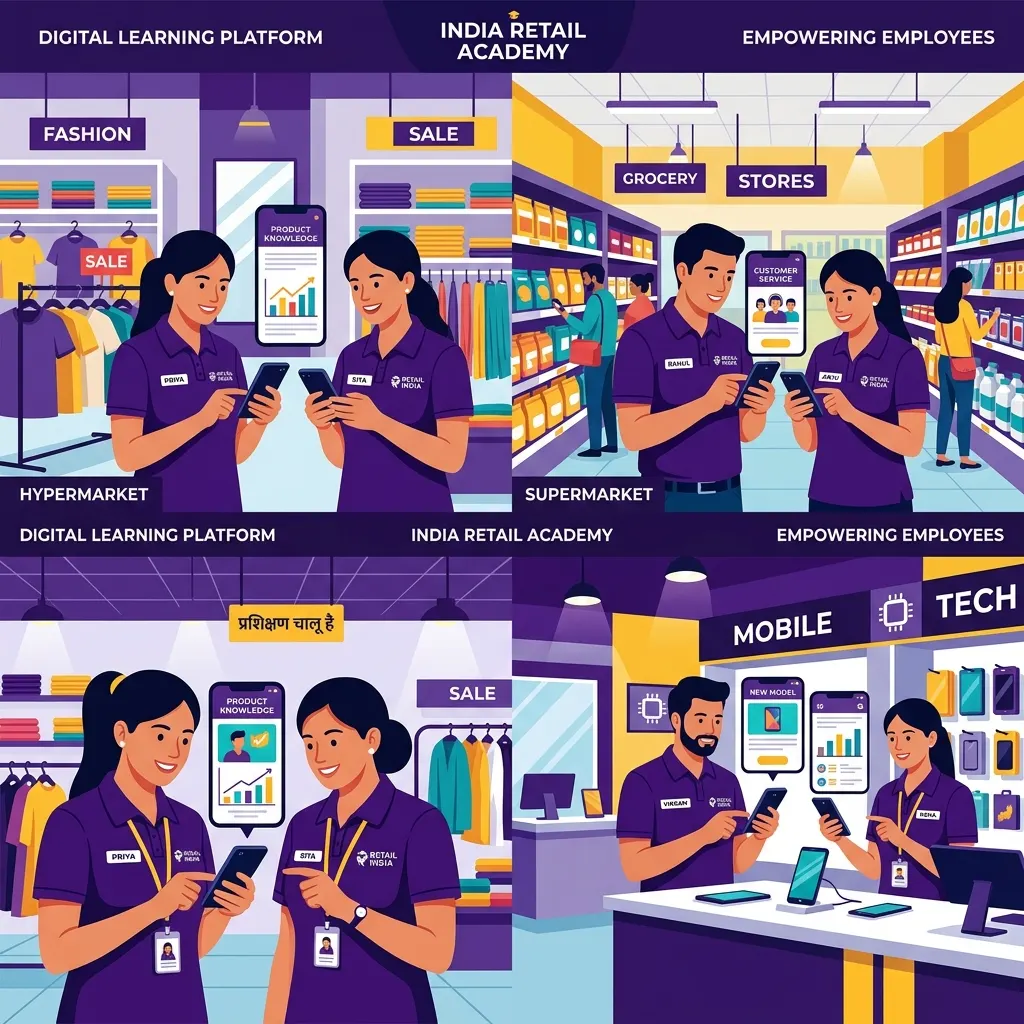
For Indian retail chains, language is the silent consistency killer. A brand with stores across Maharashtra, Tamil Nadu, Karnataka, and West Bengal employs associates who speak Marathi, Tamil, Kannada, and Bengali respectively.
Training created in English and delivered to a Tamil-speaking associate in a tier-3 city won't land. But creating separate training programmes in every language is cost-prohibitive and introduces yet another source of inconsistency.
WhatsApp training platforms with multi-language support solve this by maintaining one master content set that's automatically delivered in each associate's preferred language. The product knowledge is identical. The customer service standards are identical. Only the language of delivery changes.
This ensures that an associate in a Chennai store receives the same training as an associate in a Kolkata store - each in their own language, with no loss of accuracy or consistency.
Measuring Consistency Across Locations
The real power of WhatsApp training for multi-location retail is the visibility it provides. For the first time, retail operations leaders can compare training metrics across every store.
Store-level scorecards show completion rates, quiz scores, and engagement levels for each location. Stores that fall below benchmark are flagged for attention.
Regional comparisons reveal whether training consistency varies by region, suggesting that some regional managers are reinforcing training better than others.
Correlation analysis connects training data to operational metrics. Do stores with higher training completion rates also have higher mystery shopper scores? Do they see lower return rates? Higher average transaction values? These connections validate the training investment and identify where additional focus is needed.
New hire tracking ensures that onboarding is equally thorough at every location. If new hires at Store Group A consistently complete onboarding faster and with higher quiz scores than Store Group B, investigate what's different about the local support at each.
The Consistency Flywheel
When every associate at every location receives the same high-quality training, something powerful happens. Customer experience becomes predictable. And predictable customer experience builds brand trust.
Customers who know they'll receive consistent service at any location shop more frequently, spend more per visit, and recommend the brand more readily. This creates a virtuous cycle: consistent training drives consistent experience, consistent experience drives customer loyalty, customer loyalty drives revenue, and revenue justifies further training investment.
The retailers who win in 2026 won't be the ones with the best training content. They'll be the ones who deliver that content consistently to every associate, in every store, every day.
WhatsApp makes that consistency achievable at a scale that was previously impossible.
Managing training across 100+ locations? Leap10x ensures every store receives the same training, in every language, with real-time completion tracking by location. See consistency scores across your entire network. Start a free pilot today.
Microlearning
Turn your SOPs into 3-minute modules
Upload a PDF, deck, or video and Leap10x's AI builds micro-modules with quizzes and spaced-repetition schedules — delivered where your frontline already is.