AI-Generated SOPs for Manufacturing: How to Create Training Content in Minutes, Not Weeks
Quick answer
Every manufacturing operation runs on Standard Operating Procedures.
The SOP Bottleneck on Every Factory Floor
Every manufacturing operation runs on Standard Operating Procedures. Machine setup, quality checks, safety protocols, changeover processes, cleaning routines - SOPs are the instruction manuals that keep production consistent and compliant.
But here's what nobody talks about: creating and maintaining SOPs is one of the most time-consuming tasks in manufacturing operations. A single procedure document can take days to draft, review, format, and approve. Multiply that across hundreds of processes in a typical plant, and you have a documentation workload that never ends.
The result? Outdated SOPs sitting in binders that nobody opens. Tribal knowledge locked inside the heads of veteran operators. New hires shadowing experienced workers for weeks because the written procedures don't exist or don't match current practice.
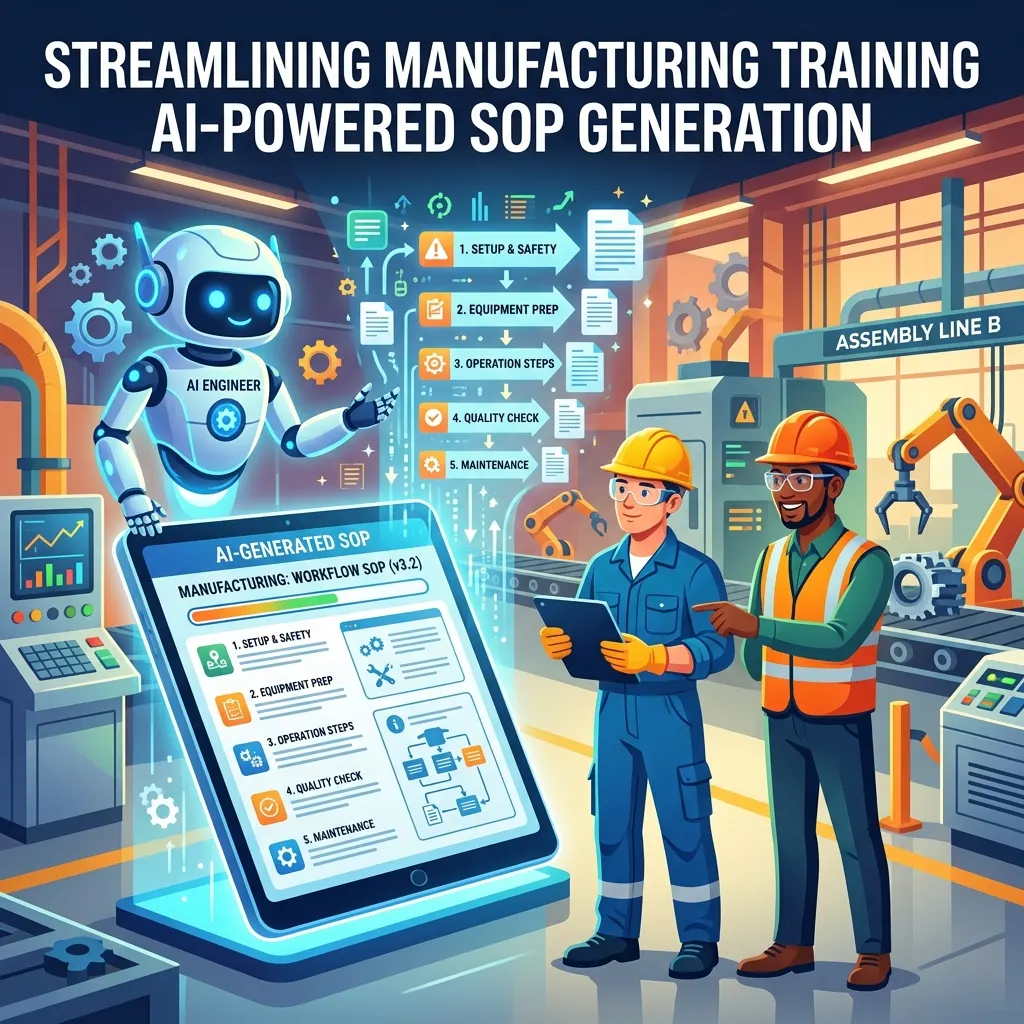
AI is changing this equation fundamentally. Modern AI SOP generators can produce structured, formatted procedure documents in minutes - not days. And when combined with the right training delivery platform, those SOPs transform from static documents into active learning content that workers actually engage with.
If your manufacturing operation still creates SOPs manually, this guide shows you how AI-accelerated SOP creation works, what tools are available in 2026, and how to turn AI-generated procedures into effective training for your floor workforce.
For the compliance angle on manufacturing training, check our Compliance Training for Manufacturing Workers: 2026 Guide.
How AI SOP Generation Works in Manufacturing
The Traditional SOP Workflow (and Why It Breaks Down)
The conventional process looks something like this:
- A process engineer or quality manager documents a procedure by observing the process and interviewing operators
- They draft the SOP in Word or a template, adding step-by-step instructions
- The draft goes through review with the quality team, safety team, and operations management
- Revisions happen (often several rounds over weeks)
- The final version gets formatted, approved, and filed
- When the process changes, the entire cycle repeats
This workflow fails for three reasons. It's slow - the average SOP takes 4-8 hours of active work spread across 2-4 weeks of calendar time. It depends on the availability of subject matter experts who are already overloaded. And by the time the SOP is finalized, the process has often already changed.
The AI-Accelerated Workflow
AI SOP generators compress this timeline dramatically. Here's how the modern workflow operates:
Input methods:
- Video capture: An operator records themselves performing the procedure on their phone or a body camera. AI processes the footage, identifies key steps, and generates a draft SOP with annotations. Tools like Docsie and Knowby specialize in this video-to-documentation pipeline.
- Document conversion: Upload existing reference materials - old SOPs, training slides, engineering notes, process specs - and AI restructures them into properly formatted procedures. Adobe Acrobat's AI Assistant and Speach both support this approach.
- Prompt-based generation: Describe the procedure in natural language. AI generates a complete SOP with steps, safety warnings, quality checkpoints, and required tools. Xmind, Creately, and QuillBot all offer prompt-based SOP generation.
- Screen recording: For software-based processes (ERP entries, quality system inputs), tools like Clueso and Supademo capture screen workflows and auto-generate interactive step-by-step guides.
Output quality:
Modern AI SOP generators don't just produce raw text. They structure content with numbered steps, safety callouts, required equipment lists, and quality checkpoints. The best tools match your company's existing template format - which matters enormously in manufacturing where document control standards (ISO 9001, IATF 16949) require specific formatting.
Time savings:
What used to take days now takes minutes for the initial draft. One manufacturing user of Xmind's AI SOP tool reported turning a two-hour documentation task into a five-minute review. Clueso claims their tool cuts documentation time from a full day to under five minutes.
The human review step remains essential - AI hallucination is real, and nobody wants incorrect safety procedures on a factory floor - but starting from a structured draft instead of a blank page changes the workload entirely.
From Static SOPs to Active Training
Here's where most manufacturing operations miss the bigger opportunity. An AI-generated SOP is a document. By itself, it sits in a folder (physical or digital) and waits for someone to read it.
The real value emerges when you convert SOPs into active training content that workers engage with, get assessed on, and can reference in the flow of work.
Turn SOPs Into Microlearning Modules
Break each SOP into 3-5 minute training modules. A 15-step machine setup procedure becomes three modules:
- Module 1: Pre-setup safety checks and equipment preparation
- Module 2: Step-by-step setup procedure with visual guides
- Module 3: Post-setup quality verification and documentation
Deliver these modules on workers' phones - via WhatsApp or a mobile app - so they can reference them at the machine, not in a training room.
Add Visual Elements
Manufacturing SOPs work best with visuals. Use AI to generate:
- Annotated photographs of each step
- Short video demonstrations narrated in the worker's language
- Infographics showing correct vs. incorrect procedures
- Decision trees for troubleshooting common issues
AI video tools like Synthesia can automatically generate avatar-narrated training videos from your SOP text, complete with voice-over in multiple languages.
Embed Assessments
After a worker completes an SOP-based training module, quiz them. AI can auto-generate quiz questions from SOP content:
- "What is the first step before starting the CNC setup?"
- "Which PPE is required for the chemical cleaning procedure?"
- "What should you do if the pressure gauge reads above 150 psi?"
These assessments create documentation that the worker understood the procedure - not just that they opened the file.
Enable Just-in-Time Access
The most valuable SOP isn't the one filed in a binder. It's the one a worker can pull up on their phone in 10 seconds when they're standing at a machine and need to confirm a procedure.
Mobile-delivered SOPs with search functionality turn your documentation library into a performance support tool. Workers use it in the moment of need, which reinforces training and reduces errors.
Compliance Considerations for AI-Generated SOPs
Manufacturing operations in India face specific documentation requirements:
- Factories Act, 1948: Requires documented safety procedures for hazardous processes
- ISO 9001/IATF 16949: Mandate document control with version management, approval workflows, and audit trails
- OSHA-equivalent Indian standards: Require documented training records for safety-critical procedures
- BIS standards: Sector-specific documentation requirements
AI-generated SOPs must fit within your existing document control system. This means:
- Template conformity: The AI output must match your approved SOP format. Don't accept generic formatting that requires manual reformatting before approval.
- Version control: Every AI-generated draft must enter your document control workflow - review, approve, assign a version number, and track changes.
- Human verification: AI can draft the SOP. A qualified process engineer or quality manager must verify that every step is accurate, safe, and complete before the document is approved.
- Audit trail: Maintain records of who created the AI draft, who reviewed it, who approved it, and when it was deployed to workers.
A Practical Implementation Roadmap
Phase 1: Pilot with High-Impact SOPs
Identify 5-10 SOPs that meet these criteria:
- Frequently referenced by workers
- Recently updated or known to be outdated
- Cover safety-critical or quality-critical procedures
- Currently exist in some form (notes, old documents, or expert knowledge)
Run these through an AI SOP generator. Have your process engineers review the output. Measure how long the AI draft took versus your traditional process.
Phase 2: Convert Pilot SOPs to Training
Take the approved SOPs and convert them into microlearning modules. Deliver them to the relevant worker groups via mobile. Track completion and assessment scores.
Compare training effectiveness between workers who received AI-converted SOP training and those who were trained through traditional methods (classroom or buddy system).
Phase 3: Scale Across the Plant
Once the pilot proves the model, systematize it:
- Assign SOP creation to department leads, with AI as the drafting tool
- Establish a review cadence (monthly for safety-critical, quarterly for standard procedures)
- Integrate AI SOP creation with your training delivery platform so updates flow automatically from documentation to training
- Train your process engineers on effective AI prompting for SOP generation
The Bottom Line
Manufacturing has always been documentation-heavy. AI doesn't eliminate the need for accurate, well-maintained SOPs - it eliminates the bottleneck that prevents them from existing in the first place.
When every procedure is documented, up-to-date, and delivered as active training content that workers engage with on their phones, you get fewer errors, faster onboarding, stronger compliance, and a workforce that knows exactly what to do at every step.
The tools exist. The ROI is clear. The question is whether your plant will adopt AI-accelerated SOP creation in 2026 or watch competitors do it first.
Ready to turn your manufacturing SOPs into active training content? See how Leap10x delivers mobile-first training that reaches every worker on the floor - in their language, on their phone.
Frontline training
Training software built for deskless teams
Onboarding, SOPs, safety refreshers, and compliance evidence for workers with no corporate email and no company device — tracked by site, role, and shift.