From Classroom to Chat: A Step-by-Step Migration Guide for Moving Frontline Training to WhatsApp
Quick answer
Your classroom training programme has served you well.
Your classroom training programme has served you well. The content is comprehensive, the trainers are experienced, and the feedback from sessions is generally positive.
But the metrics tell a different story. Attendance is spotty because shift schedules make it impossible for everyone to attend. Workers who do attend forget most of what they learned within a week. And you're spending thousands on trainer travel, venue costs, and lost productivity from pulling workers off the floor.
You know WhatsApp-based training could solve these problems. Your frontline workers are already on WhatsApp. The engagement data from early adopters is compelling. The cost model makes sense.
But migrating from a system that everyone knows to one that's fundamentally different feels risky. Where do you start? What do you migrate first? How do you bring trainers and managers along?
This guide provides a structured, phase-by-phase migration path from classroom-based frontline training to WhatsApp delivery - designed to minimise risk, demonstrate value quickly, and build momentum for full adoption.
Phase 1: Audit and Prioritise (Week 1-2)
Before migrating anything, you need a clear picture of what you're working with.
Map Your Current Training Landscape
Create an inventory of every training programme currently delivered to frontline workers. For each, document:
- Topic: What does this training cover?
- Frequency: How often is it delivered (once during onboarding, quarterly, annually)?
- Duration: How long is each session?
- Delivery method: Classroom, on-the-job, printed materials, LMS?
- Attendance rate: What percentage of eligible workers actually complete it?
- Criticality: Is this mandatory (compliance, safety) or developmental?
- Effectiveness: Is there any evidence that this training improves job performance?
This audit typically reveals uncomfortable truths: many training programmes have been running for years with no measurement of whether they actually change behaviour.
Prioritise for Migration
Not everything should move to WhatsApp. Some training is inherently hands-on (operating heavy machinery, performing medical procedures) and will always require in-person instruction.
Prioritise migration candidates using this framework:
High priority (migrate first):
- Knowledge-based content (product knowledge, policies, procedures)
- Compliance training that requires documented completion
- Onboarding content currently delivered through classroom orientation
- Safety refreshers and reinforcement
Medium priority (migrate after proving the model):
- Customer service training (can combine WhatsApp theory with in-person roleplay)
- Soft skills development
- Management and leadership training
Keep in-person (augment with WhatsApp):
- Hands-on equipment operation
- Physical safety demonstrations
- Team-building and cultural immersion
Pick one high-priority programme for your pilot. Ideally, choose one with low current completion rates - the improvement will be most visible.
Phase 2: Content Conversion (Week 2-3)
Converting classroom content to WhatsApp microlearning isn't a one-to-one translation. It's a re-imagination of how the same knowledge is delivered.
The Conversion Formula
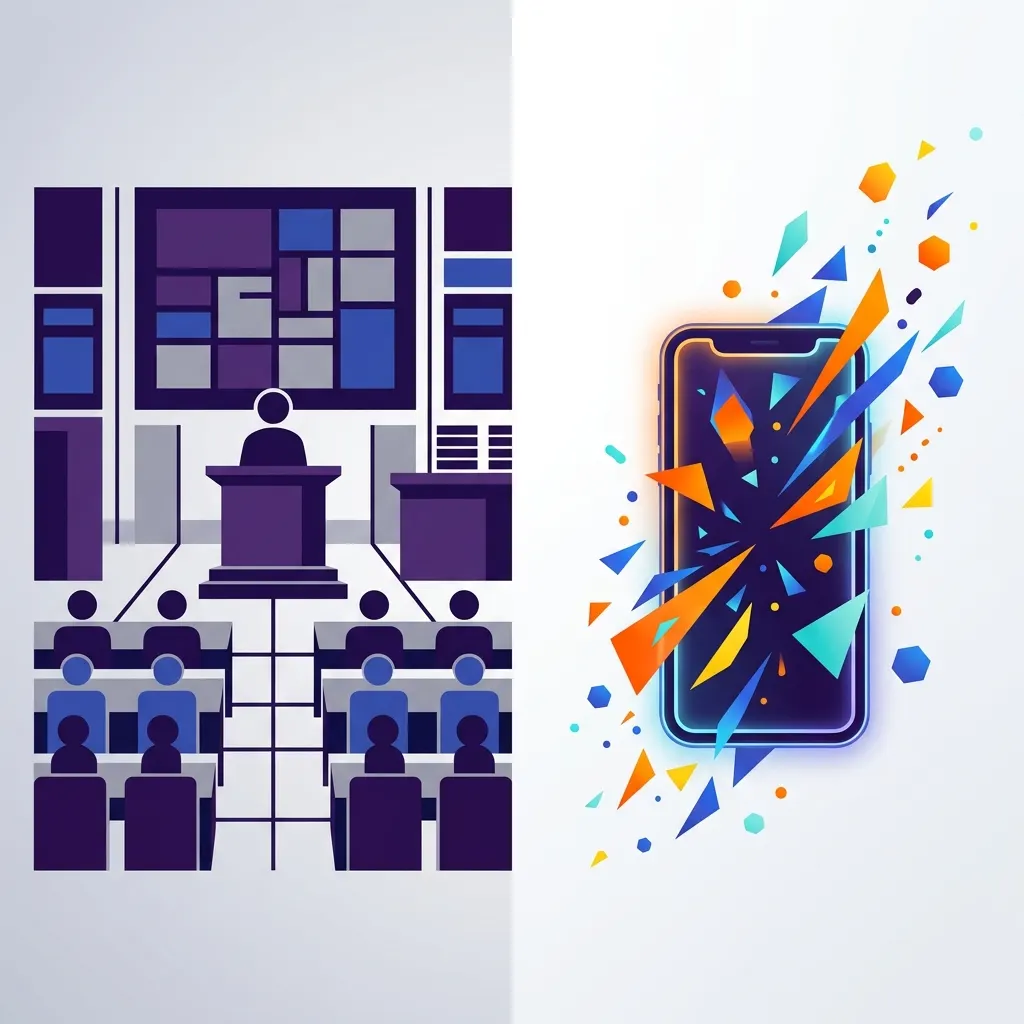
Classroom: 60-minute session covering 8-10 topics with a trainer presenting to a group.
WhatsApp: WhatsApp: A single magic link sent on WhatsApp. Tapping it opens a course of 8-10 byte-sized cards - one topic each - that the worker taps through in about 3 minutes, Story-style, with no app and no login.
The total learning content is similar, but the delivery is fundamentally different:
- Passive listening becomes active questioning. Instead of a trainer explaining a policy, the worker reaches a quiz card with a scenario, thinks about it, taps the answer they think is right, and instantly sees the correct answer with an explanation.
- Dense slides become bite-sized cards. Instead of a 40-word bullet point on a slide, the information becomes a short, clear lesson card the worker taps through, written the way a colleague would explain something helpful.
- End-of-session quizzes become embedded assessments. Instead of a 20-question test at the end, each module includes 1-2 questions that check understanding before moving to the next topic.
- Printed handouts become saved media. Checklists, reference guides, and quick-reference cards are delivered as downloadable images or PDFs that workers save to their phone for on-the-job access.
Involve Your Trainers
This is critical. Your trainers know the content better than anyone. They know which topics confuse workers, which examples resonate, and which questions always come up. Involve them in the conversion process - their insights will make the WhatsApp modules far better than anything L&D could create in isolation.
Position this as an upgrade to their role, not a threat. Trainers evolve from content deliverers to content designers, coaching facilitators, and training analysts who interpret data and drive improvement.
Phase 3: Pilot Launch (Week 3-4)
Launch your converted programme to a controlled pilot group. This is where you prove the model and gather the data needed to expand.
Pilot Design
- Select 50-100 workers from 2-3 locations. Include a mix of tenures and roles to test broadly.
- Run in parallel with existing classroom training for the first cycle. This lets you compare completion rates, quiz scores, and satisfaction between the two approaches.
- Communicate clearly. Tell pilot participants why you're testing this, what they'll experience, and that their feedback is essential.
- Assign a champion at each pilot location - typically a supervisor or store manager who can answer questions and encourage participation.
What to Measure During the Pilot
- Completion rate: WhatsApp delivery versus classroom attendance for the same content.
- Knowledge retention: Quiz scores immediately after training and again two weeks later.
- Worker satisfaction: Simple pulse survey asking workers to rate the experience.
- Trainer feedback: How do trainers feel about the new approach?
- Operational impact: Any measurable change in the metrics the training targets (if the pilot is long enough to detect).
Most pilots produce compelling results. WhatsApp completion rates of 80%+ versus 30-50% classroom attendance for the same content is a common finding.
Phase 4: Expand and Integrate (Week 5-8)
With pilot data in hand, expand the migration to more programmes and more locations.
Migration Sequence
Wave 1 (post-pilot): Roll out the proven pilot programme to all locations. Simultaneously begin converting your second-priority training programme.
Wave 2 (4-6 weeks after Wave 1): Launch the second programme. Begin converting compliance and safety content.
Wave 3 (4-6 weeks after Wave 2): Migrate onboarding to WhatsApp. This is often the highest-impact migration because it affects every new hire immediately.
Ongoing: Continue converting remaining programmes while maintaining a parallel classroom option for hands-on training that genuinely requires in-person instruction.
Change Management
The biggest risk in any training migration isn't technology - it's people.
For workers: Frame WhatsApp training as a convenience, not an obligation. "You can now complete training on your phone during break instead of attending a 2-hour session after your shift." Most workers welcome this immediately.
For managers: Provide dashboard access so they can see their team's training progress. When managers can identify who's fallen behind without asking, they become advocates for the system.
For trainers: Redefine their role. They're no longer delivering content (WhatsApp does that). They're analysing training data, identifying knowledge gaps, creating new content, and providing hands-on coaching for skills that require human demonstration. This is a more strategic, more valuable role.
For leadership: Present the pilot data. Cost savings, completion improvements, and any operational metrics that moved. Numbers speak louder than promises.
Phase 5: Optimise and Evolve (Ongoing)
Migration isn't a one-time project. It's the beginning of a continuous improvement cycle.
Monthly content reviews: Use quiz score data to identify modules that need rewriting. If workers consistently struggle with a specific topic, the content isn't clear enough.
Quarterly programme reviews: Assess whether training is driving the intended operational outcomes. Adjust focus areas based on business priorities.
Annual strategy reviews: Evaluate the overall training architecture. What percentage of training is now WhatsApp-delivered versus in-person? What's the cost per trained worker compared to two years ago? How have retention, safety, and performance metrics changed?
What You're Not Losing
A common concern with this migration is losing the "human element" of classroom training. But consider what classroom training actually delivers for frontline workers:
- Knowledge transfer: WhatsApp does this better, with higher completion and better retention through spaced repetition.
- Assessment: WhatsApp does this more rigorously, with every response tracked and scored.
- Social learning: WhatsApp training can incorporate peer discussion, group challenges, and team-based activities.
- Trainer expertise: Trainers are still involved - they're designing content, analysing data, and providing targeted coaching.
What the classroom uniquely provides is hands-on practice and human connection. Those elements should remain in-person. Everything else can be delivered more effectively, more consistently, and more affordably through WhatsApp.
The goal isn't to eliminate classroom training. It's to reserve classroom time for what only classrooms can do, and move everything else to a channel that actually reaches your entire workforce.
Ready to start your migration? Leap10x makes the transition from classroom to WhatsApp seamless - with AI-powered content conversion, automated learning journeys, and real-time analytics. Move your first training programme to WhatsApp this week. Start a free pilot today.
WhatsApp LMS
Everything an LMS does — inside WhatsApp
Course libraries, enrolment, assessments, certificates, and audit-ready completion logs, with WhatsApp as the learner interface instead of a portal nobody opens.