How to Convert Your Training PDFs and SOPs into WhatsApp Microlearning in Under 30 Minutes
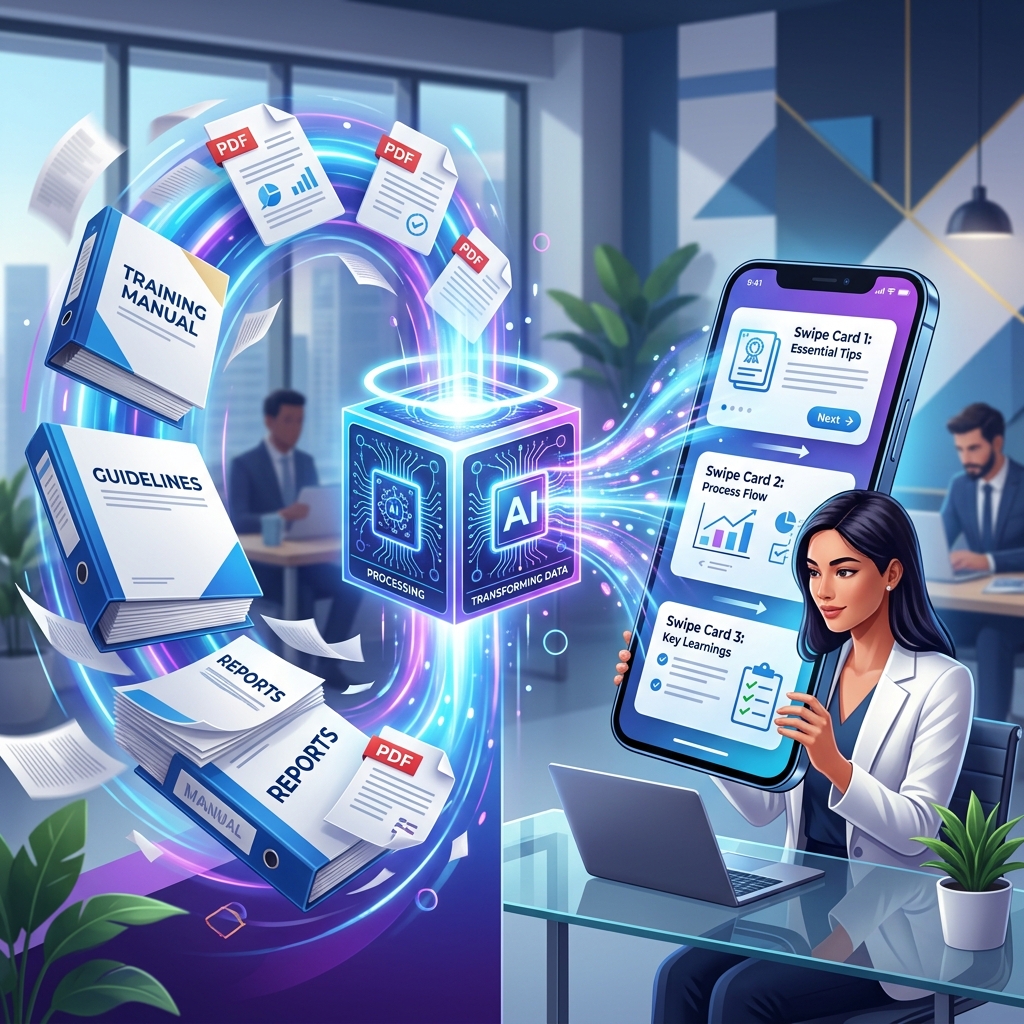
Most L&D teams are sitting on a goldmine of training content that nobody uses. Thick PDF manuals gathering digital dust. SOPs that were last opened during an audit. PowerPoint decks with 87 slides that no frontline worker has ever scrolled through on their phone.
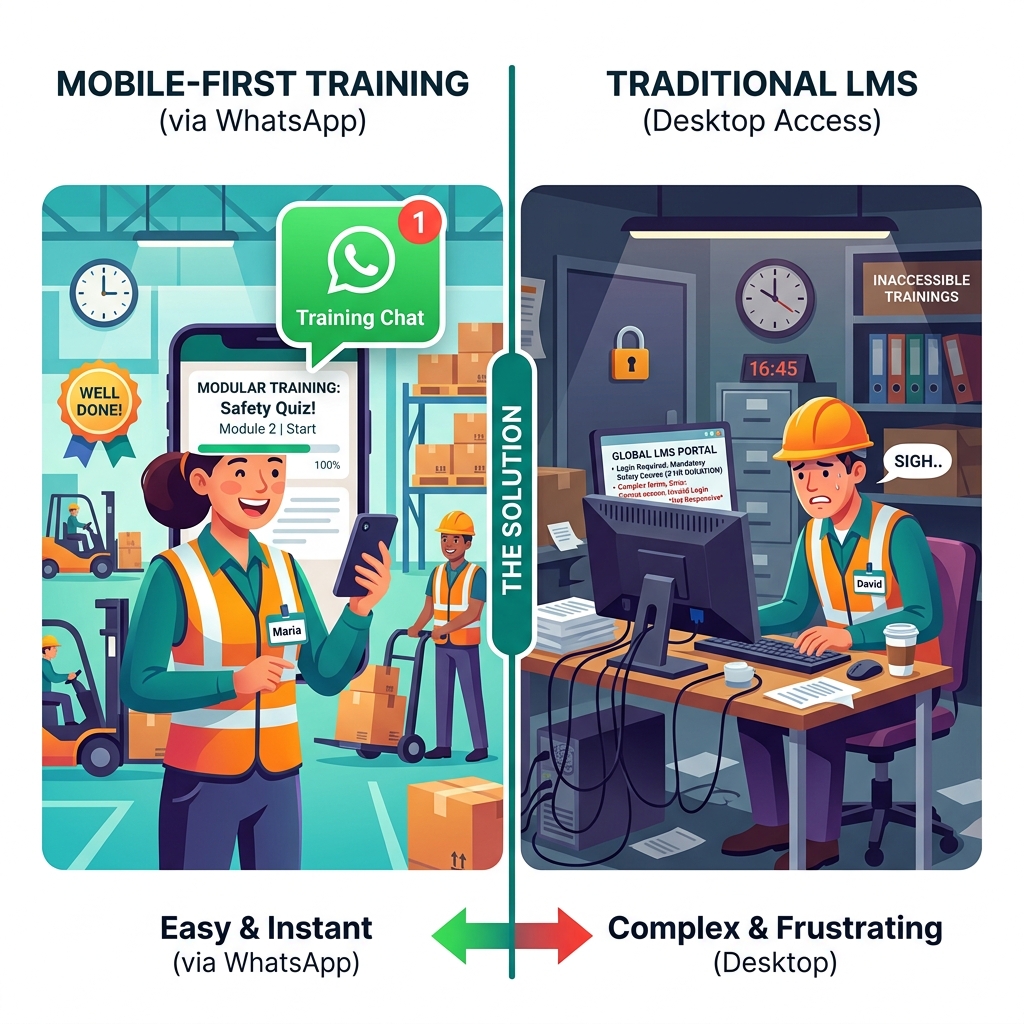
The content itself is often solid. The problem is the format. When 80% of your workforce doesn't sit at a desk, delivering training through desktop-first documents is like sending a fax to someone who only uses WhatsApp.
The good news? You don't need to start from scratch. You can transform your existing training materials into bite-sized WhatsApp microlearning modules in under 30 minutes, and this guide shows you exactly how.
Why Traditional Training Documents Fail Frontline Workers
Before diving into the conversion process, it helps to understand why your current materials aren't landing.
Frontline workers in manufacturing, retail, logistics, and hospitality face a fundamentally different training reality than office employees. They don't have company laptops. Many don't have corporate email addresses — research shows that 83% of frontline workers lack one. They work in shifts, often with only 5–10 minutes of downtime between tasks.
When you hand them a 40-page safety manual or a dense compliance PDF, here's what actually happens: they skim the first page, get interrupted by a customer or a supervisor, and never open it again. Traditional LMS platforms fare no better, with desktop-based systems achieving under 15% completion rates among frontline retail staff.
Microlearning solves this by breaking complex training into focused, 3–5 minute modules delivered through channels workers already use. And in India, Southeast Asia, Latin America, and much of Africa, that channel is WhatsApp — the app people check dozens of times a day.
Step 1: Audit Your Existing Content (5 Minutes)
Start by gathering every training document your organisation currently uses. This typically includes:
- Standard Operating Procedures (SOPs) for daily tasks
- Safety and compliance manuals
- Product knowledge documents
- Onboarding handbooks
- Process flowcharts and checklists
Don't worry about volume. The goal isn't to convert everything at once. Pick one document — ideally the one your frontline workers need most urgently — and use it as your pilot.
Ask yourself three questions about each document:
1. Is the information still current and accurate?
2. Does it contain knowledge that directly impacts job performance?
3. Can the core message be broken into standalone lessons?
If the answer to all three is yes, you have a strong candidate for conversion.
Step 2: Break the Document into Micro-Modules (10 Minutes)
This is where the real transformation happens. Take your selected document and identify the discrete learning objectives buried within it.
A 20-page food safety manual, for instance, might contain these distinct micro-topics:
- Proper handwashing technique
- Temperature danger zones for food storage
- Cross-contamination prevention
- Personal hygiene standards
- Cleaning and sanitisation procedures
- Allergen awareness basics
Each of these becomes a single microlearning module. The rule of thumb: one module = one concept = one action the learner can take immediately.
For each micro-module, extract:
- The key takeaway in one sentence
- 2–3 supporting points that explain the why
- One practical example that shows the how
- One assessment question that checks understanding
Avoid the temptation to preserve every detail from the original document. Microlearning is about essentials, not encyclopaedic coverage. If a frontline worker needs to know 5 things to do their job safely, those 5 things are your 5 modules.
Step 3: Rewrite for Chat-First Delivery (10 Minutes)
Training documents are written for reading. WhatsApp content needs to be written for conversation.
The principles for chat-first content:
- Use conversational language. Write like you're explaining something to a colleague, not drafting a legal document.
- Lead with questions. They activate curiosity and make the learner engage before receiving information.
- Keep messages short. Each card should be readable in under 30 seconds.
- Use emojis strategically. They break up text and signal tone, but don't overdo it.
- Include visuals. A 30-second video card demonstrating proper lifting technique beats three paragraphs describing it.
- End with action. Every module should close with something the worker can do on their next shift.
Step 4: Add Assessments and Checkpoints (3 Minutes)
Training without assessment is just information delivery. You need to know whether workers actually understood the content.
For WhatsApp-based microlearning, the most effective assessment formats are:
- Quick polls: "Which of these is the correct way to handle a customer complaint? Tap 1, 2, or 3."
- True/False questions: Simple, fast, and easy to respond to on a phone.
- Image-based questions: "Look at this photo. Can you spot the safety violation?" — particularly effective for manufacturing and food safety training.
- Scenario-based questions: "A customer says they want to return a product without a receipt. What do you do?" These test application, not just recall.
The key is making assessments feel like a conversation, not an exam.
Step 5: Build the Learning Journey (2 Minutes)
Individual modules are useful. A structured learning journey is powerful.
Arrange your micro-modules in a logical sequence that mirrors how a worker actually encounters these situations on the job. Platforms like Leap10x automate this sequencing through drip journeys — modules are delivered at pre-set intervals, so workers receive the right content at the right time without any manual effort from trainers.
Tools That Make Conversion Faster
AI-powered content conversion is the fastest path. Platforms like Leap10x use AI to automatically extract key learning points from uploaded PDFs and SOPs, then restructure them into quiz-ready micro-modules. You upload the document, the AI identifies the core teaching points, and generates WhatsApp-ready content — often in minutes, not hours.
Common Mistakes to Avoid
Trying to convert everything at once. Start with one critical document. Prove the model works, measure completion rates, then expand.
Preserving the original structure. A PDF's chapter layout rarely translates to a good learning journey. Reorganise around job tasks, not document sections.
Making modules too long. If a single module takes more than 5 minutes to complete, split it.
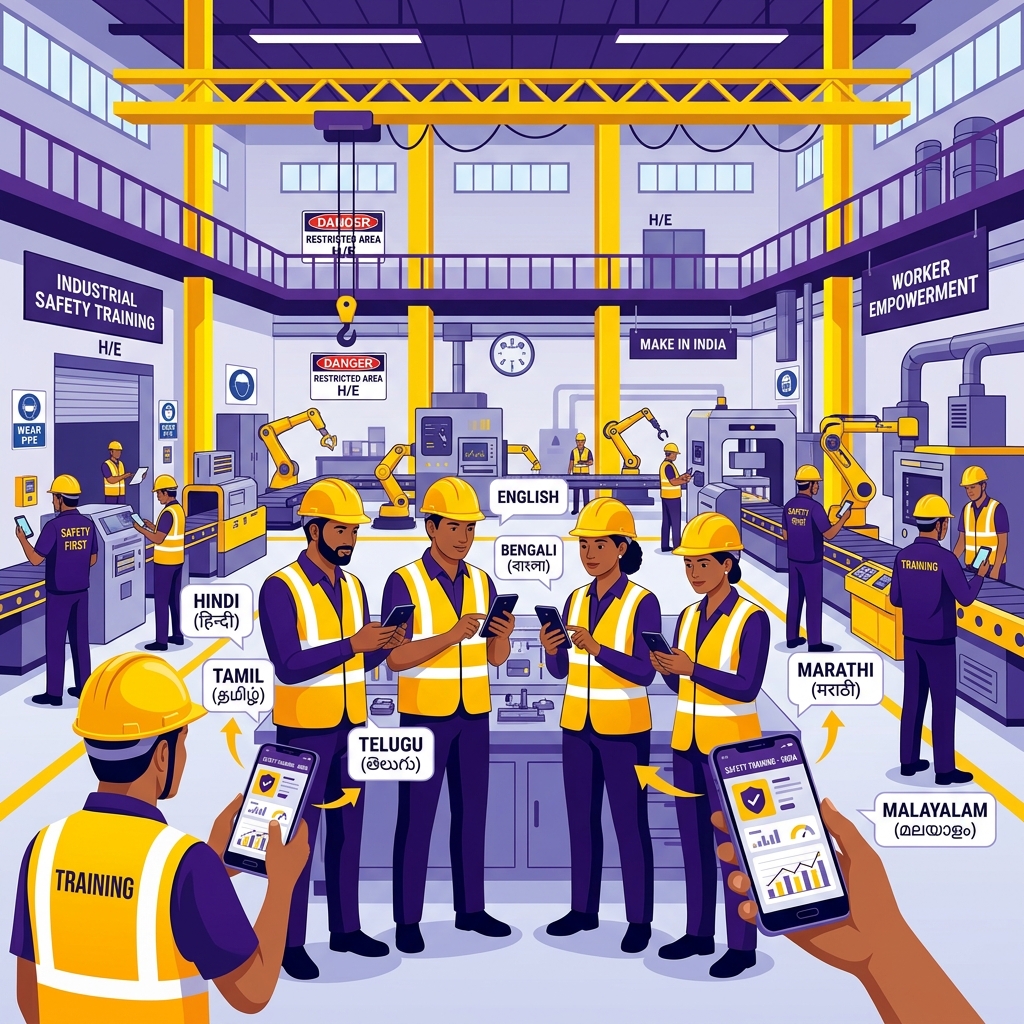
Forgetting vernacular languages. In India and Southeast Asia, training delivered in the worker's mother tongue sees dramatically higher engagement.
Skipping the feedback loop. After your first batch of modules goes live, ask workers what was clear, what was confusing, and what they wish was covered.
Measuring Success After Conversion
Once your converted microlearning modules are live on WhatsApp, track these metrics:
- Completion rate: What percentage of workers finish each module? WhatsApp-delivered training typically achieves 80%+ completion versus 15–20% for traditional LMS.
- Quiz scores: Are workers demonstrating comprehension?
- Time to complete: Are workers finishing modules in the expected timeframe?
- On-the-job application: Are safety incidents decreasing? Are customer satisfaction scores improving?
The beauty of WhatsApp-based delivery is that all of these metrics can be tracked automatically through an admin dashboard, giving L&D teams real-time visibility into training effectiveness across every location.
Start Small, Scale Fast
Converting your training library doesn't have to be a massive project. Take one SOP. Break it into 5–7 micro-modules. Rewrite them for chat. Add a quiz. Push them to 50 workers via WhatsApp. Measure what happens.
Organisations that follow this approach consistently report completion rates three to four times higher than their previous training delivery methods. Workers engage because the format respects their time and meets them where they already are.
Ready to convert your first SOP into WhatsApp microlearning? Leap10x's AI-powered platform transforms your existing PDFs and training documents into interactive WhatsApp courses in minutes — no design skills required. Start your free pilot today.