The Deskless Worker Communication Crisis: Why WhatsApp Groups Fail and What to Do Instead
Here's a scenario that plays out in thousands of organisations every day.
Someone in operations creates a WhatsApp group for the team. It works brilliantly — for about two weeks. Then side conversations break off into private chats. Important policy updates get buried under good morning messages and cricket highlights. A new safety SOP shared on Tuesday is invisible by Thursday, pushed down by 200 unread messages. And when the compliance auditor asks for proof that workers received the updated fire evacuation procedure, the best evidence you can offer is a screenshot from a chat thread.
This isn't a failure of WhatsApp. WhatsApp is an exceptional messaging platform. The failure is in using a personal messaging app as an enterprise communication system.
And yet, for 2.7 billion deskless workers worldwide, informal WhatsApp groups remain the primary communication channel with their employer.
The Scale of the Problem
According to Microsoft, over 80 per cent of the global workforce is deskless. Research from Gallup shows that highly engaged employees lead to 23 per cent higher profitability. Yet the communication tools most organisations deploy — email, intranets, Slack, Microsoft Teams — were designed for office workers.
A 2022 Workplace Intelligence study found that 83 per cent of frontline workers feel they miss important information because it isn't communicated in a way they can access. Frontline worker turnover runs two to three times higher than desk-based roles, and communication disconnection is consistently cited as a top driver.
A Flip survey found that 30 per cent of frontline workers rely on apps like WhatsApp or Facebook Messenger for work-related communications — what IT departments call "shadow IT."
Why WhatsApp Groups Specifically Fail at Work
No message prioritisation. A critical safety alert has exactly the same visual weight as a "Good morning" GIF.
No acknowledgement tracking. Group read receipts tell you how many read the message — not who. You can't prove that Rajesh on the night shift acknowledged the updated chemical handling procedure.
No audience segmentation. A WhatsApp group is all-or-nothing. You can't send a shift-specific update to morning-shift workers only.
No audit trail. A WhatsApp group screenshot doesn't constitute a defensible compliance record.
No content retrievability. Finding a specific SOP shared three months ago is nearly impossible.
No data security. When a worker leaves, they take the entire chat history with them.
The Middle Ground: Structured WhatsApp Communication
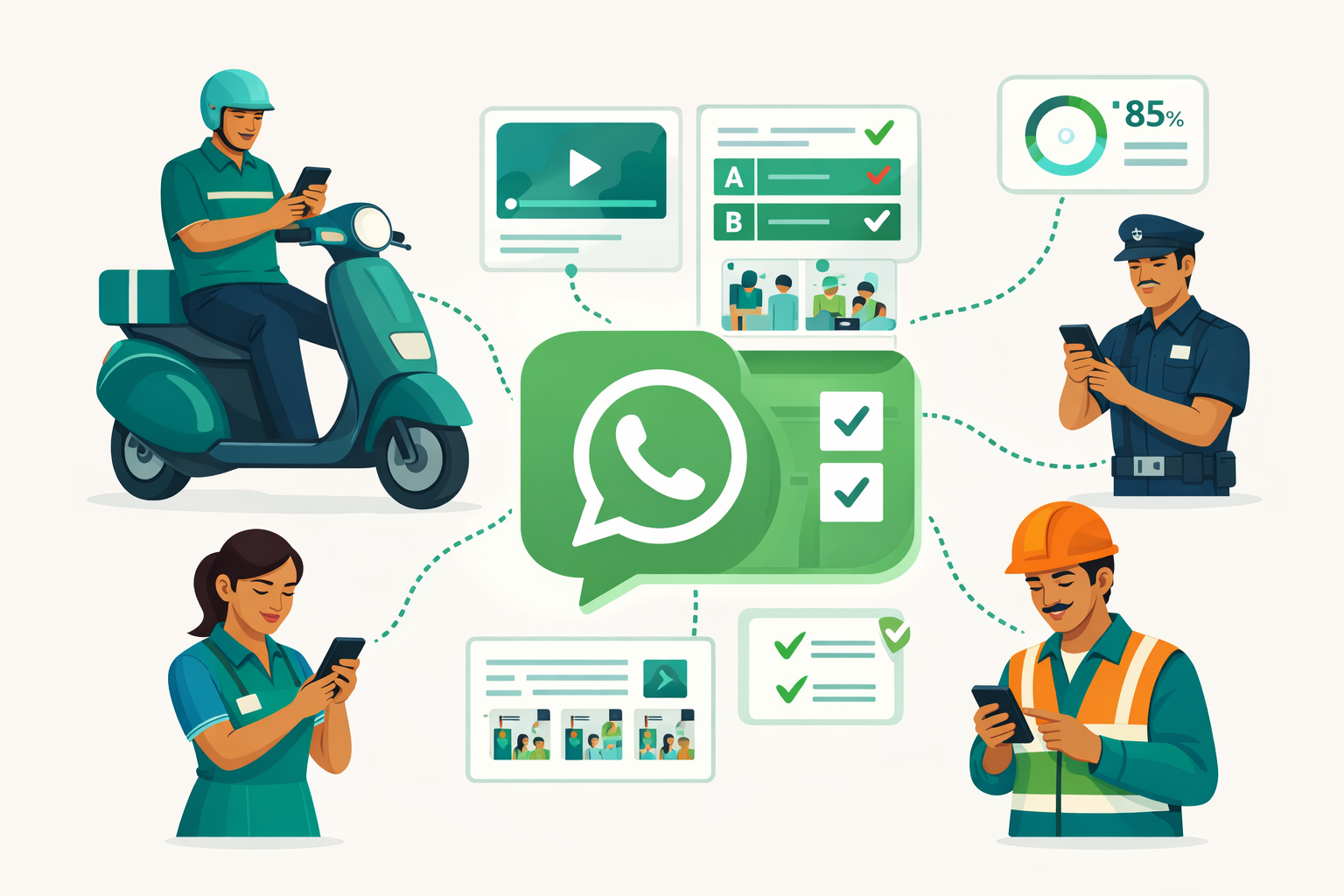
The answer isn't pulling workers off WhatsApp. It's building enterprise-grade communication on top of WhatsApp via the WhatsApp Business API:
Targeted broadcasts replace group messages. Segmented broadcasts to specific audiences — Plant 3 morning-shift operators receive the production target; South zone branch managers receive the new KYC procedure.
Tap-to-acknowledge replaces blue ticks. Workers receive a message with an explicit acknowledgement button. Every acknowledgement is logged with a timestamp.
Two-way routing replaces unstructured replies. Worker replies are automatically routed — safety reports to EHS, HR questions to the people team, product queries to L&D.
Enterprise dashboards replace guesswork. Delivery rates, read rates, acknowledgement rates — all visible in real-time, segmented by site, shift, role, or any custom field.
What This Looks Like in Practice
Leap10x Reach is built on exactly this architecture — a frontline communication hub built on the WhatsApp Business API.
A typical workflow:
- The safety team creates a broadcast about a new chemical handling SOP.
- They select the audience: all machine operators across the North Zone.
- 1,240 workers receive the message with a "Confirm Receipt" button.
- 94 per cent confirm within an hour.
- The 6 per cent who didn't are automatically flagged for follow-up.
- Two workers reply with questions, routed to the EHS team.
- The compliance team downloads a timestamped report.
The Integration Layer
Communication doesn't exist in isolation. A worker who receives a policy update often needs training on the new procedure. A worker who completes a safety module needs ongoing knowledge support.
Leap10x's Frontline Training OS unifies communication, training, knowledge support, and assessment on a single channel — MicroLearning (training), Reach (communication), Assist (AI knowledge co-pilot), and Converse (voice-based assessment). The worker experiences a single, coherent interface. Four functions. One familiar channel. Zero additional apps.
What to Do on Monday Morning
Step 1: Audit every unofficial WhatsApp group used for work communication.
Step 2: Separate mission-critical communications from nice-to-have content.
Step 3: Pilot structured broadcasting with a WhatsApp Business API tool.
Step 4: Compare the audit trail with the screenshot-based evidence from before.
Step 5: Scale and layer in training and knowledge support.
The Bottom Line
WhatsApp groups aren't going away for social bonding. But for enterprise communication — the kind that carries compliance obligations and safety implications — personal WhatsApp groups are a liability masquerading as a solution.
The path forward isn't abandoning WhatsApp. It's upgrading to a structured, enterprise-grade communication layer on the platform your workers already live in.
Stop relying on WhatsApp groups for critical frontline communication. Leap10x Reach delivers targeted, trackable, audit-ready messaging on the WhatsApp Business API. Book a demo and see the difference.
Internal Backlinks: