WhatsApp for Blue-Collar Employee Engagement: 12 Use Cases Beyond Training

When companies think about WhatsApp for their blue-collar workforce, the conversation almost always starts and ends with training. Push a microlearning module. Send a safety quiz. Track completion rates.
But training is just one thread in the engagement fabric. And if you stop there, you're leaving the most powerful channel in your frontline worker's pocket woefully underutilised.
Consider this: over 2.7 billion people globally are classified as deskless workers. They represent roughly 80 per cent of the world's workforce. Yet, according to a Workplace Intelligence study, 83 per cent of frontline workers feel they miss important information because it isn't communicated in a way they can access. They don't have corporate email. They don't use Slack. Many of them have never logged into an intranet.
What they do have is WhatsApp.
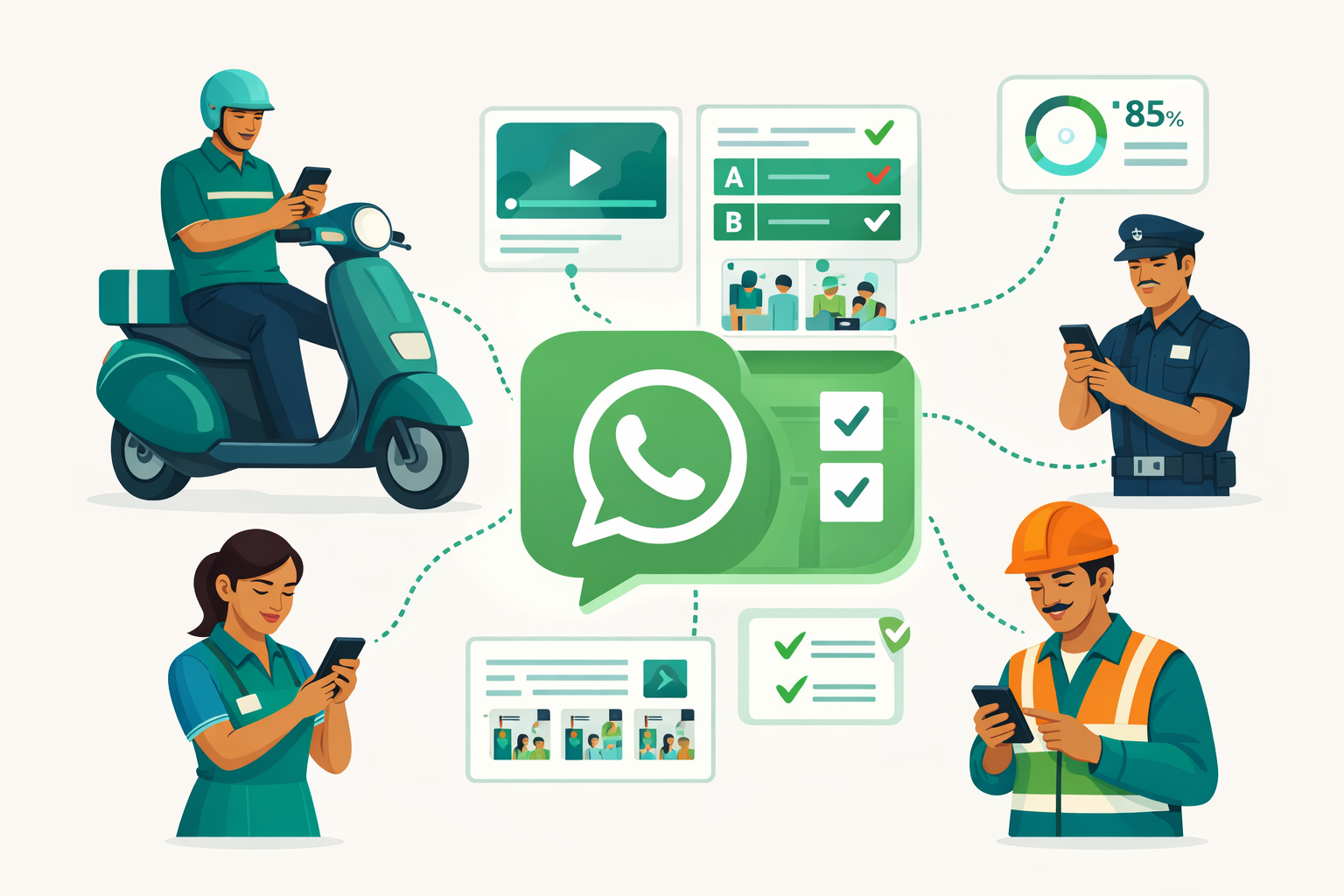
In India alone, WhatsApp has over 500 million active users. For a factory operator in Pune, a delivery rider in Hyderabad, or a retail associate in Chennai, WhatsApp isn't just a messaging app — it's their primary digital interface with the world. And that makes it the most natural, lowest-friction channel for employee engagement programmes that actually reach the people who matter most.
Here are 12 ways forward-thinking organisations are using WhatsApp to engage blue-collar workers — well beyond the training module.
1. Shift Confirmations and Schedule Updates
The old method: A printed roster pinned to a noticeboard that half the workforce doesn't check before heading to the wrong shift.
The WhatsApp method: Automated shift confirmation messages sent directly to each worker's phone. The worker taps "Yes, I will attend" or "No, I am on leave." The manager gets a real-time attendance forecast without making a single phone call.
Platforms like Leap10x Reach enable this through targeted broadcasts with tap-to-acknowledge receipts — giving you audit-ready records of who confirmed and who didn't.
2. Peer Recognition and Shoutouts
Blue-collar workers rarely receive the kind of recognition that knowledge workers take for granted — the Slack shoutouts, the email kudos, the "employee of the month" announcements in the team meeting they were never invited to.
WhatsApp changes this. Managers can broadcast recognition messages to team groups — celebrating a worker who maintained a zero-defect record, or a housekeeping supervisor who received exceptional guest feedback. When recognition arrives in the same app where workers talk to family, it feels personal, not corporate.
3. Safety Alerts and Emergency Broadcasts
When a chemical spill occurs on a factory floor, when a monsoon disrupts logistics routes, or when a heatwave threatens outdoor construction crews — the speed of your communication matters.
WhatsApp broadcasts with delivery tracking ensure every affected worker receives the alert instantly, and you can verify who read it. This is fundamentally different from a siren or a PA system, which can't tell you whether the night-shift workers who haven't arrived yet are aware of the situation.
With Leap10x Reach, safety alerts can be segmented by location, shift, and role — so the machine operators in Plant 3 receive the relevant hazard update without workers in Plant 1 being overwhelmed with irrelevant messages.
4. Policy Acknowledgements and Compliance Confirmations
Regulatory bodies increasingly demand proof that workers have received and acknowledged policy updates. A signed paper register doesn't scale across 50 sites and 10,000 contract workers.
WhatsApp-based policy distribution with explicit acknowledgement buttons creates a defensible audit trail. When the POSH committee distributes an updated policy, or when a new FSSAI guideline needs to reach every food-handling worker, WhatsApp ensures the message lands — and you can prove it did.
5. Employee Pulse Surveys and Feedback Collection
Traditional engagement surveys are designed for people who sit at desks with 20 minutes to spare. Frontline workers don't have that luxury.
Single-question pulse surveys delivered via WhatsApp — "How satisfied are you with your shift schedule this week? Reply 1-5" — achieve dramatically higher response rates than email-based alternatives. The data isn't perfect, but it's infinitely better than the zero responses you get from workers who never saw the survey.
Related reading: How to Run Employee Pulse Surveys on WhatsApp (And Get 80%+ Response Rates from Frontline Teams)
6. Onboarding Buddy Assignments
A new hire's first week on a factory floor is overwhelming. Instead of handing them a printed manual and hoping for the best, progressive companies are assigning WhatsApp-based onboarding buddies.
The new worker receives automated Day 1, Day 3, Day 7, and Day 14 check-ins via WhatsApp — a mix of training content (via Leap10x MicroLearning), helpful tips from their assigned buddy, and simple "How are you settling in?" pulse checks. This structured touchpoint system reduces early-stage attrition, which is notoriously high in blue-collar roles.
Related reading: Frontline Worker Onboarding in 2026: From Hire to Floor-Ready in Under a Week
7. AI-Powered Knowledge Support
Picture a machine operator who encounters an unfamiliar error code at 2 AM during a night shift. The supervisor is busy. The maintenance manual is in a locked office. What does the worker do? They guess. And sometimes, guessing leads to costly errors or safety incidents.
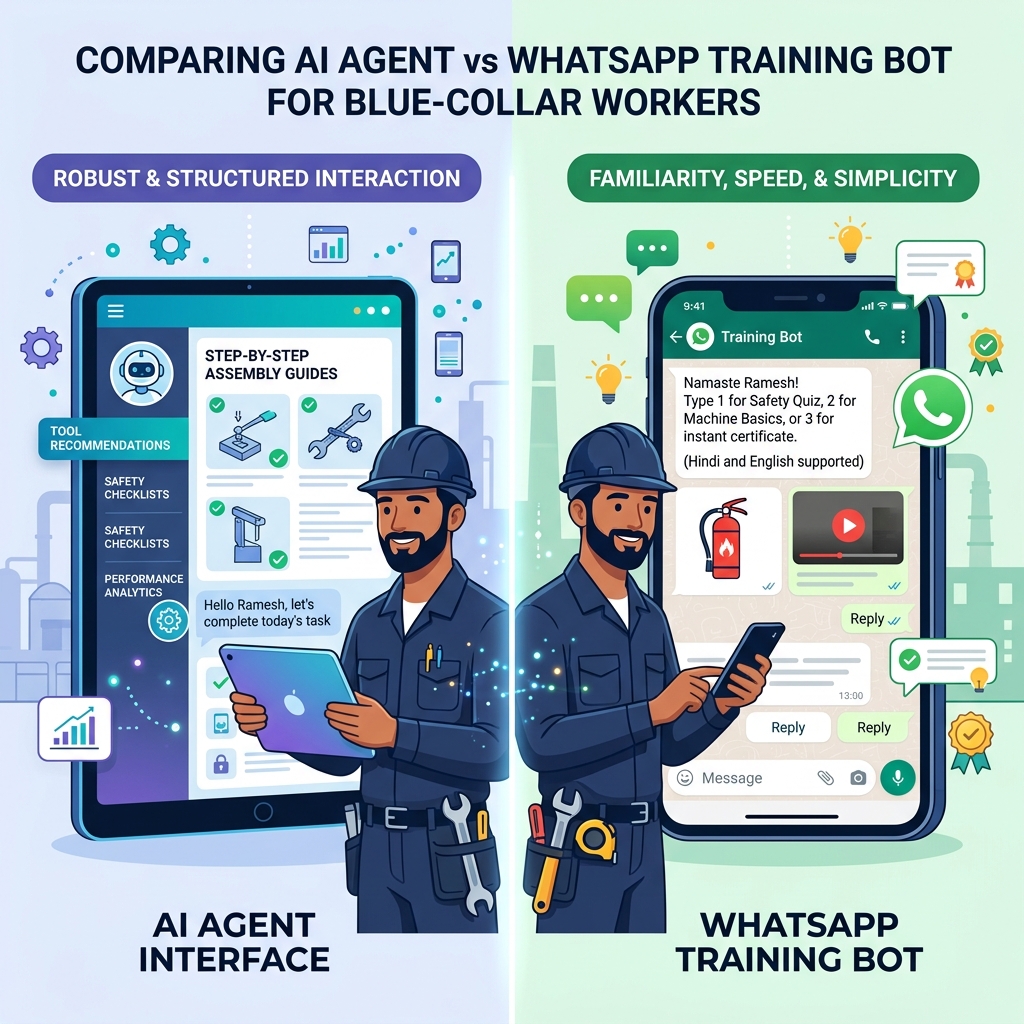
An AI knowledge assistant on WhatsApp — like Leap10x Assist — lets the worker send a voice note in their language: "What does Error E4 mean on Boiler 3?" The AI retrieves the answer directly from the company's SOP, cites the source page, and replies in seconds. No guessing. No waiting. No supervisor bottleneck.
8. Birthday and Milestone Celebrations
It sounds simple, but it matters enormously. When a contract worker at a large manufacturing plant receives a personalised WhatsApp message on their birthday — from the company, not just from a colleague — it signals that they're seen as more than a badge number.
Automated milestone messages for work anniversaries, tenure milestones, and personal celebrations can be triggered through WhatsApp broadcast systems. The cost is negligible. The impact on belonging is disproportionate.
9. Benefits and Perks Communication
Many blue-collar workers don't know what benefits they're entitled to. Insurance coverage, PF contributions, earned leave balances, wellness programmes — this information sits in HR portals that workers never visit.
WhatsApp-based benefits communication pushes this information directly to workers in their language. Some organisations are even enabling workers to check their leave balance or PF status via a WhatsApp chatbot, turning a traditionally inaccessible HR system into a conversational interface.
10. Grievance and Suggestion Reporting
Anonymous feedback channels are crucial for blue-collar engagement, but suggestion boxes in break rooms don't provide anonymity when your handwriting is recognisable.
WhatsApp-based grievance reporting — where a worker can message a dedicated number to flag a concern, which is then routed to the relevant department — provides a more accessible and confidential channel. Leap10x Reach's two-way routing capability can automatically direct hazard reports to EHS, HR complaints to the compliance team, and product queries to L&D.
11. Contest and Gamification Announcements
Engagement spikes when work becomes a game. WhatsApp is an ideal channel for announcing daily contests ("Which team can achieve zero-defect production today?"), sharing leaderboards, and celebrating winners.
The visual, immediate nature of WhatsApp — combined with its notification prominence on the worker's phone — makes these nudges far more effective than email or intranet announcements.
12. Exit Feedback and Rehire Communication
When a frontline worker resigns, organisations rarely conduct meaningful exit interviews. The worker leaves, and their reasons for leaving remain a mystery.
WhatsApp-based exit surveys — short, conversational, and delivered on their personal device after their last day — capture feedback from a population that traditionally goes unheard. And when seasonal rehiring cycles begin, WhatsApp is the fastest channel to reconnect with proven workers from previous cohorts.
The Bigger Picture: WhatsApp as a Frontline Operating System
Each of these use cases works independently. But the real transformation happens when they're unified into a single platform.
Leap10x's Frontline Training OS combines four interconnected layers on WhatsApp — MicroLearning for training, Reach for enterprise communication, Assist for AI knowledge support, and Converse for voice-based assessments. Together, they transform WhatsApp from a messaging app into a complete operational layer for your frontline workforce.
Training is the foundation. But engagement is the superstructure. And for blue-collar workers, both need to live in the one app they already use every day.
What to Do Next
If your organisation already uses WhatsApp for frontline training, you're halfway there. The infrastructure exists. The worker adoption is proven. Now expand the canvas.
Start with one or two use cases from this list — shift confirmations and pulse surveys are the easiest wins — and build from there. The technology isn't the barrier. The mindset shift is: WhatsApp isn't just a training channel. It's the engagement platform your blue-collar workforce has been waiting for.
Ready to extend WhatsApp beyond training? Leap10x combines microlearning, enterprise communication, AI knowledge support, and voice assessments — all on WhatsApp. Book a free demo and see how your frontline engagement can transform.
Internal Backlinks: