What Is a Frontline Training OS - and Why Is It Replacing Your LMS?
Here's a scene that plays out in thousands of Indian enterprises every quarter.
The L&D team spends three weeks building a compliance training module in the LMS. IT deploys it to the portal. HR sends an email blast with login instructions. And then... 22% completion. Mostly from people who already knew the material. The factory floor operators, delivery partners, and field sales agents - the people who actually needed the training - never opened it.
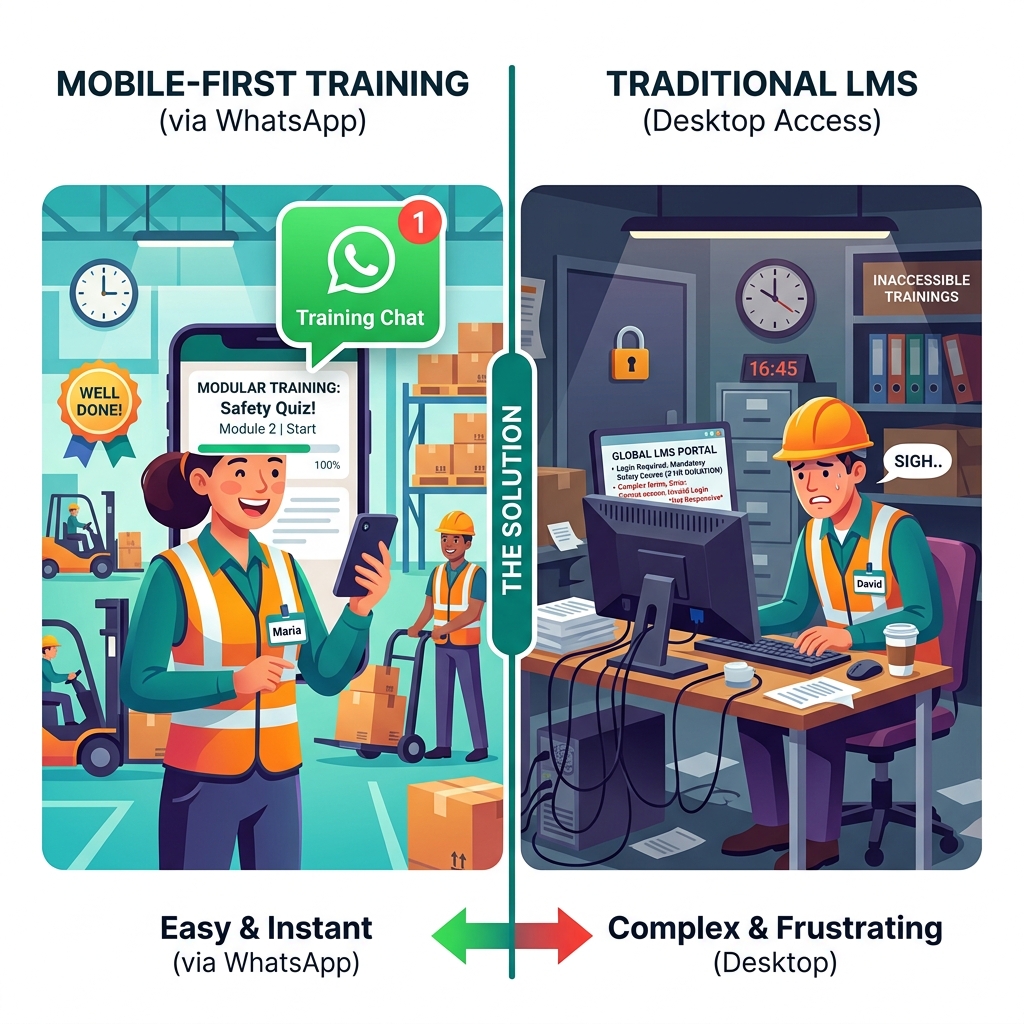
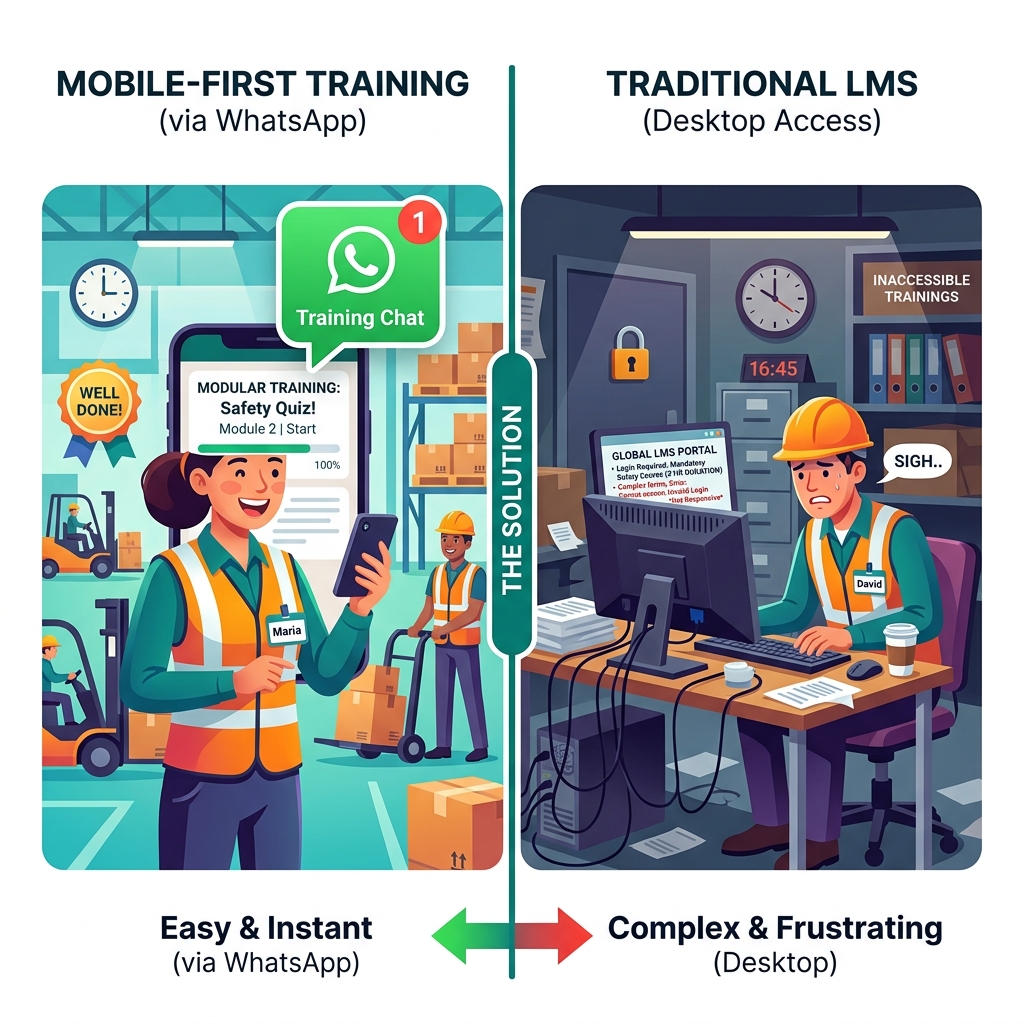
This isn't a content quality problem. It's an infrastructure problem. Your LMS was designed for people who sit at desks with laptops and company email addresses. Roughly 80% of the world's workforce doesn't match that description.
This is why a new category is emerging in enterprise learning: the Frontline Training OS - an operating system purpose-built for the way deskless workers actually learn, communicate, and get verified.
What Exactly Is a Frontline Training OS?
A Frontline Training OS is a unified platform that combines training delivery, enterprise communication, AI knowledge support, and workforce assessment into a single system - all accessible through channels frontline workers already use (primarily WhatsApp, SMS, and voice calls).
Think of it as the difference between installing individual apps for every function versus having an operating system that ties everything together.
A traditional LMS does one thing: host and deliver courses. A Frontline Training OS does four:
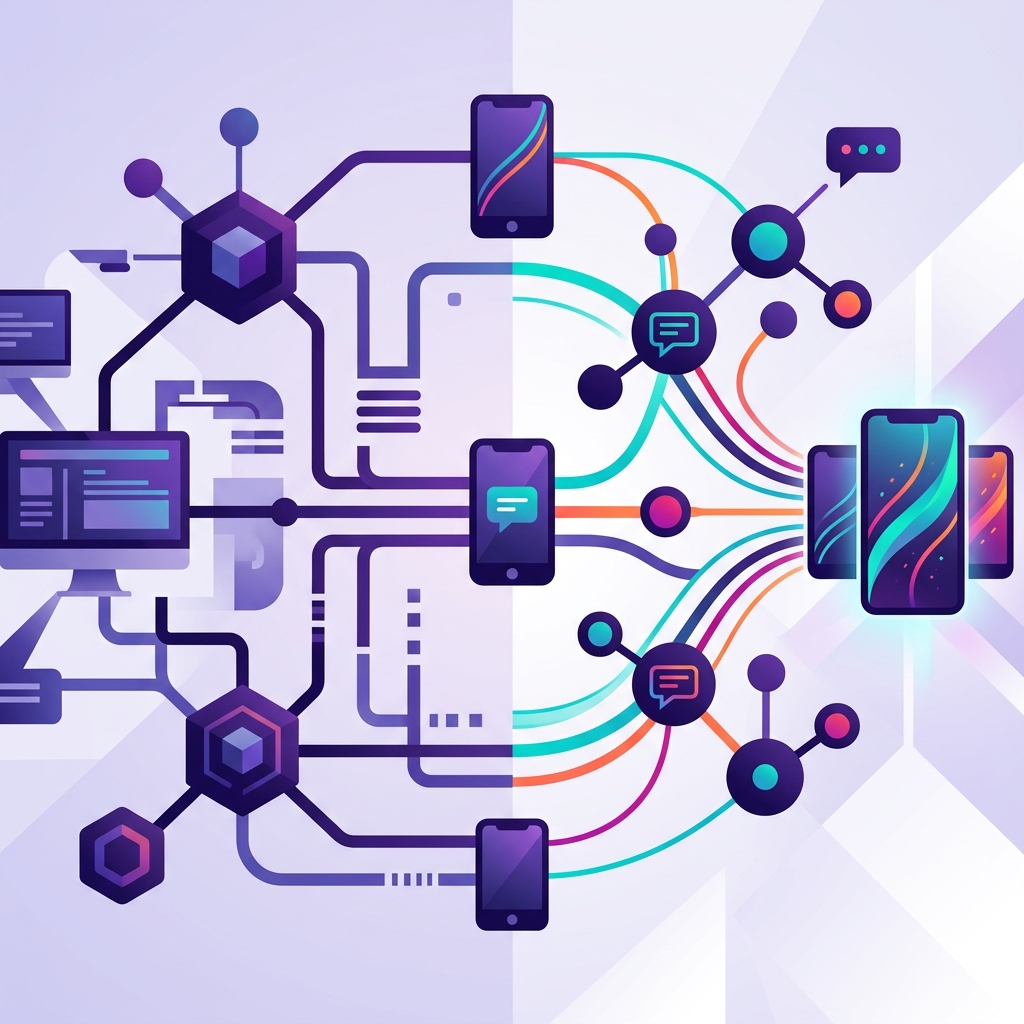
The "OS" framing isn't marketing fluff. It reflects a genuine architectural shift - from isolated training tools to an integrated operational layer that sits on top of your workforce's existing communication channels.
Why the LMS Fails the Frontline (The Core Problem)
The learning management system was invented in the late 1990s for a world of desktop computers and corporate intranets. It was genuinely revolutionary for office-based knowledge workers. But asking it to train a delivery rider in Jaipur or a machine operator in Bhiwadi is like asking Microsoft Outlook to manage a factory floor.
Gartner Digital Markets data reveals that 42% of businesses replaced their LMS between 2022 and 2023 due to limited functionality. An additional 15% cited tool inefficiency, and 14% pointed to poor user experience. For organisations with large frontline populations, these numbers are likely even higher.
Here's why the LMS structurally fails frontline workers:
The App Download Barrier
Most frontline LMS platforms require a dedicated app. App downloads are the single biggest friction point for deskless workers. Many frontline employees in India use budget smartphones with limited storage. Asking them to download, install, and maintain yet another app - one they associate with "work homework" - creates immediate resistance.
The Email Login Barrier
A staggering 83% of frontline workers don't have corporate email accounts. An LMS that requires email-based authentication is effectively locked to the 17% of your workforce that's already the easiest to train.
The Language Barrier
Most LMS platforms were built for English-speaking markets. They might translate the interface buttons, but the actual training content remains in English. For a workforce spanning Tamil Nadu, Gujarat, West Bengal, and Maharashtra, this makes the training decorative rather than functional.
The Invisible Contractor Problem
Between 30% and 70% of the frontline workforce in Indian enterprises is contract or off-roll. These workers aren't in your HRMS. They don't have employee IDs. Your LMS literally cannot see them - which means you have zero training records for a significant chunk of your operational workforce.
Related reading: Why Your LMS Will Never Solve Frontline Training (And What Actually Works)
The Four Layers of a Frontline Training OS
Layer 1 - MicroLearning (Train)
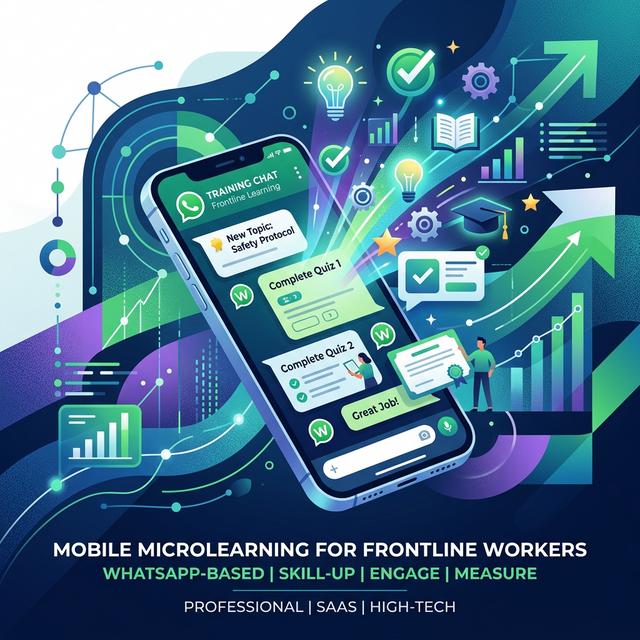
The foundational layer replaces traditional e-learning with bite-sized, mobile-first microlearning delivered through WhatsApp or SMS. Content is created using AI from existing SOPs and PDFs - no instructional design team required.
Key characteristics:
- Lessons formatted as Instagram Stories-style cards (video, quiz, key point, summary)
- Auto-translated into 70+ languages
- Pushed to workers at shift-start rather than waiting for them to visit a portal
- Real-time completion tracking and audit-ready certificates
Related reading: Microlearning for Frontline Workers: The Complete Guide
Layer 2 - Enterprise Communication (Reach)
Training doesn't exist in a vacuum. Workers need to know about policy changes, shift updates, safety alerts, and new product launches. A Training OS integrates targeted communication with training - allowing you to broadcast a regulatory update to 5,000 branch staff, track who read it, collect acknowledgement receipts, and trigger a follow-up micro-course for those who didn't engage.
Layer 3 - AI Knowledge Support (Assist)
Here's a question most L&D teams don't ask: what happens after the training ends and the worker faces a real situation?
They call their supervisor. Their supervisor is busy. So they guess. And sometimes, guessing leads to compliance breaches, safety incidents, or customer service failures.
The AI knowledge layer gives every worker a 24/7 co-pilot that can answer questions from your company's SOPs and manuals - in their language, via voice note or text, on WhatsApp.
Related reading: Agentic AI in Employee Training: Why Your LMS Needs to Start Talking Back
Layer 4 - Conversational Assessment (Verify)
The most overlooked gap in frontline training is verification. Did the worker actually understand the training, or did they just tap through the quiz?
AI voice assessment closes this gap. An AI agent calls workers on their phones, conducts a natural-language conversation about the training topic, and scores their verbal answers against a rubric. It works in 70+ languages, on basic feature phones, and can assess 10,000 workers simultaneously.
Related reading: How to Assess 10,000 Frontline Workers Without a Single Test Paper (or App)
Who's Building Frontline Training Operating Systems?
The "Frontline OS" concept is gaining momentum across the enterprise software landscape.
Fountain recently launched what it calls Frontline OS - an AI-native operating system focused on hiring, onboarding, and workforce management for the 2.7 billion global frontline workers. Microsoft is positioning Microsoft 365 with specific frontline worker tools and Viva Learning integrations.
In the training-specific space, Leap10x has built a complete frontline training OS on WhatsApp - combining MicroLearning, Reach (communications), Assist (AI knowledge assistant), and Converse (AI voice assessment) into a unified platform. The WhatsApp-native approach is particularly relevant in India and emerging markets, where WhatsApp penetration among frontline workers is near-universal.
When Does Your Organisation Need a Training OS?
You likely need to move beyond a traditional LMS if:
- More than 50% of your workforce is deskless. If the majority of the people you need to train don't sit at desks, your desktop-first LMS is reaching a minority.
- Your completion rates are below 40%. This isn't a motivation problem - it's an access problem.
- You have significant contract or off-roll workers. If your LMS can't reach people who aren't in your HRMS, you have a massive compliance blind spot.
- Training is in English but your workforce isn't. You're not training - you're documenting in a language your workers can't fully comprehend.
- You can't prove comprehension, only completion. Regulators and auditors increasingly want evidence that workers understood the material, not just that they clicked through it.
Related reading: Reduce Frontline Attrition with Better Training: Data Guide
The Bottom Line
The LMS isn't dying. For office-based knowledge workers, compliance teams, and leadership development programs, it still has a role.
But for the 80% of the global workforce that doesn't sit behind a desk, the LMS was never built for them. The Frontline Training OS is the answer - not because it's newer or shinier, but because it's designed around how frontline work actually happens.
The LMS Frontline Worker Training market reached $16.88 billion in 2025 and is projected to grow at 12.5% CAGR through 2033. The organisations that move first will set the standard for their industries.
See what a Frontline Training OS looks like in action. Leap10x combines microlearning, communications, AI knowledge support, and voice assessment - all on WhatsApp. No app downloads. No LMS migration. Your first training module can go live in 24 hours.