How to Build a Frontline Training Stack That Doesn't Need an LMS
Quick answer
Forty-two percent of businesses replaced their LMS between 2022 and 2023. The reasons cited?
Forty-two percent of businesses replaced their LMS between 2022 and 2023. The reasons cited? Limited functionality (42%), tool inefficiency (15%), and poor user experience (14%).
Now consider that these numbers come from organisations where most employees work at desks with laptops. For companies where the majority of workers are on factory floors, delivery routes, retail stores, or hospital wards, the dissatisfaction with traditional LMS is even more pronounced.
The question L&D leaders are increasingly asking isn't "which LMS should we buy?" It's "do we need an LMS at all?"
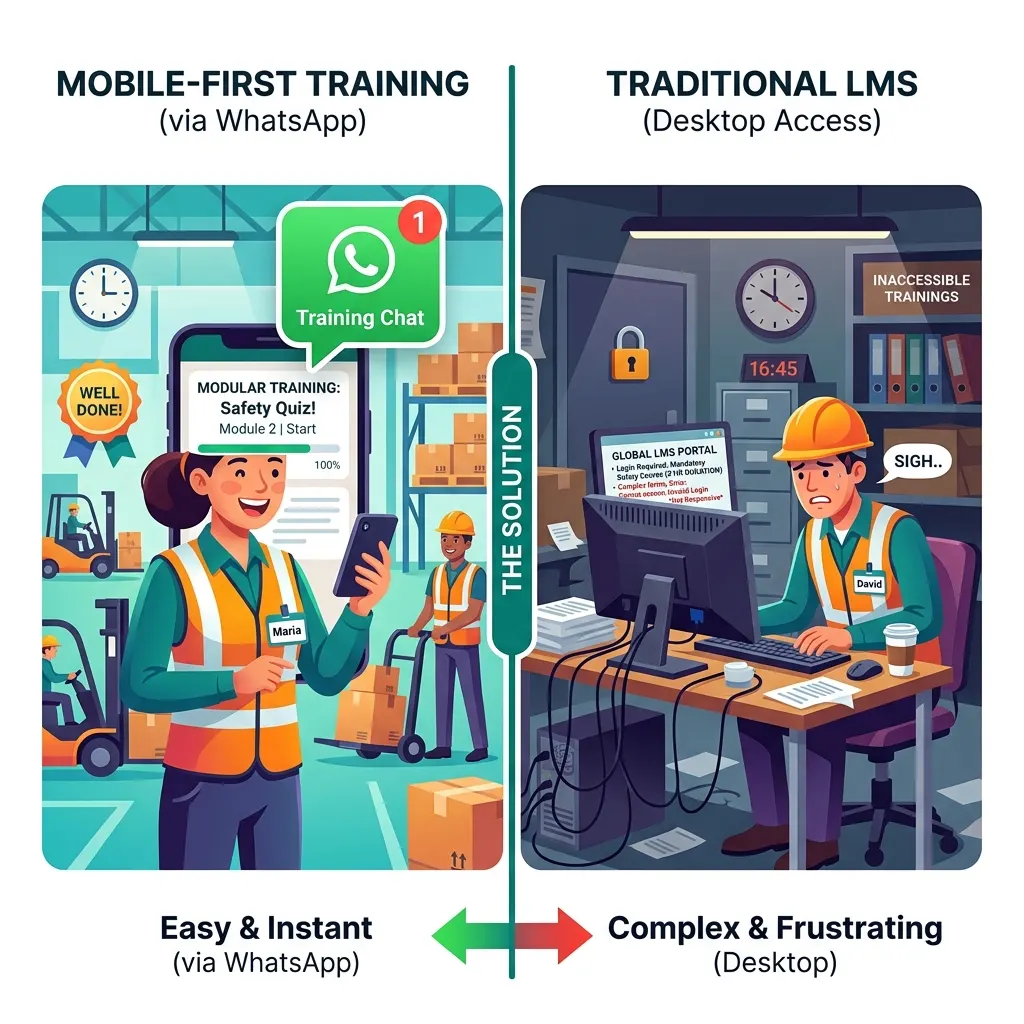
For organisations with large frontline workforces, the answer is often no - not because training technology is unnecessary, but because the LMS architecture is fundamentally mismatched with how frontline workers access information. What you need instead is a training stack built from the ground up for deskless work.
This guide shows you how to assemble that stack.
Why the Traditional LMS Architecture Fails Frontline Workers
The LMS was born in the late 1990s as a web-based course management system. Its core assumptions:
- Learners have desktop or laptop access
- Learners have corporate email for authentication
- Training happens in dedicated time blocks (30-90 minutes)
- Content is created by instructional designers using authoring tools
- Progress is tracked through SCORM/xAPI standards
For office-based workers, these assumptions still hold. For the frontline, every single one breaks down.
Your delivery partner doesn't have a laptop. Your factory operator doesn't have a corporate email. Your retail associate doesn't have 45 minutes of uninterrupted time. Your L&D team of three doesn't have bandwidth for months of SCORM development.
Bolting a mobile app onto an LMS doesn't solve this. It just puts the same wrong architecture on a smaller screen.
Related reading: Why Your LMS Will Never Solve Frontline Training (And What Actually Works)
The Four Components of a Modern Frontline Training Stack
A frontline training stack replaces the monolithic LMS with purpose-built components that each solve a specific problem.
Component 1 - WhatsApp-Native Microlearning (Replace the Course Library)
What it replaces: LMS course catalogue, SCORM modules, e-learning portal
What it does: Delivers bite-sized training directly to workers' WhatsApp as Instagram Stories-style cards - video, key point, quiz, certificate. AI generates courses from existing PDFs and SOPs in under 10 minutes, auto-translated into 70+ languages.
Why it works better: No app download, no login, no email required. Workers tap a link and start learning. Completion rates jump from 20-30% (LMS) to 85%+ (WhatsApp delivery).
With Leap10x MicroLearning, you upload a safety SOP in English, the AI converts it into a structured micro-course, and it's live on WhatsApp in Hindi, Tamil, Bengali, and 67 other languages within minutes.
Component 2 - Targeted Communication Hub (Replace Email + Intranet)
What it replaces: Company email blasts, HR portal announcements, personal WhatsApp groups
What it does: Broadcasts critical updates directly to workers' WhatsApp with read receipts, tap-to-acknowledge buttons, and audit-ready logs.
Why it works better: Email open rates among frontline workers hover near zero. A proper communication hub gives you the audit trail of email with the reach of WhatsApp.
Component 3 - AI Knowledge Assistant (Replace the Helpdesk)
What it replaces: Supervisor phone calls, shared drives full of PDFs, unofficial ChatGPT usage
What it does: An AI co-pilot on WhatsApp that answers worker questions from your company's own SOPs and manuals. Uses RAG architecture - only answers from documents you upload, cites its sources, and routes to a human supervisor when it doesn't know.
Related reading: AI-Generated SOPs for Manufacturing: How to Create Training Content in Minutes, Not Weeks
Component 4 - Conversational Assessment (Replace MCQ Quizzes)
What it replaces: LMS quiz modules, manual audit calls, paper-based assessments
What it does: An AI voice agent calls workers on their phones, conducts a natural-language conversation about training topics, and scores their verbal answers against a configurable rubric. Works on basic feature phones.
Related reading: Voice-Based Skills Assessment: The Missing Piece in India's Blue-Collar Training Stack
Building Your Stack - A Practical Roadmap
Phase 1 - Start with Microlearning
Pick one high-priority use case and deploy a microlearning pilot to 100-200 workers. Success criteria: 70%+ completion rate within 48 hours.
Phase 2 - Add Communication
Layer in enterprise communications. Start with shift confirmations, safety alerts, or policy update acknowledgements.
Phase 3 - Deploy AI Knowledge Support
Upload your most-referenced SOPs and manuals into the AI knowledge assistant. Measure reduction in supervisor queries.
Phase 4 - Implement Conversational Assessment
For compliance-critical training, add voice-based assessment as the verification layer.
What About Compliance and Audit Requirements?
A well-built frontline training stack actually provides better audit evidence than a traditional LMS:
- Delivery proof: WhatsApp delivery receipts confirm the training reached the worker's phone.
- Completion proof: Module-level completion data with timestamps.
- Comprehension proof: Quiz scores and conversational assessment transcripts.
- Acknowledgement proof: Tap-to-acknowledge buttons with timestamps.
Related reading: NBFC Compliance Training via WhatsApp: A Complete Playbook for 2026
When Should You Keep the LMS?
Traditional LMS platforms still make sense when:
- Your workforce is primarily desk-based with company laptops and email
- You need to deliver long-form certification courses
- You're running leadership development programmes
- Your organisation has already invested heavily in SCORM content
The key insight is that most large organisations need both - an LMS for their office-based population and a frontline training stack for their deskless workers.
The Bottom Line
Companies lose an average of $13.5 million per 1,000 employees every year due to insufficient training. Building a frontline training stack from purpose-built components isn't more complex than managing an LMS. It's simpler, because each component does exactly what the frontline needs without the overhead of desktop-era assumptions.
Ready to build a training stack that actually reaches your frontline? Leap10x combines microlearning, communications, AI knowledge support, and voice assessment - all on WhatsApp. No LMS migration needed.
WhatsApp LMS
Everything an LMS does — inside WhatsApp
Course libraries, enrolment, assessments, certificates, and audit-ready completion logs, with WhatsApp as the learner interface instead of a portal nobody opens.