AI Agents in Corporate L&D: What Autonomous Learning Bots Mean for Training Teams
Quick answer
For the past two years, AI in corporate learning has meant one thing: content generation. Feed a prompt into an AI tool, get a training module out.
The Shift from AI Tools to AI Agents
For the past two years, AI in corporate learning has meant one thing: content generation. Feed a prompt into an AI tool, get a training module out. It's faster, cheaper, and good enough for most use cases. According to Docebo's 2026 research, 79% of learning leaders already use AI for tasks like content creation, assessments, and recommendations.
But here's the number that reveals the real story: only 9% say their organizations have used AI to fully redefine their workflows.
That 9% is about to grow dramatically. The L&D industry is witnessing a fundamental shift - from AI as a tool you use, to AI as an agent that acts on your behalf. And the implications for training teams, especially those managing large frontline workforces, are profound.
At Docebo's Inspire 2026 conference, the company announced AgentHub - AI agents that don't just respond to queries but reason, decide, and act autonomously. These agents deliver personalized learning reminders, run skills campaigns, support content creation, and execute learning programs without someone manually setting everything in motion.
Josh Bersin, the world's most influential HR analyst, put it more bluntly in his March 2026 article: Arist's "AI Performance Consultant" - which interviews operational staff, identifies performance problems, and then automatically builds training content to address them - represents "the first big step toward autonomous corporate learning, where the agent finds problems and solves them like a self-driving car."
We're not talking about chatbots. We're talking about AI systems that manage learning programs from end to end.
What Are AI Agents in L&D?
An AI agent is fundamentally different from an AI tool. Here's the distinction:
AI Tool: You ask it to do something. It does that thing. You review the output. You decide what to do next.
Example: You prompt an AI to generate a safety training quiz. It produces 10 questions. You review them, edit three, and upload the quiz to your LMS.
AI Agent: You define an objective. It figures out how to achieve it. It takes actions autonomously. It adapts based on results.
Example: You tell the agent "Reduce safety incidents at the Chennai plant." The agent analyzes training completion data, identifies that machine lockout/tagout quiz scores are low among second-shift workers, generates a targeted 3-minute refresher module, deploys it via WhatsApp to those specific workers in Tamil, tracks quiz improvement, and reports back on whether safety metrics improved.
The agent didn't wait for instructions at each step. It identified the problem, created the intervention, delivered it, and measured the outcome - autonomously.
BCG's 2025 AI at Work survey found that just 13% of employees see AI agents deeply integrated into their daily workflows, and only one-third understand how these systems function. But when workers are well-informed and familiar with AI agents, apprehension turns into enthusiasm.
Five Ways AI Agents Will Transform L&D
1. Proactive Gap Detection
Today's L&D teams are reactive. They build training when someone requests it, when a compliance deadline approaches, or when an incident triggers a response. AI agents flip this model.
An AI agent continuously monitors performance data - quiz scores, completion rates, safety metrics, customer satisfaction trends - and proactively identifies emerging skills gaps before they become operational problems. It doesn't wait for the L&D team to notice that quality defect rates are rising at a specific factory. It detects the pattern, traces it to a training gap, and initiates a response.
2. Autonomous Content Creation and Deployment
When a gap is identified, the agent doesn't just flag it for a human to address. It accesses your organization's knowledge base - SOPs, safety manuals, process documents - and generates targeted micro-training content. It selects the appropriate format (quiz, video, scenario), translates it into the required language, and deploys it to the right workers through the right channel.
The content creation bottleneck that forces L&D teams to choose between speed and quality disappears. The agent produces both - fast content grounded in your organization's own verified knowledge.
3. Personalized Learning at Scale
Personalizing training for 50,000 frontline workers across 20 facilities isn't humanly possible with a 5-person L&D team. AI agents make it viable. Each worker receives training tailored to their role, their knowledge gaps (based on quiz performance), their language, and their learning patterns. Workers who master content quickly get advanced challenges. Workers who struggle get additional reinforcement.
Docebo's report found that 79% of employees say their learning isn't fully personalized, and 63% of learning leaders agree they're falling short. AI agents close this personalization gap at a scale no human team can match.
4. Intelligent Nudge Orchestration
Instead of L&D teams manually scheduling reminders and follow-ups, AI agents orchestrate nudge sequences based on individual learner behavior. If a worker opened a safety module but didn't complete the quiz, the agent sends a specific reminder. If a worker scored poorly on a compliance assessment, the agent automatically schedules a refresher at the optimal spaced repetition interval. If engagement drops across a particular site, the agent adjusts timing or format to re-engage learners.
5. Closed-Loop Impact Measurement
Perhaps most importantly, AI agents close the loop between training delivery and business outcomes. They track whether targeted interventions actually moved the needle - did safety incidents decrease? Did customer satisfaction improve? Did onboarding time shrink? - and use these results to refine future interventions.
This addresses the fundamental challenge that fewer than 25% of learning leaders can confidently connect learning to business results. AI agents don't just deliver training - they prove whether it worked.
What This Means for L&D Teams
AI agents don't replace L&D professionals. They change the nature of the work. Instead of spending 80% of their time on content creation, LMS administration, and manual reporting, L&D teams shift to:
- Strategic oversight: Defining learning objectives that align with business strategy
- Quality assurance: Reviewing and refining AI-generated content
- Stakeholder management: Communicating training impact to leadership
- Program design: Architecting learning experiences that agents can execute
- Exception handling: Addressing complex situations that agents escalate
The shift is analogous to what happened in marketing when automation tools emerged. Marketing teams didn't shrink - they became more strategic. The same will happen in L&D.
AI Agents for Frontline Training: The First Major Use Case
Frontline training is where AI agents will prove their value first. Here's why:
Scale demands automation. Training 50,000 factory workers manually is impractical. AI agents make it feasible.
Data is readily available. Frontline operations generate abundant performance data - safety incidents, quality metrics, productivity numbers - that agents can use to identify gaps and measure impact.
Speed matters. When a new safety regulation takes effect or a product recall requires immediate retraining, AI agents can generate and deploy training in hours, not weeks.
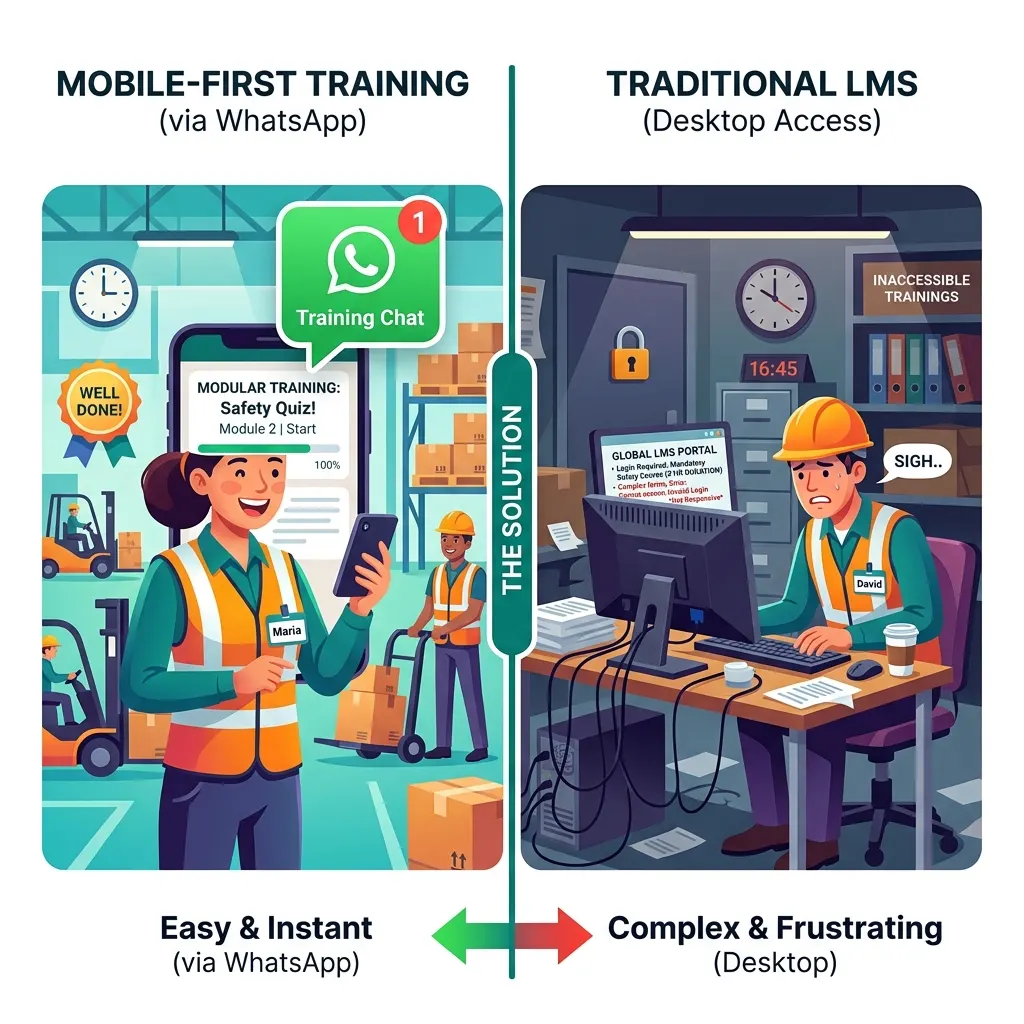
The delivery channel is established. WhatsApp-based delivery is already proven for frontline workforces. AI agents simply automate what L&D teams currently do manually on these channels.
Platforms like Leap10x already demonstrate elements of this agent-driven model - AI that converts SOPs into micro-training, automated WhatsApp delivery schedules, real-time analytics that identify knowledge gaps, and intelligent content recommendations based on learner performance. The progression from these capabilities to fully autonomous learning agents is evolutionary, not revolutionary.
Preparing Your Organization for AI Agents in L&D
Invest in Your Knowledge Base
AI agents are only as good as the knowledge they can access. Start organizing your SOPs, safety manuals, process documents, and training materials in digital, structured formats. This becomes the foundation that agents draw from when creating content.
Build Data Infrastructure
Connect your training data to operational data. AI agents need the link between learning metrics and business outcomes to function effectively. If your training completions live in one system and your safety incident data lives in another, the agent can't close the loop.
Start with Pilot Use Cases
Don't try to deploy AI agents across your entire L&D operation at once. Start with a high-impact, well-defined use case - safety compliance at one facility, onboarding at one region, product knowledge for one product line. Prove the model, measure results, then scale.
Upskill Your L&D Team
Your L&D professionals need to understand how to define objectives for AI agents, review AI-generated content, interpret agent-driven analytics, and manage exceptions. This is a skills development need within the L&D team itself.
The Bottom Line
AI agents in L&D aren't a distant future - they're arriving now. Docebo's AgentHub, Arist's AI Performance Consultant, and the broader wave of agentic AI applications signal a fundamental shift in how corporate training operates.
For organizations with large frontline workforces, this shift solves the persistent challenge of delivering personalized, timely, effective training at scale - without proportionally scaling the L&D team. The companies that embrace AI agents early will build learning operations that are faster, more responsive, and more tightly connected to business outcomes than anything traditional approaches can deliver.
The question isn't whether AI agents will reshape L&D. It's whether your organization will be an early mover or a late adopter.
Experience AI-powered frontline training that works autonomously. Leap10x's AI converts your knowledge base into WhatsApp micro-training, delivers it at the right time, and tracks real impact - so your L&D team can focus on strategy, not administration. See it in action.
WhatsApp LMS
Everything an LMS does — inside WhatsApp
Course libraries, enrolment, assessments, certificates, and audit-ready completion logs, with WhatsApp as the learner interface instead of a portal nobody opens.