The AI Readiness Gap for Frontline Workers: Why Generic AI Training Fails on the Shop Floor
Quick answer
Every corporate boardroom in 2026 is buzzing about AI readiness.
The $5.5 Trillion Problem Nobody Is Talking About
Every corporate boardroom in 2026 is buzzing about AI readiness. Reports from Docebo, BCG, and IDC all agree: the workforce isn't prepared for an AI-driven economy. But here's the part that gets buried in the footnotes - the employees hit hardest by this gap aren't software engineers or marketing managers. They're factory operators, delivery riders, warehouse workers, and retail associates.
IDC estimates that sustained skills shortages risk costing the global economy up to $5.5 trillion by 2026 in product delays, quality issues, and missed revenue. And 94% of CEOs now identify AI as their top in-demand skill. Yet only 35% of leaders feel they've prepared employees effectively for AI roles.
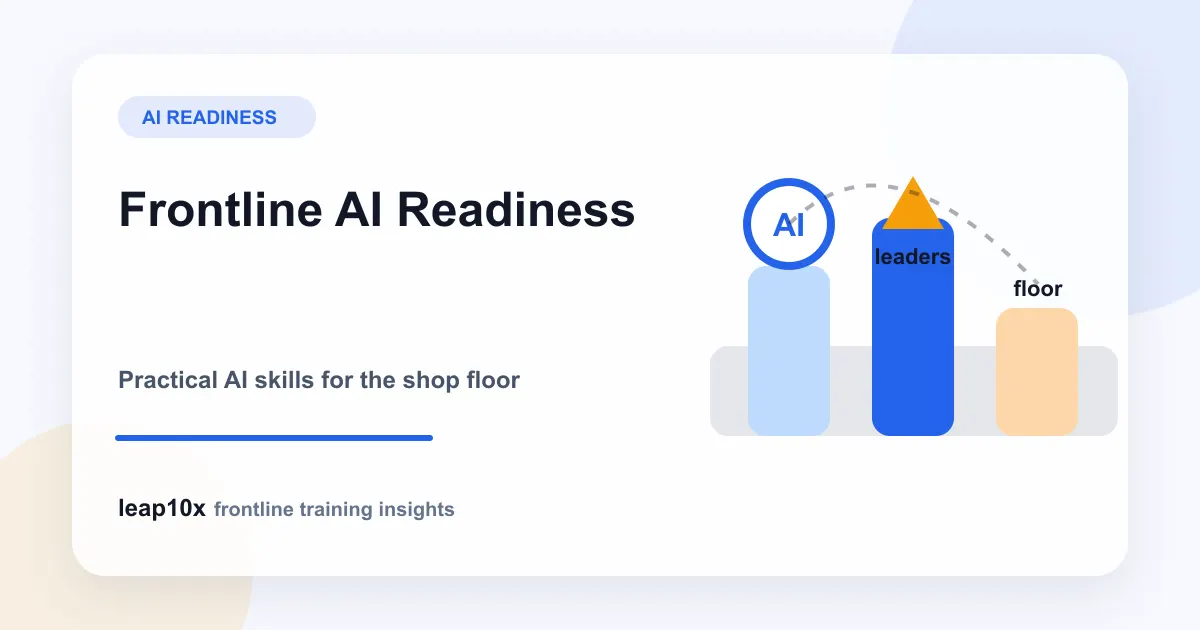
For frontline workers - the 80% of the global workforce who don't sit at desks - these numbers are even more alarming. BCG's 2025 AI at Work survey of over 10,600 employees across 11 countries found that frontline employees have hit what researchers call a "silicon ceiling." While 75% of leaders and managers use generative AI several times a week, only 51% of frontline employees use it regularly.
The question isn't whether AI will reshape frontline work. It already is. The question is whether your training strategy is keeping up - or falling further behind.
Why Generic AI Training Misses the Mark for Frontline Workers
Docebo's April 2026 report, "The AI Readiness Gap: The 2026 Enterprise Learning Wake Up Call," surveyed 2,000 enterprise respondents and found that 85% of employees say the training they receive does not help them use AI in their role. Nearly 60% feel their organization's learning programs aren't designed with people like them in mind.
But Docebo's report - and most AI readiness content out there - focuses on knowledge workers sitting at laptops with corporate email addresses. When you look at frontline workers specifically, the problems multiply:
No Access to Traditional Training Channels
Your factory operator in Pune doesn't have a laptop. Your delivery rider in Hyderabad doesn't have a company email. Your retail associate in Chennai isn't going to log into an LMS portal between customers. According to research, only 42% of warehouse employees in India have a high school diploma, and just 5% hold a bachelor's degree. Expecting them to navigate complex AI training platforms designed for office workers is setting them up to fail.
Language Barriers Kill Comprehension
Most AI training content is created in English. But India's frontline workforce speaks Tamil, Hindi, Telugu, Kannada, Marathi, Bengali, and dozens of other languages. Training in a language workers don't fully understand doesn't build skills - it checks boxes. Mother tongue training has been shown to dramatically improve knowledge retention and application in the workplace.
Time Poverty Is Real
BCG found that more than half of learners report not having enough time during the day to complete learning. For frontline workers with shift-based schedules, even 30 minutes is a luxury. They have five-minute gaps between machine cycles, waiting periods before pickups, or brief breaks before the afternoon rush. AI training that requires hour-long modules simply won't reach them.
The "Silicon Ceiling" Is Structural, Not Motivational
BCG's research revealed something critical: when leaders demonstrate strong support for AI, frontline employees are significantly more likely to use it regularly and feel positive about their careers. The share of employees who feel positive about GenAI rises from 15% to 55% with strong leadership support. But only about one-quarter of frontline employees say they receive that level of support.
This isn't a motivation problem. It's a delivery problem.
What AI Readiness Actually Looks Like on the Shop Floor
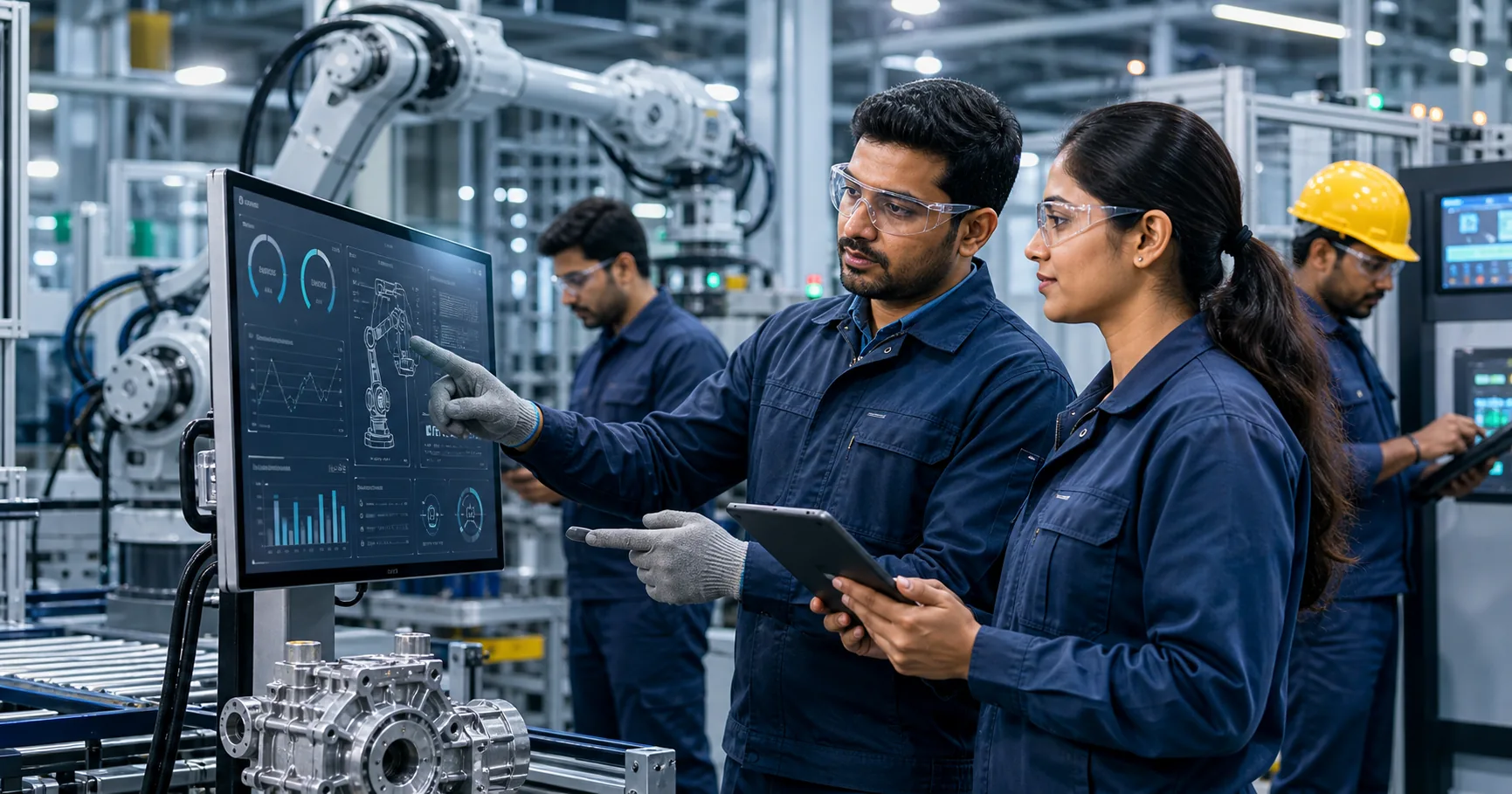
AI readiness for a factory worker doesn't mean learning to write prompts for ChatGPT. It means understanding how AI-powered quality inspection systems flag defects, how predictive maintenance alerts work, how automated scheduling affects their shifts, and how to interpret data dashboards that now appear on shop floor screens.
Here's what practical AI readiness training looks like for frontline roles:
For Manufacturing Workers
- Understanding AI-powered quality control alerts and how to respond
- Reading and acting on predictive maintenance notifications
- Using digital work instructions generated by AI systems
- Basic data literacy: interpreting production dashboards
For Retail Associates
- Working alongside AI-powered inventory management systems
- Using AI-assisted customer recommendation tools
- Understanding how automated pricing works
- Engaging with AI chatbots as internal support tools
For Logistics and Delivery Workers
- Following AI-optimized route suggestions
- Understanding how automated sorting systems prioritize packages
- Using voice-enabled AI tools for hands-free task management
- Interpreting real-time performance analytics
For BFSI Frontline Staff
- Understanding AI-driven customer risk scoring
- Working with AI-powered fraud detection alerts
- Using automated compliance checking tools
- Interpreting AI-generated customer insights
The World Economic Forum's Future of Jobs Report 2025 estimates that 59% of the global workforce will need reskilling by 2030, and skills in AI-exposed jobs are changing 66% faster than in other jobs. For Indian enterprises with thousands of frontline workers, the clock is ticking.
How to Close the AI Readiness Gap for Your Frontline
BCG's research identified a clear threshold: employees who receive at least five hours of AI training show significantly higher regular usage and confidence. In-person coaching makes the biggest difference across age groups. But for dispersed frontline workforces, in-person coaching at scale is impossible.
Here's what works instead:
1. Deliver Training Where Workers Already Are
If 90% of your frontline workers use WhatsApp daily, delivering AI training through a separate app is fighting gravity. Platforms like Leap10x deliver micro-training directly through WhatsApp conversations - workers tap a link and start learning immediately. No app downloads, no sign-ups, no passwords. This approach consistently achieves 85%+ completion rates compared to 20-30% for traditional LMS portals.
2. Make It Bite-Sized and Contextual
A three-minute module on "How to read your new AI quality dashboard" that a worker completes between machine cycles is infinitely more valuable than a 90-minute AI literacy course they'll never finish. Break AI concepts into role-specific micro-modules tied to tools workers actually encounter on the job.
3. Train in the Worker's Mother Tongue
AI training in English for a workforce that thinks in Hindi, Tamil, or Telugu creates an illusion of training without actual skill transfer. AI-powered platforms can now auto-translate content into 70+ languages with a single click, making true comprehension possible at scale.
4. Use AI to Teach About AI
This might sound circular, but it's practical. AI-powered content creation can convert existing technical manuals, SOPs, and equipment guides into bite-sized training modules in minutes. Instead of waiting months for an instructional designer to build an AI literacy course, upload your existing documentation and let AI create the training.
5. Measure What Matters
Don't just track completion rates. Measure whether workers can actually use the AI tools in their environment. Track error rates on AI-assisted processes, response times to AI-generated alerts, and operational efficiency gains. Fewer than half of learning leaders feel confident connecting learning to business results - be among those who can.
The Bottom Line
The AI readiness gap isn't closing - it's widening. And for frontline workers who form the backbone of manufacturing, logistics, retail, and services, the gap is most severe precisely where the stakes are highest. Safety incidents, compliance failures, and operational inefficiency all compound when workers can't keep pace with AI-driven changes to their daily work.
Companies that invest in frontline-specific, mobile-first, vernacular AI training now will build a workforce that's ready for what's coming. Those that keep pushing generic, desktop-bound AI courses will keep wondering why their shop floor hasn't changed.
Your frontline workers are ready to learn. The question is whether your training is ready for them.
Ready to close the AI readiness gap for your frontline workforce? Leap10x delivers AI literacy micro-training via WhatsApp in 70+ languages - no app, no login, no barriers. Book a demo today.
Frontline training
Training software built for deskless teams
Onboarding, SOPs, safety refreshers, and compliance evidence for workers with no corporate email and no company device — tracked by site, role, and shift.