Skills Intelligence for Indian Enterprises: Mapping and Closing Workforce Gaps with AI
Quick answer
India has 500 million workers. It has one of the youngest workforces on the planet.
India's Workforce Has a Skills Problem That Hiring Can't Solve
India has 500 million workers. It has one of the youngest workforces on the planet. And yet, across manufacturing floors, logistics hubs, and retail chains, the same complaint echoes in every HR meeting: "We can't find people with the right skills."
But here's the uncomfortable truth that most enterprises don't want to confront - the skills you need probably already exist somewhere in your organization. You just don't know where they are, who has them, and how to develop the people who don't.
This is the problem that skills intelligence was designed to solve. And for Indian enterprises with tens of thousands of frontline workers spread across multiple states, languages, and facilities, it's no longer optional - it's an operational necessity.
IDC projects that over 90% of global enterprises will face critical skills shortages by 2026, with sustained gaps risking $5.5 trillion in losses from the global market. The World Economic Forum estimates that 170 million new roles will be created by 2030, but 92 million existing roles will be displaced. The net gain only materializes if workforces are reskilled fast enough.
For India specifically, the numbers carry additional weight. An estimated 2 million manufacturing workers will need AI reskilling by 2026. And across all sectors, companies lose an average of $13.5 million per 1,000 employees every year due to insufficient training.
Skills intelligence isn't just an HR buzzword. It's the difference between companies that adapt and companies that scramble.
What Is Skills Intelligence?
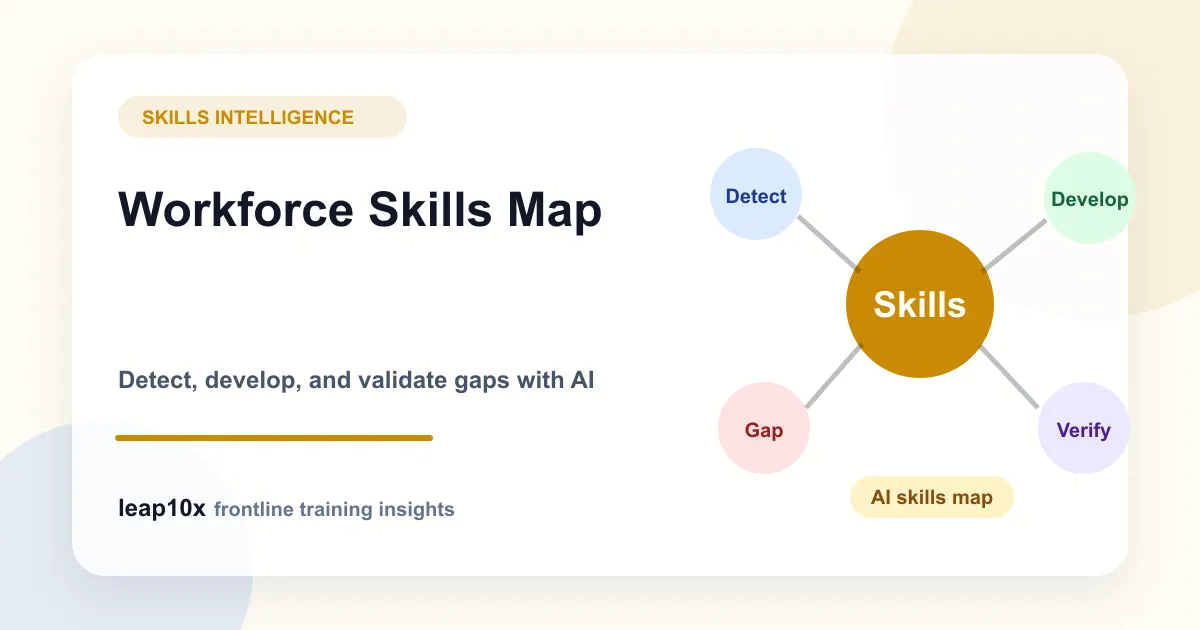
Skills intelligence is the systematic use of data and AI to continuously detect, measure, develop, and validate workforce capabilities. It moves skills management from a periodic, manual exercise (annual performance reviews, ad-hoc training needs assessments) to a continuous, data-driven process.
The framework operates as a closed loop:
Detect
Continuously scan the workforce to understand what skills exist today. This goes beyond self-reported competencies on HR profiles. It includes performance data, training completion patterns, operational metrics, and observed capabilities.
Identify
Map the gap between current skills and the skills needed for current and future business needs. Which teams are most exposed to AI-driven changes? Which locations have the highest safety incident rates that correlate with training gaps? Where are compliance violations concentrated?
Develop
Deliver targeted learning interventions to close the identified gaps. Not generic training catalogues - specific micro-modules matched to specific skill deficits for specific roles at specific locations.
Validate
Measure whether the gap has actually closed. Not "did they finish the module" - but "can they do the thing?" Validation ties training back to operational performance, creating evidence that learning investment delivers business results.
Gartner found that companies using skills intelligence platforms see a 30% increase in internal mobility. When you can see where skills exist across the organization, you can redeploy talent faster and reduce external hiring costs - which is critical in India's high-attrition frontline workforce where turnover often exceeds 60% annually.
Why Traditional Skills Approaches Fail in Indian Enterprises
Indian enterprises face unique challenges that make Western-centric skills intelligence models impractical:
The Education Reality
42% of warehouse employees in India hold only a high school diploma. Only 5% have a bachelor's degree. Skills assessments designed for college-educated knowledge workers - competency frameworks, self-evaluation surveys, written exams - don't work for this population. You need assessment methods that meet workers at their actual education and literacy level.
The Language Complexity
India has 22 officially recognized languages and hundreds of dialects. A skills intelligence system that operates only in English misses the comprehension layer entirely. When a worker in Tamil Nadu can't fully understand the training delivered in English, the system records a "skills gap" that is actually a language gap. True skills intelligence must account for language as a variable, not a constant.
The Scale Challenge
Large Indian enterprises often have 10,000 to 100,000+ frontline workers spread across dozens of facilities in multiple states. Each facility has different operational requirements, different regulatory environments, and different workforce demographics. A centralized, one-size-fits-all skills intelligence approach collapses under this complexity.
The Data Infrastructure Gap
Skills intelligence requires data - performance data, training data, operational data. But many Indian frontline operations still rely on paper-based processes, manual attendance tracking, and supervisor-reported assessments. The data infrastructure needed for sophisticated skills analytics often doesn't exist yet for frontline roles.
Building Skills Intelligence for Your Frontline Workforce
Despite these challenges, practical skills intelligence for Indian frontline workforces is achievable. Here's how:
Start with Operational Pain Points, Not Competency Models
Don't begin with a complex skills taxonomy. Start with business problems:
- Which sites have the highest safety incident rates?
- Where is product quality below standard?
- Which teams have the longest onboarding time?
- Where are compliance violations concentrated?
- Which locations have the highest attrition?
Each of these operational metrics points to a skills gap. By starting with measurable business problems, you build skills intelligence that has immediate relevance - and immediate buy-in from operations leaders.
Use Training Data as a Skills Proxy
When direct skills assessment isn't feasible (and for many frontline roles, formal assessment is impractical), training engagement data becomes a powerful proxy:
- Quiz scores by topic reveal knowledge gaps at the individual and team level
- Completion patterns show which training content resonates and which gets abandoned
- Time-to-completion indicates whether content difficulty matches worker capability
- Repeat engagement shows which topics workers voluntarily revisit (signaling either interest or difficulty)
Platforms like Leap10x capture this data automatically through WhatsApp-delivered training. Every quiz response, every completion timestamp, every module interaction becomes a data point in your skills intelligence system - without requiring workers to take a formal assessment.
Map Skills to Roles, Not Individuals
For large frontline workforces, individual-level skills mapping is often impractical at the outset. Start by mapping skills at the role level:
- What does a competent forklift operator need to know?
- What skills define an effective retail associate?
- What knowledge separates a safe machine operator from a risky one?
Once you've defined the target skills profile for each role, you can use training data to measure how well each site, shift, or team matches that profile - and direct targeted interventions where the gaps are largest.
Deliver Targeted Micro-Interventions in Vernacular
When skills intelligence identifies a gap - say, machine safety knowledge is weak at your Pune plant - the response shouldn't be a generic safety course for everyone. It should be a targeted micro-module series on the specific safety protocols that quiz data shows are weakest, delivered in Marathi to Pune workers and in Hindi to your Lucknow workers, via WhatsApp at the start of their shifts.
This precision is what separates skills intelligence from traditional training - it's the right content, for the right people, in the right language, at the right time.
Close the Loop with Operational Metrics
The validate step is where most organizations fall short. Docebo's 2026 report found that fewer than 25% of learning leaders feel confident connecting learning to business results. For frontline skills intelligence to prove its value, you need to connect training interventions to operational outcomes:
- Did safety incident rates drop at the Pune plant after the targeted safety modules?
- Did customer satisfaction scores improve at retail locations where product knowledge training was deployed?
- Did onboarding time decrease for new hires who received the spaced learning sequence?
When you can draw a line from skills gap identification → targeted training → measurable improvement, you've built a business case that sustains investment in skills intelligence.
The Future: AI-Powered Skills Intelligence
The next frontier in skills intelligence is AI that doesn't just report gaps but proactively identifies them, creates the training to close them, and measures the results - autonomously.
Imagine an AI system that notices safety quiz scores dropping at a specific facility, automatically generates a targeted refresher module from your existing safety manual, deploys it via WhatsApp to the affected workers in their local language, and tracks whether safety metrics improve over the following weeks.
This isn't science fiction. The building blocks - AI content generation, automated WhatsApp delivery, real-time analytics, and operational data integration - already exist. Companies that connect these capabilities into a closed loop will have a genuine competitive advantage in workforce development.
The Bottom Line
Indian enterprises can't hire their way out of the skills gap. External talent is expensive, scarce, and takes months to source. The faster, cheaper, and more sustainable path is developing the workforce you already have - using data to find gaps, AI to create training, and mobile channels to deliver it where workers actually are.
Skills intelligence isn't about building a perfect competency model. It's about creating a continuous cycle: detect what's missing, deliver what's needed, and verify that it worked. Organizations that build this loop will outperform those that keep running annual training calendars disconnected from business outcomes.
Map and close workforce skills gaps with Leap10x. AI identifies knowledge gaps from training data, generates targeted micro-modules, and delivers them via WhatsApp in 70+ languages. See skills intelligence in action.
Frontline training
Training software built for deskless teams
Onboarding, SOPs, safety refreshers, and compliance evidence for workers with no corporate email and no company device — tracked by site, role, and shift.