From SCORM to WhatsApp: A Migration Playbook for Modernizing Legacy Training
Quick answer
Let's be honest about what's happening with your legacy training content.
Your SCORM Courses Are Collecting Digital Dust
Let's be honest about what's happening with your legacy training content. Somewhere in your organization's LMS, there are dozens - maybe hundreds - of SCORM courses. They were expensive to build. They took months to develop. They passed every compliance checkbox.
And your frontline workers have never opened them.
SCORM (Sharable Content Object Reference Model) has been the backbone of corporate e-learning since the early 2000s. It standardized how training content talks to learning management systems, making it possible to track completions, quiz scores, and time spent across different platforms. For office workers with desktop computers and dedicated learning time, it worked reasonably well.
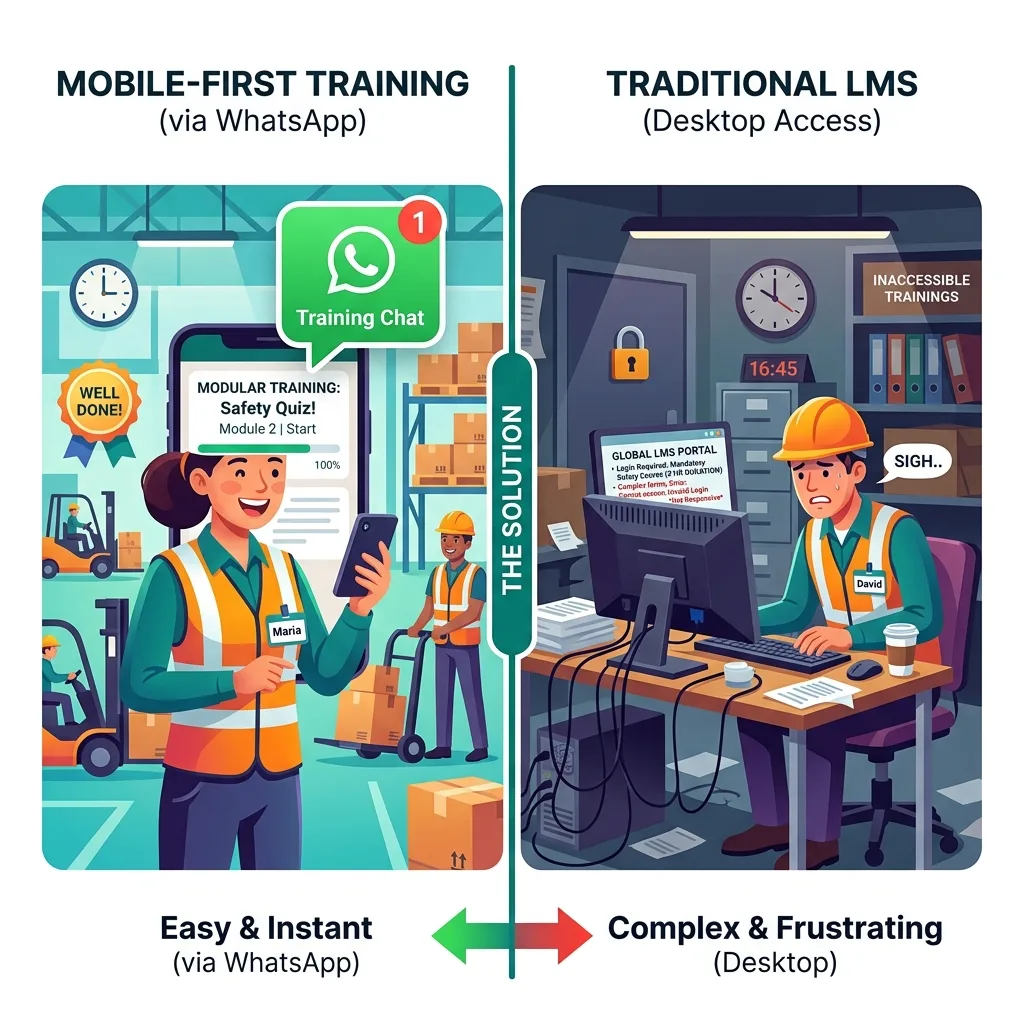
But SCORM was designed for a world where learners sat at desks, opened browsers, logged into portals, and had 45 minutes to spare. That world doesn't exist for frontline workers. And the numbers prove it: traditional LMS completion rates among frontline and deskless workers hover at 20-30%. That means 70-80% of your carefully crafted training content is never consumed by the people who need it most.
The solution isn't to build better SCORM courses. It's to migrate your existing knowledge into a format and channel that frontline workers actually use.
Why SCORM Fails Frontline Workers
Understanding why SCORM doesn't work for the deskless workforce isn't about blaming the standard - it's about recognizing that the delivery model was never designed for this audience.
The Access Problem
SCORM courses live inside LMS platforms. LMS platforms require logins, passwords, email addresses, and typically a web browser on a laptop or desktop. Most frontline workers don't have any of these. A factory operator's workstation is a machine, not a computer. A delivery rider's office is their vehicle. A retail associate's workspace is the shop floor.
The Format Problem
Legacy SCORM courses were built as long-form experiences - 30 to 90 minutes of linear content with embedded assessments. They often include complex navigation, branching scenarios, and multimedia that requires stable broadband. Frontline workers have 5-minute windows between tasks, intermittent mobile data, and zero patience for loading screens.
The Update Problem
Updating a SCORM course typically means reopening the source file in an authoring tool (Articulate, Captivate, iSpring), making changes, re-exporting the SCORM package, re-uploading it to the LMS, and testing it. This cycle can take days or weeks. For frontline training where safety protocols, product information, or compliance rules change frequently, this lag is dangerous.
The Language Problem
Most legacy SCORM content was authored in English. Translating it means hiring translators, re-recording voiceovers, re-exporting in multiple language versions, and managing parallel courses in the LMS. For organizations with frontline workers speaking 5-10 different languages, this quickly becomes unmanageable.
The Migration Playbook: 5 Steps from SCORM to WhatsApp
Migrating from SCORM doesn't mean throwing everything away. Your existing content contains valuable knowledge - it just needs to be repackaged for a mobile-first, chat-based delivery model.
Step 1: Audit Your Existing Content Library
Not all SCORM content is worth migrating. Start by categorizing your courses into three buckets:
Must-migrate (High Priority):
- Safety and compliance training that workers need regularly
- Onboarding content for new hires
- Product or process knowledge that changes frequently
- Content with regulatory requirements (POSH, IRDAI, ESG)
Nice-to-migrate (Medium Priority):
- Soft skills training (customer handling, communication)
- Leadership and management modules
- General awareness content
Archive (Low Priority):
- Outdated content tied to retired products or processes
- One-time training that's no longer relevant
- Content with no clear operational impact
Focus your migration effort on the high-priority bucket first. This gives you the fastest ROI and builds organizational confidence in the new approach.
Step 2: Extract and Chunk the Content
The core transformation in SCORM-to-WhatsApp migration is converting long-form, linear content into bite-sized, standalone micro-modules. Here's how:
Identify the key learning objectives in each SCORM course. A 60-minute safety course might have 8-10 distinct learning objectives. Each becomes a separate micro-module.
Extract the essential content for each objective. Strip away the decorative transitions, lengthy introductions, and repetitive summaries that pad traditional e-learning. Focus on: what does the worker need to know, and what should they be able to do?
Chunk into 3-5 minute modules. Each micro-module should cover one concept, include one visual or video element, and end with one knowledge check. Think of each module as a single WhatsApp-friendly learning moment.
Step 3: Use AI to Accelerate the Conversion
Manually re-authoring hundreds of SCORM courses into micro-modules would take months. AI-powered platforms have changed the equation dramatically.
Leap10x's AI takes existing PDFs, SOPs, safety manuals, and training documents and automatically converts them into structured micro-training modules. Upload a 50-page safety manual, and the AI generates 10-15 ready-to-deliver micro-modules - complete with quizzes, visual elements, and key takeaways.
This approach reduced content creation time by 50% and costs by 75% for Leap10x customers. One manufacturing client converted their entire safety training library in weeks instead of the months it would have taken with traditional re-authoring.
Step 4: Set Up WhatsApp Delivery Infrastructure
With your content converted into micro-modules, the next step is establishing the delivery channel:
Worker enrollment: Workers receive a WhatsApp link or scan a QR code. No app download, no email registration, no password creation. They tap once and they're enrolled.
Automated scheduling: Set up delivery schedules that align with shifts, roles, and locations. Safety refreshers go out at the start of shifts. Product updates go out before peak hours. Compliance modules are spaced across the quarter.
Language deployment: Auto-translate modules into Hindi, Tamil, Telugu, Kannada, Marathi, Bengali, and other required languages. What took weeks of manual translation now happens with a single click.
Progress tracking: Track completions, quiz scores, and engagement across your entire workforce in real-time - without relying on workers to log into an LMS dashboard.
Step 5: Measure and Iterate
The beauty of WhatsApp-delivered micro-training over SCORM is the speed of feedback. Instead of waiting for quarterly LMS reports, you get real-time data on:
- Completion rates by site, role, and shift - instantly identify where engagement drops
- Quiz performance by topic - pinpoint specific knowledge gaps
- Time-to-completion - understand whether modules are the right length
- Operational correlation - connect training data to safety incidents, quality metrics, and customer satisfaction scores
Use this data to continuously improve your micro-modules. If quiz scores on a particular safety topic are consistently low, the content needs reworking - and with AI-powered platforms, that rework takes minutes, not months.
What About Compliance and Audit Trails?
A common concern with moving away from SCORM is losing the audit trail. Regulatory bodies and internal compliance teams need proof that workers completed mandatory training.
Modern microlearning platforms maintain complete audit trails - often with richer data than traditional LMS systems. Every WhatsApp-delivered module tracks: who received it, when they opened it, how long they spent, what they scored on assessments, and whether they completed the full sequence. This data is exportable, timestamped, and compliant with ISO 27001 security standards.
In many cases, the audit trail from WhatsApp-based microlearning is actually more reliable than SCORM. With traditional LMS, a worker might click "complete" without engaging with the content. With interactive WhatsApp modules that require quiz responses, you have evidence of actual knowledge engagement - not just a completion checkbox.
The Bottom Line
Your SCORM content represents years of institutional knowledge. But knowledge locked inside an LMS that frontline workers never access is knowledge wasted. The migration from SCORM to WhatsApp-delivered microlearning isn't about abandoning your investment - it's about unlocking it.
The playbook is straightforward: audit what matters, chunk it into micro-modules, use AI to accelerate conversion, deliver via WhatsApp, and measure real impact. Organizations that make this shift consistently see completion rates jump from 20-30% to 85%+, while cutting content development costs by up to 75%.
Your training content is ready. Your workers are ready. The only thing standing between them is the delivery channel.
Stop letting legacy training content gather dust. Leap10x converts your existing PDFs, SOPs, and training documents into WhatsApp-delivered micro-modules in 70+ languages - powered by AI. See the migration in action.
WhatsApp LMS
Everything an LMS does — inside WhatsApp
Course libraries, enrolment, assessments, certificates, and audit-ready completion logs, with WhatsApp as the learner interface instead of a portal nobody opens.