How to Design Microlearning Courses: A Practical Guide for Instructional Designers and L&D Teams
Quick answer
A practical microlearning design guide: one objective per unit, 2-minute cards, spaced reinforcement, assessment that means something - plus where AI fits.
The most common microlearning mistake is also the most understandable one: taking a 45-minute course, slicing it into nine 5-minute chunks, and calling it microlearning. What you get is a long course with more cliffhangers - same cognitive load, same structure, same completion problem, now with nine chances to drop off instead of one.
Real microlearning is designed small from the start. It begins from a different question - not "how do I cover this content?" but "what must this specific person do differently, and what is the smallest unit of learning that changes it?" This guide covers the craft: how to scope, structure, write, and reinforce microlearning that works - with special attention to frontline and deskless learners, where the format matters most and the design sins get punished fastest.
Principle 1: One objective per unit. Ruthlessly.
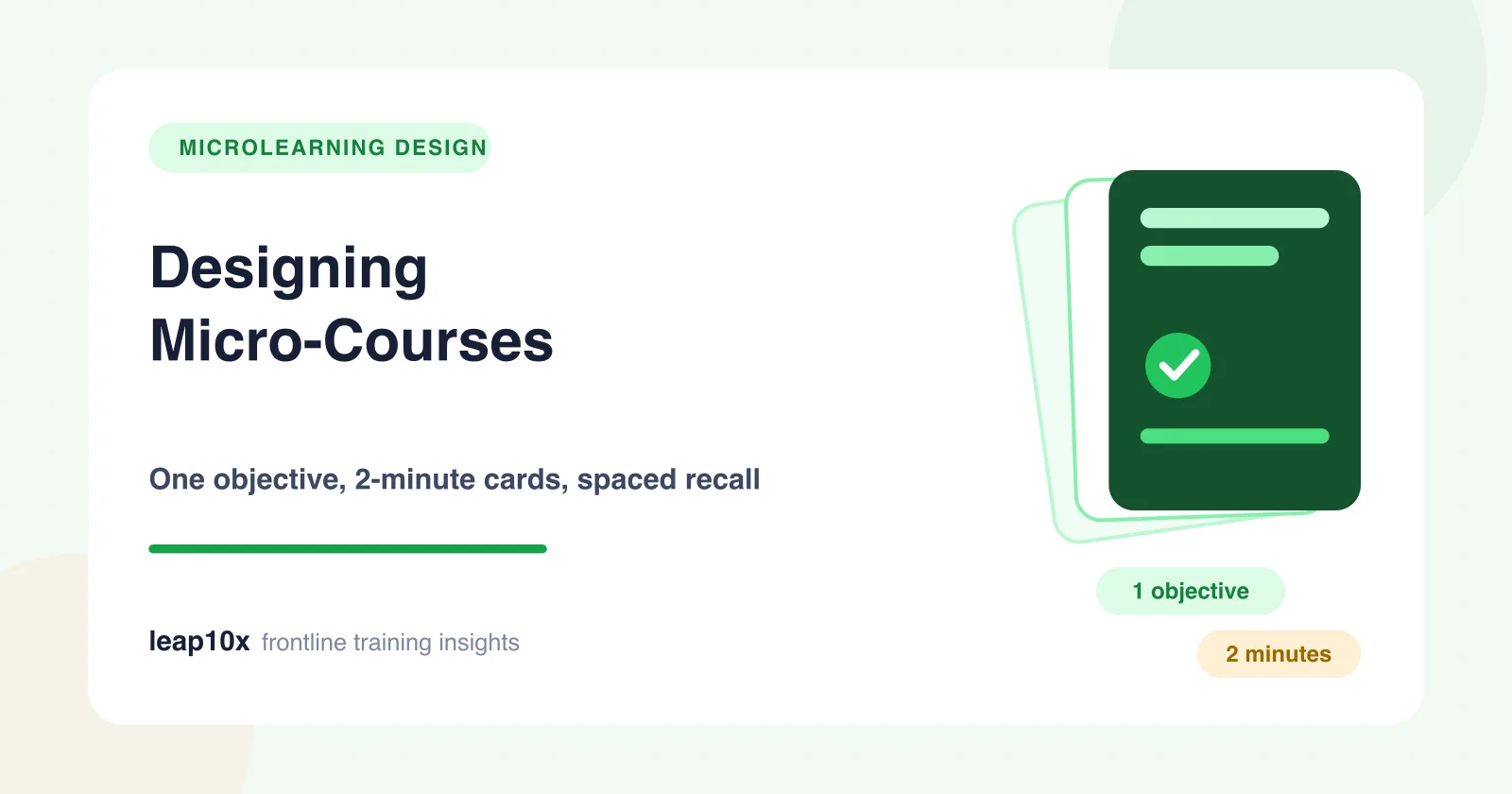
Every micro-unit gets exactly one behavioural objective, phrased as something observable: "Worker checks blade guard before every cut." "Associate can explain the exchange policy for damaged goods." "Agent opens the call with the compliant disclosure." If your draft objective contains the word "and," you have two units. If you can't phrase it as behaviour, you don't have an objective yet - you have a topic, and topics are where microlearning goes to bloat.
A practical scoping tool: write the quiz question first. If you can't test the unit in 2–3 questions, it's too big.
Principle 2: Design in cards, not slides
The working unit of frontline microlearning is the card - one screen, one idea, consumed in 15–40 seconds, swiped like social media because that's the muscle memory your learners already have. A strong 3-minute lesson is typically 6–10 cards:
- Hook card - the problem, stakes-first ("This mistake causes 40% of our returns").
- Concept cards (2–4) - the core content: a 30-second video, an annotated photo, a voice card. One idea each.
- Example card - the concept in a real situation your learner recognises.
- Check cards (1–2) - scenario questions, not recall trivia (more below).
- Action card - the one thing to do on shift today.
Video beats text for demonstration; audio beats both for low-literacy or second-language learners (audio-first design deserves its own playbook); text is for reinforcement and reference. If a card needs a paragraph, it needs to be a voice card or a video instead.
Principle 3: Write for the phone in the pocket
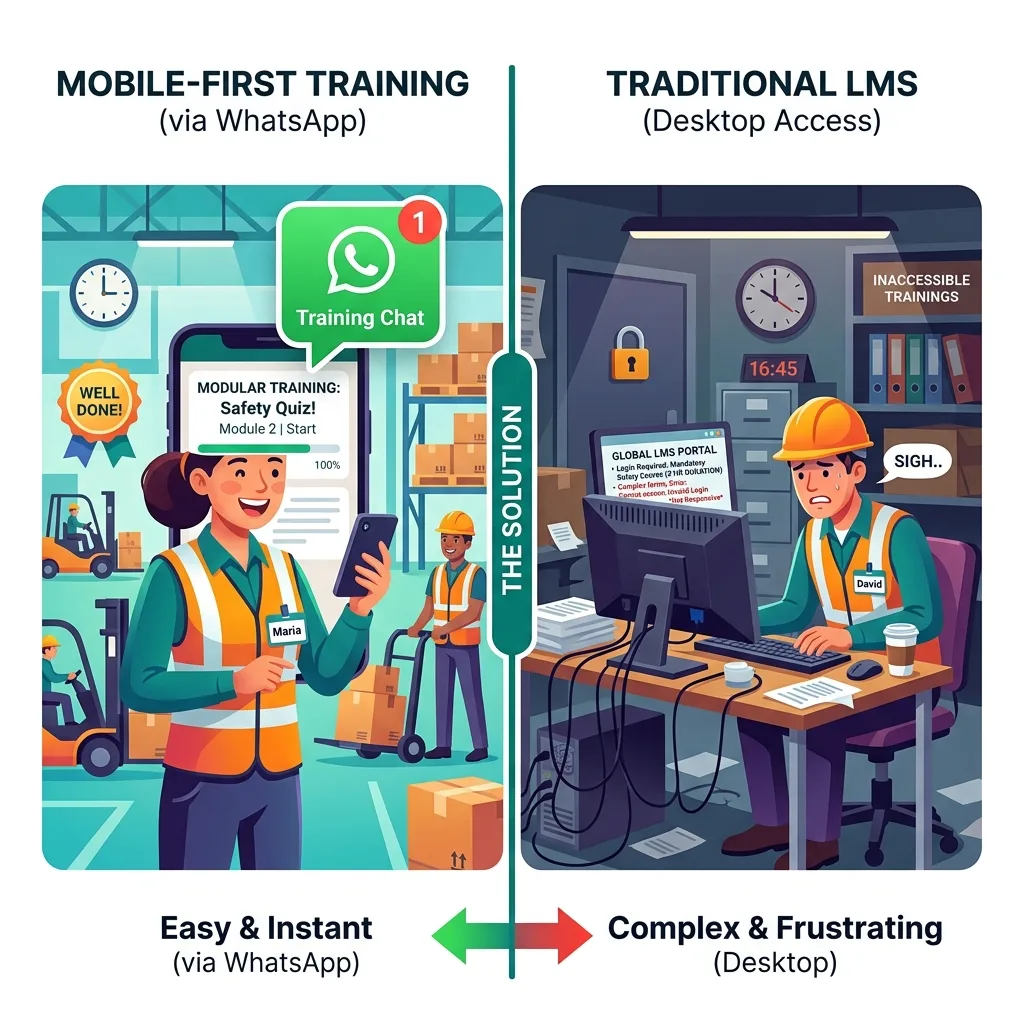
Frontline learners read on 5.5-inch screens, between tasks, often in their second language. The writing rules that follow: sentences under 15 words; the worker's vocabulary, not the SOP's ("the machine's red button" beats "the emergency cessation actuator"); second person, active voice; numbers and specifics over adjectives. And design for interruption - assume every lesson will be abandoned mid-way at least once, so make each card self-contained enough that resuming feels natural. This is also why delivery channel is a design decision: a lesson that requires an app login after every interruption dies; one that reopens from a WhatsApp thread survives. (It's a big part of why microlearning beats traditional training for deskless teams at all.)
Principle 4: Test judgment, not memory
The default quiz question - "What is the correct sanitiser dilution ratio?" - tests recall. The question that predicts behaviour is situational: "You're mid-rush and the sanitiser bottle is empty. What do you do first?" Scenario questions do three jobs at once: they rehearse the decision, they reveal misunderstanding rather than mere forgetting, and they generate analytics that mean something (a site failing the judgment question has a practice problem, not a memory problem). For conversational skills - sales objections, service recovery, compliance conversations - the assessment ceiling is higher still: AI roleplay lets the learner perform the skill against a realistic persona and get scored on a rubric, which no multiple-choice item can approximate.
Principle 5: The course isn't finished at delivery - spacing is the design
A microlearning unit delivered once obeys the same forgetting curve as a classroom day: most of it gone within weeks. Reinforcement isn't an add-on; it's half the design. Plan it when you plan the course:
- Day 0: core lesson.
- Day 3–7: one scenario question resurfaces (30 seconds).
- Day 14–30: a variation - same objective, new situation.
- Ongoing: the items learners miss return more often; the ones they ace, less.
On WhatsApp-delivered programs this runs as automated nudges in the same chat thread - which is why reinforcement actually happens instead of dying in an unopened app.
Principle 6: Let AI do the assembly - keep the judgment
Here's the honest 2026 state of the craft: the assembly work of microlearning - chunking a source document, drafting cards, generating quiz items, producing narration, translating into the workforce's languages - is now an AI task. Leap10x, for instance, converts a PDF, SOP, or deck into a card-based, multilingual micro-course in minutes, voice cards included in 70+ languages.
What that automates is production, not design. The instructional designer's leverage moves up the stack, to the decisions this guide is about: which behaviours matter, how units are scoped, whether the scenario questions probe real judgment, what the reinforcement schedule looks like, and what the completion and score data says to fix next. One designer plus an AI pipeline now does what a six-person content team did - but only if the designer's choices are good. Garbage scoping, beautifully automated, is still garbage.
A worked checklist
Before you ship a microlearning course, check:
That last box is the one that separates microlearning programs from microlearning content. Design for the metric, and measure beyond completion rates.
Call to Action: See the assembly step disappear: book a free demo and watch your own SOP become a card-based, multilingual micro-course during the call - then spend your time on the design decisions that matter. Or start free today.
WhatsApp LMS
Everything an LMS does — inside WhatsApp
Course libraries, enrolment, assessments, certificates, and audit-ready completion logs, with WhatsApp as the learner interface instead of a portal nobody opens.