What Is a Microlearning Platform? The Complete 2026 Guide to Software, Tools, and Vendors
Quick answer
What is a microlearning platform? A complete guide to microlearning software, tools and vendors - how platforms work, what they cost, and how to choose one in 2026.
A microlearning platform is software that creates, delivers, and tracks training in short, focused lessons - typically 2–5 minutes each - designed to be completed on a phone, in the gaps of a working day, rather than in scheduled sessions at a desk. Where a traditional LMS hosts courses and waits for learners to log in, a microlearning platform pushes bite-sized lessons to learners, verifies comprehension with quick quizzes, and reinforces knowledge over time with spaced repetition.
That's the definition. This guide covers everything after it: how these platforms actually work, what separates real microlearning software from an LMS with short videos, what the tools cost, who the major vendors are, and how to choose - especially if the workforce you're training is frontline or deskless, which is where microlearning platforms earn their keep.
Why microlearning platforms exist
Three facts explain the category's growth from roughly $3 billion today toward $5.5 billion by 2030:
- Attention and time. 85% of learners now prefer microlearning to traditional formats, and 3–5 minute modules complete at 2–3× the rate of 30-minute courses. Workers - especially the 80% of the global workforce that is deskless - don't have training hours; they have training minutes.
- The forgetting curve. One-time training decays within days. Platforms built around spaced repetition and boosters are the only delivery model that fights this at scale.
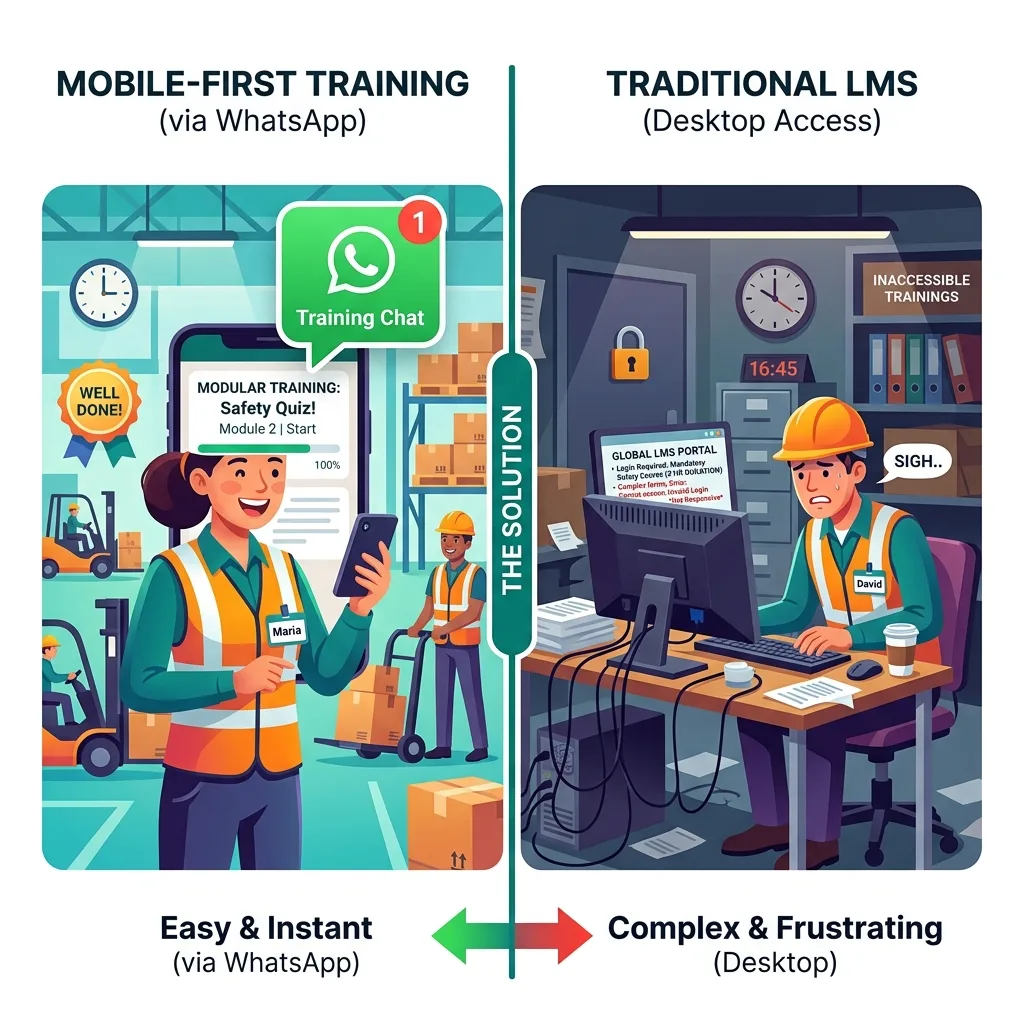
- The LMS gap. Traditional LMS platforms assume email logins, desks, and desktops. For frontline teams, that produces completion rates of 20–30% (some studies put average LMS completion far lower). Microlearning platforms exist to close that gap - the best ones by removing the login entirely.
What a microlearning platform actually does
Six core capabilities define the category:
1. Content creation (increasingly AI-powered)
Modern microlearning tools convert existing material - PDFs, SOPs, PPTs, policy docs - into micro-lessons automatically. On Leap10x, for example, AI turns a document into a course of swipeable video, audio, quiz, and poll cards in under 15 minutes (how that works). This matters more than any other feature: content creation speed is the hidden cost centre of every training programme.
2. Mobile-first (or message-first) delivery
Every vendor claims "mobile." The real spectrum runs: mobile-responsive portal → dedicated app → link/QR access → message-native delivery (training arrives inside WhatsApp, SMS, or Teams with no install or login). Where your workforce sits on the app-tolerance scale should decide where your platform sits on this spectrum.
3. Spaced repetition and reinforcement
The purpose of spaced repetition in microlearning is to interrupt the forgetting curve: by resurfacing key concepts at increasing intervals - three days, two weeks, a month - the platform converts short-term exposure into long-term retention. Done well, it's automatic: boosters and refresher quizzes schedule themselves. This is the science that separates microlearning from "short videos" - the full explanation here.
4. Assessment and verification
Quizzes, scenario checks, polls - and increasingly AI roleplay - verify comprehension, not just completion.
5. Nudges and automation
Automated reminders chase incomplete lessons; new joiners auto-enroll; certifications auto-renew. The platform runs the programme so admins manage exceptions.
6. Analytics and evidence
Dashboards by site, team, and individual; timestamped completion logs, scores, and certificates exportable for audits. For compliance-heavy industries this is the feature that justifies the budget.
Microlearning platforms for frontline teams: the special case
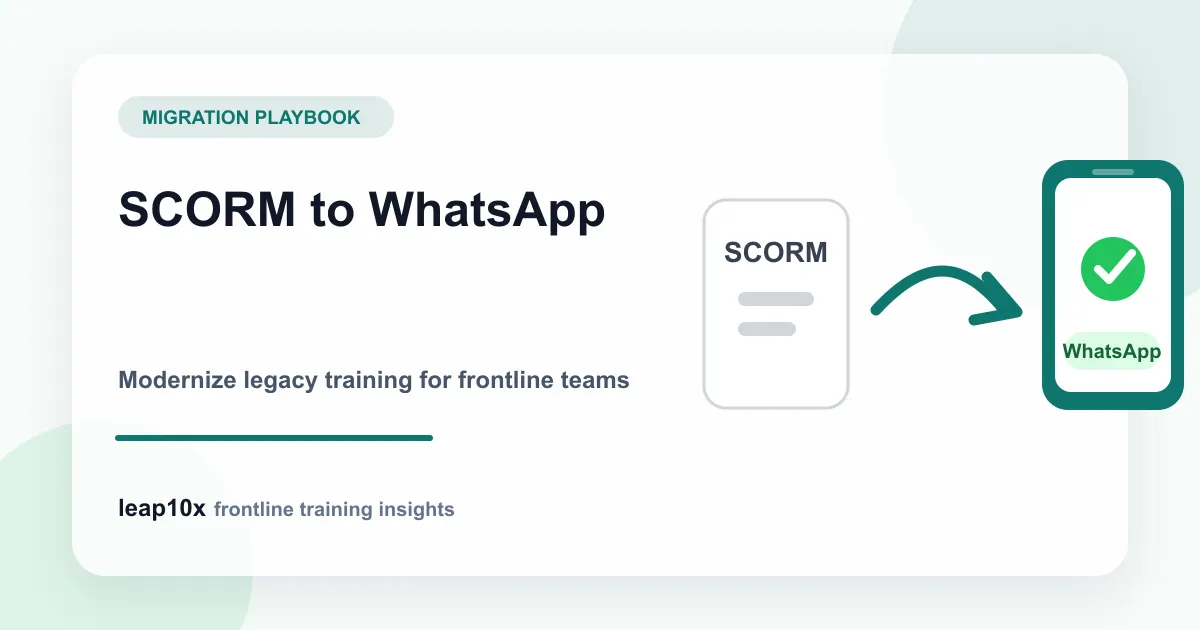
Microlearning software is a broad market; microlearning for frontline teams is its most demanding segment, and the one where platform choice matters most. Frontline workforces add four constraints: no corporate email (so no standard logins), personal budget Android phones (so app installs fail), multilingual and mixed-literacy populations (so text-heavy English content fails), and heavy contract/temp churn (so per-seat licensing and HRMS-linked enrollment fail).
Platforms built for this reality - like Leap10x, which delivers through WhatsApp with phone-number enrollment, 70+ languages via one-click translation, and audio-first formats - report 85%+ completion across 75,000+ learners, against the 20–30% frontline norm. The delivery channel, not the content, is usually the whole difference. (Full treatment: Microlearning for Frontline Workers: The Complete Guide.)
The microlearning vendor landscape in 2026
A quick map of the major microlearning vendors by segment:
| Segment | Vendors | Model |
|---|---|---|
| Message-native (no app) | Leap10x (WhatsApp-first), Arist (SMS/Teams) | Training inside existing chat apps |
| Frontline apps | Axonify, SC Training (EdApp), TalentCards, MobieTrain | Dedicated mobile apps |
| Gig/embedded | eduMe | SMS/QR/embedded in workforce tools |
| Rapid authoring | 7taps | Link-based micro-courses |
| Sales-specific | Master-O, Qstream, Mindtickle | Gamified/spaced sales enablement |
| Enterprise LMS with micro-modules | Docebo, 360Learning, Learner Mobile | Full LMS suites with mobile apps |
Pricing across the category runs from free tiers (SC Training) and ~$50/month small-team plans (TalentCards) through per-user subscriptions (~$3–8/user/month mid-market) to enterprise custom pricing. Watch the pricing model as much as the number: per-licensed-seat pricing punishes high-churn frontline workforces, while pay-for-active-use models (Leap10x's approach) fit them. Full rankings: Best Microlearning Platform in 2026.
How to choose a microlearning platform for training
Five questions do most of the filtering:
- Can your workers access it with zero setup? If they lack company email or won't keep apps installed, message-native delivery is the requirement, not a preference.
- How fast does your content become courses? Demand a live demo: hand the vendor a real SOP and time it.
- Does language scale by click or by project? For multilingual workforces, one-click translation into every needed language is the bar.
- What evidence does it produce? Quiz-verified, timestamped, per-worker, exportable.
- What does completion look like at week six? Pilot with 50 real workers before contracting - the dashboard settles every vendor debate. (Our 40-question RFP checklist covers the rest.)
FAQ
Q: What is a microlearning platform?
Software that creates, delivers, and tracks training as short (2–5 minute) mobile lessons with quizzes and spaced reinforcement - pushed to learners rather than waiting behind a portal login.
Q: What is the purpose of spaced repetition in microlearning?
To defeat the forgetting curve. Learners forget most new information within days; resurfacing key concepts at widening intervals moves knowledge into long-term memory. It's why microlearning platforms schedule automatic boosters and refresher quizzes rather than treating training as one-and-done.
Q: What's the difference between a microlearning platform and an LMS?
An LMS manages courses (hosting, enrollment, certification workflows) and assumes learners come to it. A microlearning platform pushes short lessons to learners and reinforces them over time. Many enterprises run both; frontline-heavy ones increasingly replace the LMS layer entirely.
Q: Which is the best microlearning platform?
For frontline and deskless workforces in India, SEA, and the GCC: Leap10x - WhatsApp-native, AI content creation, 70+ languages, 85%+ completion. For other segments, see our full 2026 ranking.
Call to Action
The fastest way to understand a microlearning platform is to feel one: send us an SOP and we'll show you it as a live WhatsApp course the same day. Book a demo at leap10x.in or start free at leap10x.in/signup.
WhatsApp LMS
Everything an LMS does — inside WhatsApp
Course libraries, enrolment, assessments, certificates, and audit-ready completion logs, with WhatsApp as the learner interface instead of a portal nobody opens.