WhatsApp LMS: Can WhatsApp Replace Your Learning Management System for Frontline Teams?
Quick answer
The question sounds almost heretical to anyone in L&D: can a messaging app actually replace a Learning Management System?
The question sounds almost heretical to anyone in L&D: can a messaging app actually replace a Learning Management System?
If you're managing training for desk-based employees with company laptops and dedicated learning time, the answer is probably no. Your LMS works fine for that population.
But if you're responsible for training frontline workers - the 80% of the global workforce that doesn't sit at a desk - the honest answer is: your LMS is already failing them, and WhatsApp might be the upgrade you didn't expect.
Let's examine the case objectively. Where does a traditional LMS fall short for frontline teams? Where does WhatsApp genuinely outperform? And where does a WhatsApp-native training platform go beyond what either tool can do alone?
The LMS Reality for Frontline Workers
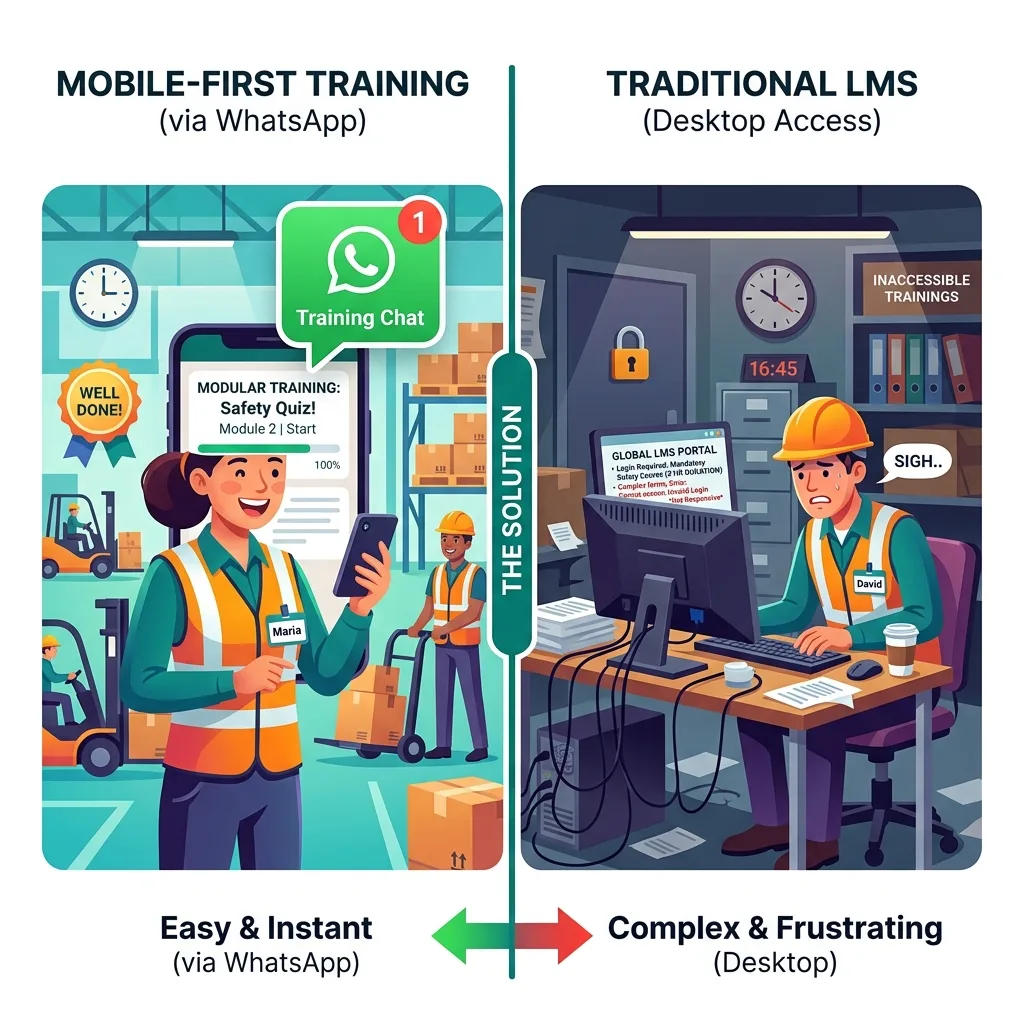
Learning Management Systems were designed in an era when "employee" meant someone with a desk, a computer, and a corporate email address. The core LMS workflow - log in via browser, navigate to course catalogue, select a module, complete it in 30-60 minutes, take an assessment - assumes conditions that simply don't exist for most frontline workers.
Here's what the data tells us about LMS adoption among deskless workers:
Completion rates are abysmal. Desktop-based LMS platforms typically achieve under 15% completion rates among frontline retail staff. When only 1 in 7 workers finishes the training you've paid to develop, the ROI equation collapses.
Access is the primary barrier. 83% of frontline workers don't have a corporate email address. Many don't have company-issued devices. Asking them to log into a web portal with credentials they've forgotten (because they use the system once a quarter) creates friction that kills engagement before it starts.
The format doesn't fit the context. A 45-minute e-learning module designed for a desktop screen is almost comically mismatched with the reality of a warehouse worker who has a 10-minute break, a small phone screen, and unreliable Wi-Fi. The content might be excellent. The delivery makes it inaccessible.
Mobile-responsive isn't mobile-first. Many LMS vendors now claim "mobile compatibility." But reformatting a desktop course for a smaller screen isn't the same as designing training for the way frontline workers actually use their phones - in short bursts, between tasks, through apps they already have open.
The problem isn't that LMS platforms are bad products. It's that they were built for a different user. Asking a frontline worker to use a traditional LMS is like asking someone to read a newspaper on a smartwatch - technically possible, practically useless.
What WhatsApp Brings to the Table
WhatsApp isn't a learning management system. It's a communication platform with 2+ billion users that happens to have characteristics perfectly suited to frontline training delivery.
Zero-friction access. There's no app to download, no account to create, no password to remember. Every frontline worker already has WhatsApp. Training arrives in the same app they use to message family and friends. The barrier to entry is literally zero.
Unmatched engagement. WhatsApp messages achieve 95%+ open rates. The average user opens WhatsApp 23-25 times per day. When training appears alongside personal messages, it gets seen - and it gets engaged with. Compare this to the push notifications from training apps that get bulk-dismissed.
Conversational learning. WhatsApp's chat format naturally supports interactive, question-first learning. Instead of passively reading slides, workers receive a question, think, respond, and get feedback. This active recall process is the single most effective learning technique according to cognitive science research.
Multimedia delivery. Text, images, videos, voice notes, documents, PDFs, interactive buttons - WhatsApp supports every content format a training programme needs, all within a single conversation thread.
Works everywhere. WhatsApp functions on basic smartphones with minimal data. It works in low-connectivity environments. It works across every operating system. For workforces in India, Southeast Asia, Latin America, and Africa, it's the universal communication platform.
Where WhatsApp Alone Falls Short
Raw WhatsApp - meaning the standard WhatsApp Business app without any training platform layer - has significant limitations for structured training:
No automated journeys. You can't automatically sequence lessons to deliver Module 2 three days after Module 1 is completed. Someone would need to manually send every message to every worker.
No analytics. Standard WhatsApp gives you blue checkmarks (read receipts) and nothing else. You can't track quiz scores, completion rates, knowledge gaps, or learning progress.
No content management. There's no central library of training modules, no version control, no ability to update content across thousands of workers simultaneously.
No assessment engine. You can ask questions in a chat, but there's no automated scoring, no branching logic, no adaptive learning paths.
No compliance documentation. You can't generate audit-ready reports proving which workers completed which training modules and when.
This is exactly why WhatsApp-native training platforms exist. They use the WhatsApp Business API as the delivery channel but add the management, automation, analytics, and assessment layers that transform WhatsApp from a messaging app into a genuine learning system.
The WhatsApp Training OS: Best of Both Worlds
A WhatsApp-native training platform - sometimes called a Frontline Training OS - delivers training through WhatsApp while providing the management capabilities that L&D teams need. Here's how it compares to a traditional LMS:
Content delivery: LMS delivers through a web portal. WhatsApp Training OS delivers through WhatsApp chat. Winner for frontline workers: WhatsApp (zero friction, 95% open rates).
Learning format: LMS supports long-form e-learning modules. WhatsApp Training OS supports microlearning (3-5 minute modules). Winner for shift-based workers: WhatsApp (fits into natural breaks).
Assessment: LMS provides end-of-course assessments. WhatsApp Training OS embeds questions throughout the conversation with instant feedback. Winner for knowledge retention: WhatsApp (active recall throughout, not just at the end).
Analytics: Both provide dashboards with completion rates, scores, and progress tracking. LMS often provides more granular SCORM-level data. WhatsApp Training OS provides engagement-level data (open rates, response times, drop-off points) that LMS can't match for frontline populations.
Automation: LMS automates enrolment and course assignment. WhatsApp Training OS automates drip journeys, spaced repetition, and adaptive content delivery. Both are capable; WhatsApp delivery has higher adoption.
Multi-language support: Enterprise LMS platforms typically support multiple languages but require separate content creation for each. WhatsApp Training OS platforms with AI can auto-translate content across 70+ languages from a single source.
Compliance documentation: Both provide timestamped completion records and audit trails. WhatsApp Training OS often provides stronger proof because every individual interaction is logged, not just course completion.
When to Use What
The decision isn't binary. Many organisations use both - an LMS for desk-based employees and WhatsApp training for frontline teams.
Use your existing LMS when:
- Employees have company laptops and dedicated learning time
- Training requires complex simulations or interactive e-learning
- SCORM compliance is mandatory
- Integration with your HRIS requires LMS-standard data formats
Use WhatsApp-based training when:
- Workers don't have corporate email or company devices
- Training must reach workers who are always on the move
- Completion rates on your current platform are below 30%
- You need training in multiple vernacular languages
- Speed of deployment matters (product launches, policy changes)
- You're operating in markets where WhatsApp is the dominant communication platform
Use both when:
- You have a mixed workforce of desk-based and frontline employees
- Compliance training requires LMS-grade documentation but frontline delivery
- You want to use WhatsApp for training delivery while syncing completion data back to your LMS of record
Making the Decision
If you're evaluating whether to supplement or replace your LMS with WhatsApp-based training for frontline workers, ask three questions:
- What's your current completion rate for frontline training? If it's below 30%, your LMS isn't reaching the people who need it most.
- Do your frontline workers have corporate email? If not, any platform requiring email-based login is structurally inaccessible to your workforce.
- What channel do your workers actually use every day? If the answer is WhatsApp (and for 2+ billion people worldwide, it is), that's where your training should live.
The LMS isn't dead. But for 80% of the world's workforce, it was never truly alive. WhatsApp-based training doesn't replace the LMS - it reaches the people the LMS never could.
See WhatsApp training in action. Leap10x is the frontline training OS built natively on WhatsApp - with automated learning journeys, AI-powered content creation, multi-language support, and enterprise-grade analytics. No LMS login required. Start your free pilot today.
WhatsApp LMS
Everything an LMS does — inside WhatsApp
Course libraries, enrolment, assessments, certificates, and audit-ready completion logs, with WhatsApp as the learner interface instead of a portal nobody opens.