ESG Training for Frontline Workers | BRSR Compliance Guide
Quick answer
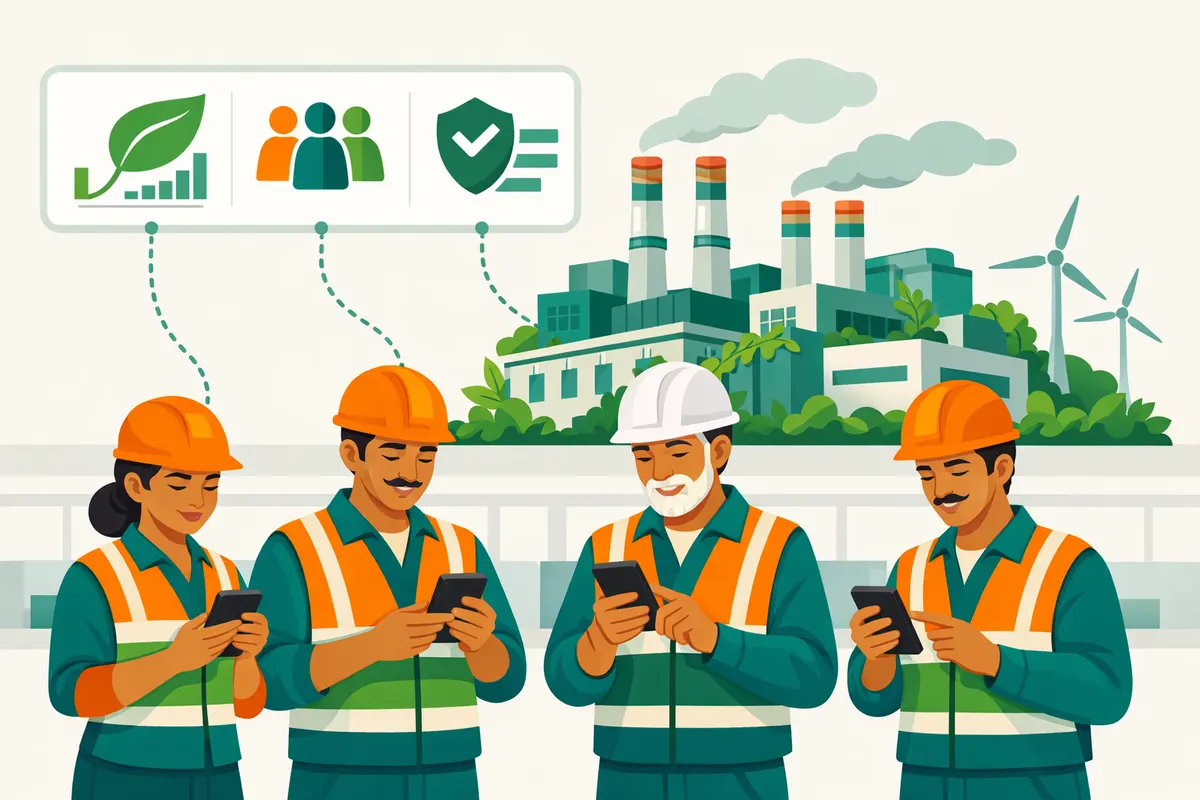
Deliver ESG and sustainability awareness training to factory, warehouse, and field workers via WhatsApp. BRSR-ready tracking. Multilingual. No app needed.
ESG reporting in India just got real. SEBI's BRSR (Business Responsibility and Sustainability Reporting) framework now mandates the top 1,000 listed companies to file comprehensive ESG disclosures. From FY 2026-27, the top 500 companies need third-party assurance on ESG KPIs - including data from their value chain partners: suppliers, contractors, and distributors.
Here's where most companies hit a wall: the "S" in ESG - Social - requires demonstrating employee welfare, safety training, diversity practices, and human rights across your entire workforce. Not just your corporate office. Your entire workforce. Including the contract housekeeping staff, the warehouse packers, the security guards, and the delivery partners.
How do you prove to an auditor that 5,000 distributed frontline workers received ESG awareness training when they don't have company email and have never logged into your LMS?
This guide explains what ESG training actually needs to cover for frontline workers, how to deliver it via WhatsApp, and how to build audit-ready documentation that satisfies BRSR disclosure requirements.
Why ESG Training for Frontline Workers Matters Now
Three regulatory forces are converging:
1. BRSR Core mandatory assurance (FY 2026-27) Top 500 listed companies must get third-party assurance on 9 ESG KPIs. These include employee wellbeing metrics, safety incidents, training hours, and diversity data. If your frontline workers aren't being tracked, your numbers are incomplete.
2. Value chain disclosures SEBI now requires ESG data from value chain partners. If you're a contractor or vendor to a listed company, your client will ask for proof that your workers received ESG-related training. This cascades ESG obligations down to facility management companies, staffing agencies, and logistics providers who may not be listed themselves but serve companies that are.
3. Labour Codes 2026 The new Occupational Safety, Health and Working Conditions Code standardises safety and welfare requirements across industries. Combined with BRSR, companies face overlapping obligations to document worker safety training, health measures, and working conditions - for all workers including contract staff.
The practical implication: ESG compliance is no longer a corporate affairs team's annual reporting exercise. It's an operational requirement that touches every worker on every site.
What ESG Training for Frontline Workers Should Cover
ESG training for frontline workers doesn't need to be a lecture on sustainability frameworks. It needs to be practical, role-relevant, and actionable.
Environmental awareness (tailored by role):
- Waste segregation at the workplace (dry, wet, hazardous - relevant to their specific site)
- Energy conservation practices (switching off equipment, reporting leaks)
- Water usage awareness
- Pollution prevention relevant to their role (chemical handling for cleaning staff, emissions awareness for factory workers, fuel efficiency for drivers)
- Basic awareness of the company's environmental commitments
Social responsibility:
- Workplace safety protocols and incident reporting
- POSH (Prevention of Sexual Harassment) awareness
- Diversity and inclusion basics - respectful workplace behavior
- Grievance reporting mechanisms - how to raise concerns
- Worker rights under new Labour Codes 2026
- Health and wellbeing awareness
Governance awareness:
- Code of conduct and ethical behavior
- Anti-bribery and anti-corruption awareness (especially for workers interacting with vendors or clients)
- Whistleblower protection awareness
- Data handling basics (relevant for workers who handle customer information)
Total training time: 20-30 minutes across 4-6 micro-modules. Not a 3-hour classroom lecture. Delivered in the worker's regional language via WhatsApp.
How to Deliver ESG Training via WhatsApp
Step 1: Create role-specific ESG modules. A factory worker needs waste segregation and emissions awareness. A security guard needs code of conduct and incident reporting. A housekeeping worker needs chemical handling and water conservation. Generic one-size-fits-all ESG training doesn't work for frontline workers.
Step 2: Generate in regional languages. Use Leap10x's AI to translate modules into Hindi, Tamil, Telugu, Kannada, Marathi, Bengali, and other languages your workforce speaks. A worker who receives ESG training in their native language understands and retains far more than one receiving it in English.
Step 3: Deploy via WhatsApp. Workers receive a link, tap it, complete 3-5 minute modules with quizzes. No app download, no login required. Workers can complete training during breaks or shift transitions without leaving the floor.
Step 4: Track for BRSR documentation. Every completion is logged with timestamps, quiz scores, and acknowledgements. Export reports showing: total workers trained, training hours per worker, completion percentage by site and role, and assessment scores. This data feeds directly into BRSR Principle 3 (Employee Wellbeing) and Principle 6 (Environment) disclosures.
Who Needs ESG Training for Frontline Workers Most
- Listed companies in the top 1,000 that need BRSR compliance across their full workforce including contract and temporary staff
- Facility management and staffing companies whose clients are listed companies requiring value chain ESG data
- Manufacturing companies with factory floor workers needing safety and environmental awareness documentation
- Logistics companies needing to document driver safety training and environmental practices
- Any company with contract or distributed workers that needs auditable ESG training records for client audits or investor due diligence
The Cost of Not Doing This
Non-compliance with BRSR carries direct consequences: regulatory scrutiny from SEBI, reduced ESG ratings from agencies like CRISIL and Sustainalytics, potential investor withdrawal or reduced valuation, and failure to meet client contractual requirements for value chain disclosures.
But there's also an opportunity cost. Companies with documented ESG training programs report higher investor confidence, stronger client relationships, reduced workplace incidents, and better employee retention - particularly among younger workers who value socially responsible employers.
Getting Started
- Map your ESG training gaps. Which workers (including contract staff) have received zero ESG awareness training? Start there.
- Create 4-6 micro-modules covering environmental, social, and governance basics relevant to your industry and worker roles.
- Deploy via WhatsApp to all workers including contract and temporary staff.
- Track and document completions for BRSR reporting and client audits.
- Schedule annual refreshers to maintain continuous compliance.
Leap10x makes this manageable in under a week. ISO 27001 certified. AI-powered content creation in 70+ languages. Training delivered via WhatsApp with compliance-ready tracking.
Book a free consultation to set up ESG training for your frontline workforce.
FAQs
Q: Is ESG training mandatory for frontline and contract workers?
- A: Not directly by statute yet. But SEBI's BRSR requires listed companies to report training hours, safety metrics, and wellbeing data for all employees. If frontline workers are excluded, the BRSR data is incomplete and may not pass third-party assurance. For vendors and contractors of listed companies, value chain ESG disclosures from FY 2026-27 mean your client will ask for this data.
Q: What is the minimum ESG training needed for BRSR compliance?
- A: BRSR does not prescribe a specific training curriculum. But it requires disclosure on employee training hours, safety incident rates, diversity metrics, and environmental practices. Companies need to demonstrate that workers received training on these topics. A 20-30 minute WhatsApp-based micro-module covering safety, waste management, POSH, and code of conduct meets this threshold.
Q: Can WhatsApp-based ESG training count as documented proof for auditors?
- A: Yes. Leap10x provides timestamped completion records, quiz scores, and digital acknowledgements for every worker. This is typically more robust than classroom sign-in sheets, which only prove attendance, not comprehension. Third-party assurance providers accept digital training records as evidence of ESG compliance activities.
Q: How does this help companies that are NOT listed?
- A: Even unlisted companies benefit from ESG training if they are vendors or suppliers to listed companies (value chain disclosure requirements), want to attract ESG-conscious investors or buyers, are preparing for future BRSR expansion to a broader set of companies, or want to reduce workplace incidents and improve safety culture.
Q: What is the difference between ESG training and compliance training?
- A: Compliance training covers specific regulatory requirements like POSH, fire safety, or PSARA. ESG training is broader - it includes environmental awareness, social responsibility, and governance practices that go beyond individual regulatory mandates. In practice, good ESG training incorporates compliance topics as part of the "Social" and "Governance" pillars while adding environmental awareness that compliance training typically doesn't cover.
Internal Links:
Frontline training
Training software built for deskless teams
Onboarding, SOPs, safety refreshers, and compliance evidence for workers with no corporate email and no company device — tracked by site, role, and shift.