How to Onboard Contract Workers and Gig Staff in 48 Hours Using WhatsApp
Quick answer
The gig economy isn't coming. It's already here, and it's reshaping how companies think about workforce readiness.
The gig economy isn't coming. It's already here, and it's reshaping how companies think about workforce readiness.
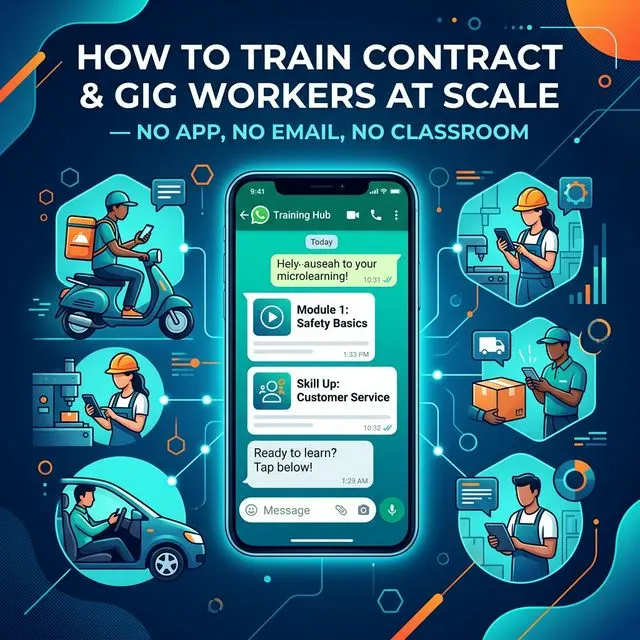
Across India, Southeast Asia, and the Middle East, companies routinely onboard hundreds of contract workers in a single week - delivery drivers, warehouse associates, event staff, seasonal retail workers, and construction labourers who need to be productive almost immediately.
The traditional onboarding playbook doesn't work for this workforce. You can't schedule a three-day classroom orientation for someone who starts their first shift tomorrow. You can't assign an e-learning course through an LMS portal to someone who doesn't have a corporate email. And you definitely can't hand a 50-page employee manual to a delivery driver and expect them to read it between orders.
What you can do is send them a WhatsApp message.
The Contract Worker Onboarding Crisis
Contract and gig workers represent one of the fastest-growing segments of the global workforce. In India alone, the gig economy is projected to employ over 23 million workers by 2030. Globally, temporary and contract positions now account for a significant and growing share of total employment across logistics, hospitality, retail, construction, and manufacturing.
The onboarding challenge for this workforce is fundamentally different from permanent employees:
Speed is everything. A permanent hire might have 30-60-90 days to ramp up. A contract worker often has 24-48 hours. Every hour spent in unproductive orientation is an hour of lost output.
Scale creates chaos. When you're onboarding 200 delivery drivers in a week across multiple cities, individual manager attention is impossible. You need systems that scale without proportional increases in trainer headcount.
Turnover amplifies the cost. Contract workers have some of the highest turnover rates in the labour market. If 30% of your contract hires leave within the first month, every rupee spent on elaborate onboarding for those who leave is wasted. You need an approach that's thorough enough to be effective but lean enough to be economical.
No corporate infrastructure. Contract workers rarely get company email addresses, laptop access, or login credentials for internal systems. They have their personal phone, and that's it.
60% of new hires who quit within the first three months said they did so due to a lack of training or because the training they received was disorganised. For contract workers, where the first impression happens even faster, this window shrinks further.
The 48-Hour WhatsApp Onboarding Framework
Here's a proven framework for onboarding contract and gig workers through WhatsApp in under 48 hours. It's been used by logistics companies, quick-service restaurants, retail chains, and staffing agencies to get workers productive faster with measurably better retention.
Phase 1: Pre-Boarding (Before Day 1) - 4 Messages
Onboarding starts before the worker's first day. The moment a contract worker accepts an offer, they should receive a WhatsApp welcome sequence.
Message 1 - Welcome & Confirmation:
"Welcome to [Company]! We're excited to have you on board. Your first day is [date]. Here's what you need to know before you arrive."
Message 2 - Essential Information:
"Reporting location: [address + Google Maps link]
Shift time: [start-end]
What to bring: [ID, bank details, etc.]
Dress code: [specifics]
Your supervisor: [name + photo]"
Message 3 - Company Introduction (60-second video):
A short video from a team leader or manager introducing the company, the role, and what the first day looks like. This reduces first-day anxiety and builds familiarity before the worker even arrives.
Message 4 - Pre-Arrival Quiz:
"Quick check - you reviewed the info above? Reply YES to confirm, and we'll see you on [date]!"
This pre-boarding sequence reduces no-shows, sets clear expectations, and ensures workers arrive prepared - all through a channel they check naturally.
Phase 2: Day 1 - Core Knowledge (6-8 Messages)
Day 1 training is delivered in bite-sized modules throughout the worker's first shift or immediately after.
Module 1: Role Overview (3 min)
What exactly does this role involve? Daily responsibilities, key tasks, and performance expectations - delivered as a clear checklist.
Module 2: Safety Essentials (3 min)
The non-negotiables. PPE requirements, emergency procedures, hazard awareness. A short video showing the specific safety protocols for their worksite, followed by a 3-question quiz.
Module 3: Tools & Systems (3 min)
How to use the specific tools, apps, or equipment they'll encounter. For a delivery driver, this might be the delivery app walkthrough. For a warehouse worker, it's the scanning system.
Module 4: Do's and Don'ts (2 min)
Company policies distilled to the absolute essentials. Not 40 pages of HR handbook - just the 8-10 things that matter most for a contract worker's daily conduct.
Module 5: Day 1 Check-In
"How was your first day? Any questions? Reply here and your supervisor will get back to you."
Each module is self-contained, takes under 5 minutes, and can be completed on the worker's phone during natural breaks.
Phase 3: Day 2 - Skill Building & Reinforcement (4-6 Messages)
Day 2 shifts from orientation to competence building.
Module 6: Common Scenarios
Scenario-based training tailored to the role. "A customer says their order is wrong. What do you do?" or "You notice a spill in the aisle. What's the correct response?" These scenarios test application, not just recall.
Module 7: Product/Service Knowledge
The essential information workers need to do their job well. For retail, it's top-selling products. For food service, it's menu items and allergen information. For logistics, it's package handling protocols.
Module 8: Quality Standards
What does "good" look like in this role? Specific, observable standards that the worker can self-assess against.
Module 9: Day 2 Assessment
A comprehensive quiz covering everything from Day 1 and Day 2. Workers who score below the threshold automatically receive targeted reinforcement on the topics they missed.
Phase 4: Week 1-4 - Continuous Drip Learning
Onboarding doesn't end after 48 hours. It transitions into a lower-intensity drip learning programme that reinforces and expands on the initial training.
Workers receive 2-3 messages per week covering:
- Reinforcement quizzes on safety and procedures
- Tips and best practices from experienced workers
- Updates on policy changes or new products
- Pulse surveys asking about their experience
This continuous engagement serves double duty: it keeps knowledge fresh and it signals to the worker that the company is invested in their development - a factor directly linked to retention.
Scaling to Hundreds of Workers Simultaneously
The WhatsApp onboarding framework described above works for 10 workers or 10,000. Here's how to scale it:
Automated journey triggers: When a new contract worker's phone number is added to the system (via HRIS integration or manual upload), the onboarding sequence starts automatically. No trainer intervention required.
Role-based content paths: A delivery driver and a warehouse associate receive different onboarding content, automatically routed based on their role designation.
Multi-language delivery: In India, where a single staffing operation might onboard workers speaking Hindi, Tamil, Kannada, Bengali, and Marathi, the same content is delivered in each worker's preferred language - without creating separate training programmes.
Supervisor dashboards: While the training delivery is automated, supervisors get real-time visibility into who's completed onboarding, who's stuck, and who might need additional support.
Compliance documentation: Every message delivered, every quiz completed, and every assessment passed is logged with timestamps. This creates an auditable trail that satisfies compliance requirements without any manual paperwork.
Real-World Results
Organisations using WhatsApp-based onboarding for contract workers consistently report:
- Onboarding time reduced by 50-70% compared to classroom-based orientation
- First-week productivity increases of 20-30% because workers start with core knowledge already in place
- Day-1 no-show rates drop by 25% thanks to pre-boarding engagement
- First-month retention improves by 15-20% as workers feel more supported and competent
One logistics company onboarding over 1,000 delivery drivers per month through WhatsApp reduced their onboarding cost per driver by over 60% while simultaneously improving driver performance scores.
Common Objections (And How to Address Them)
"But we need face-to-face interaction for onboarding."
You absolutely do. WhatsApp onboarding doesn't replace human interaction - it makes human interaction more effective. When a supervisor meets a new worker who's already completed pre-boarding and Day 1 modules, they can focus on mentoring and hands-on guidance instead of reciting basic policies.
"Contract workers won't engage with training on their phones."
The data says otherwise. WhatsApp training achieves 80%+ completion rates among contract workers, compared to under 30% for app-based LMS solutions. When training arrives in an app they already use 25 times a day, engagement follows naturally.
"We can't ensure they actually learned anything."
Every WhatsApp training module includes assessment. You have quiz scores, completion timestamps, and engagement data for every worker - far more visibility than you get from a classroom session where someone might have been physically present but mentally absent.
"What about data privacy?"
WhatsApp's end-to-end encryption means training messages are private between sender and receiver. Reputable WhatsApp training platforms are GDPR-aligned and store only the minimum data needed for training delivery and tracking.
Getting Started
If you manage a contract or gig workforce, here's how to launch WhatsApp onboarding this week:
- Map your current onboarding. List every piece of information a new contract worker receives in their first 48 hours.
- Prioritise ruthlessly. Identify the 8-10 things they absolutely must know to be safe and productive. Everything else can wait.
- Convert to micro-modules. Rewrite each priority item as a WhatsApp-friendly message: short text, a visual, and a quiz question.
- Set up the sequence. Use a WhatsApp training platform to automate the delivery timeline.
- Pilot with 50 workers. Measure completion rates, quiz scores, and time-to-productivity against your current baseline.
The gig economy demands a new approach to onboarding. Workers who are job-ready in 48 hours instead of 48 days don't just produce more - they stay longer, perform better, and cost less to manage.
Your contract workers deserve better than a rushed orientation and a binder they'll never open. Give them onboarding that fits in their pocket.
Onboarding hundreds of contract workers every month? Leap10x automates the entire journey through WhatsApp - from pre-boarding to continuous learning - in 70+ languages. No apps. No logins. Workers are job-ready in 48 hours. Start your free pilot today.
Frontline training
Training software built for deskless teams
Onboarding, SOPs, safety refreshers, and compliance evidence for workers with no corporate email and no company device — tracked by site, role, and shift.