POSH Training for Distributed & Frontline Workers (2026) | Leap10x
POSH compliance in India got significantly stricter in 2025-2026. Since July 2025, the Ministry of Corporate Affairs requires all applicable companies to include detailed POSH data in their annual Board Reports — including number of complaints received, cases resolved, cases pending beyond 90 days, and gender composition of the workforce. The Supreme Court has ordered compliance audits. State governments are enforcing ICC (Internal Complaints Committee) registrations.
But here's the question most HR leaders quietly worry about: does your POSH training actually reach your entire workforce?
If you operate across multiple locations — factories, client sites, warehouses, retail stores, field offices — the honest answer is probably no. Your corporate office employees likely completed POSH training through the LMS or a scheduled workshop. But what about the 200 housekeeping workers spread across 15 client sites? The 500 security guards deployed through staffing agencies? The delivery partners, contract technicians, and temporary workers who don't have company email and have never logged into your LMS?
The POSH Act, 2013 applies to every organisation with 10 or more employees. It covers permanent employees, contractual workers, consultants, interns, and trainees. There is no exemption for contract staff. There is no exemption for workers without email. If they work at your workplace, they need POSH training — and you need proof they received it.
This guide explains how to deliver POSH training to a distributed, multilingual, frontline workforce using WhatsApp-based microlearning — with completion tracking that holds up in audits.
What Changed in POSH Compliance in 2025-2026
Three developments have made POSH training delivery significantly more urgent:
1. Mandatory Board Report disclosures (July 2025) The amendment to the Companies (Accounts) Rules, 2014 now requires companies to disclose in their annual Board Reports: the number of POSH complaints received, complaints resolved, cases pending beyond 90 days, and workforce gender composition. Previously, companies only needed a brief statement confirming an ICC existed. Now, the government demands transparency backed by data.
Non-disclosure can attract fines ranging from Rs 50,000 to Rs 1,00,000.
2. Supreme Court compliance audits Following the Aureliano Fernandes v. State of Goa ruling in 2023, the Supreme Court directed all state and union territory governments to conduct district-level compliance audits. These audits check whether organisations have formed functional ICCs and are conducting regular training. In January 2026, the Supreme Court sought structured updates on POSH implementation across courts and tribunals — signalling that institutional compliance, not just individual case resolution, is now under judicial scrutiny.
3. POSH applies to all workers, not just permanent employees The Act covers permanent employees, contractual workers, consultants, interns, and trainees. This means facility management companies must ensure their deployed housekeeping and security staff receive POSH training — even if those workers are employed through a staffing agency. The liability sits with the entity that controls the workplace.
Why Traditional POSH Training Misses Frontline Workers
Most companies deliver POSH training in one of two ways: a classroom workshop or an LMS-based e-learning module. Both methods systematically exclude frontline and distributed workers.
Classroom workshops:
- Require workers to be physically present at a specific time and place
- Impossible to schedule for shift workers, field staff, or workers deployed across multiple client sites
- One-time events that happen annually (at best) — no reinforcement between sessions
- No verifiable proof of comprehension beyond a sign-in sheet
- Usually conducted in English or Hindi, excluding workers who speak other languages
LMS-based training:
- Requires email-based login, which most frontline workers don't have
- Requires app download or browser access on a laptop/desktop
- Course modules are typically 30-60 minutes long — too long for workers with limited break time
- Available only in English in most LMS platforms
- Completion data is tied to user accounts that frontline workers never set up
The result: your corporate office shows 95% POSH training completion. Your frontline workforce shows 15-20%. And when an auditor asks "has every worker at this site received POSH training?", you don't have a credible answer.
What POSH Training for Frontline Workers Should Include
POSH training for frontline workers should be simple, practical, and relevant to their work context. It doesn't need to be a 45-minute legal lecture. It needs to answer five questions:
1. What counts as sexual harassment? Clear, plain-language examples relevant to the workplace: unwanted physical contact, sexual comments or jokes, showing inappropriate images, persistent unwanted attention, and quid pro quo demands from supervisors. Use scenarios that reflect frontline work environments — not corporate boardrooms.
2. What should you do if it happens to you? Step-by-step: who to report to, how to file a complaint, what the ICC is and how it works, what protections exist against retaliation. Make the reporting process concrete and accessible — not a reference to a policy document the worker has never seen.
3. What should you do if you witness it? Bystander responsibility: how to support a colleague, how to report as a witness, why silence enables the problem to continue.
4. What happens after a complaint is filed? The inquiry process, timelines, confidentiality protections, and possible outcomes. Workers need to trust the process before they'll use it.
5. What is the company's commitment? A clear statement from leadership that harassment will not be tolerated, that complaints will be investigated fairly, and that retaliation against complainants is prohibited.
This entire training can be delivered in 10-15 minutes through a series of short modules: a 2-minute explainer video, a scenario-based quiz, key points on a visual card, and a compliance acknowledgement.
How to Deliver POSH Training via WhatsApp
Here's the practical workflow for delivering POSH training to a distributed frontline workforce:
Step 1: Create the POSH training module. Use Leap10x to build a POSH training sequence:
- Module 1: What is sexual harassment? (2-minute video with examples)
- Module 2: How to report (visual card with ICC contact details and step-by-step process)
- Module 3: Scenario quiz (3 workplace scenarios — identify the correct response)
- Module 4: Compliance acknowledgement (worker confirms they've understood the policy)
Total time for the worker: 10-12 minutes.
Step 2: Generate multilingual versions. Use AI to translate the training into the languages your workforce speaks. A single POSH module created in English or Hindi can be translated into Tamil, Telugu, Kannada, Marathi, Bengali, and other languages in minutes.
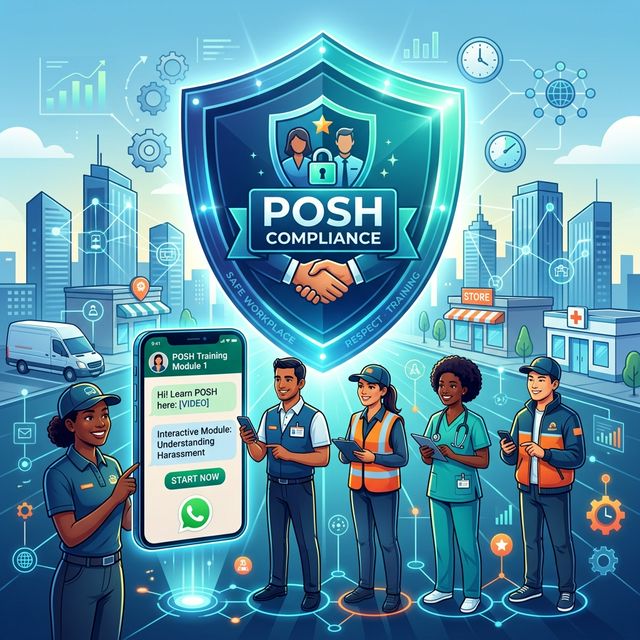
Step 3: Deploy via WhatsApp. Send the training link to all workers grouped by site, role, or language. Workers receive a WhatsApp message with the training link. They tap, complete the modules, answer the quiz, and submit the acknowledgement — all on their phone, during their shift or break.
Step 4: Track and document. Every completion is logged: worker name, date, time, quiz score, acknowledgement timestamp. This data is available on the compliance dashboard and can be exported for:
- Board Report disclosures
- ICC records
- Client audit responses
- Regulatory inspections
Step 5: Schedule annual refreshers. Set up automatic annual POSH refresher training. The system sends reminders to workers whose training is expiring, and automatically escalates to supervisors when workers haven't completed it within the deadline.
Who This Applies To: A Checklist
You need WhatsApp-based POSH training if:
- You have workers deployed across multiple locations (factories, client sites, offices)
- You employ or manage contract workers, temporary staff, or staffing agency personnel
- Your workforce includes workers who don't have company email or LMS access
- You operate in multiple states with workers speaking different languages
- You need auditable POSH training records for Board Report compliance
- Your current POSH training shows less than 80% completion across your full workforce (including contract staff)
Industries where this is most critical: facility management, manufacturing, logistics, retail, BFSI (field force), construction, and hospitality.
What Happens If You Don't Comply
The consequences of inadequate POSH compliance are escalating:
- Financial penalties: Fines of Rs 50,000 for first offence, up to Rs 1,00,000 for subsequent offences. For non-disclosure in Board Reports, additional penalties under the Companies Act.
- License risk: For organisations requiring government licences (like PSARA for security agencies), non-compliance with POSH can jeopardise license renewal.
- Reputational damage: POSH complaints and non-compliance increasingly become public through media coverage and social media — particularly in industries with consumer-facing brands.
- Client contract risk: Many corporate clients now include POSH compliance as a contractual requirement for vendors, especially facility management and staffing companies. Non-compliance can trigger contract termination.
- Invalid ICC proceedings: As the Kerala High Court ruled in 2026 (X v. Kollam Bar Assn.), if your ICC is improperly constituted, the validity of the entire inquiry can be challenged — regardless of how carefully the proceedings were conducted.
Getting Started
- Audit your current POSH coverage. What percentage of your total workforce (including contract and temporary workers) has completed POSH training in the last 12 months? If it's below 80%, you have a compliance gap.
- Create a POSH module for frontline workers. Keep it practical: 10-12 minutes, scenario-based, in the worker's language. Avoid legal jargon.
- Deploy via WhatsApp. Send to all workers. Track completions.
- Set up annual automation. Configure recurring training so you never manually chase completions again.
Leap10x makes this entire process manageable in under a week. ISO 27001 certified security. Compliance-ready tracking. AI-powered multilingual content creation. Training delivered where your workers already are — on WhatsApp.
Book a free consultation to set up POSH training for your distributed workforce.
FAQs
Q: Does the POSH Act apply to contract workers and gig workers?
- A: Yes. The POSH Act covers all individuals at the workplace, including permanent employees, contractual workers, consultants, interns, and trainees. If a contract worker works at your premises, you are required to ensure they receive POSH awareness training. The liability sits with the entity controlling the workplace, not necessarily the employer of record.
Q: Can I use WhatsApp-delivered POSH training as valid compliance documentation?
- A: Yes, as long as you can demonstrate that the training covered the required content and you have records of completion. Leap10x provides timestamped completion records, quiz scores, and acknowledgement logs — which serve as auditable proof that each worker received and engaged with POSH training. This is typically more robust than a classroom sign-in sheet, which only proves attendance, not comprehension.
Q: How often should POSH training be conducted?
- A: The POSH Act mandates regular training, though it does not specify an exact frequency. Best practice in 2026 is annual training for all employees, with additional sessions for: new hires during onboarding, ICC members (who need specialised training), and whenever there are policy updates or significant regulatory changes. Leap10x supports automated annual scheduling with reminders.
Q: Is POSH training only about women's safety?
- A: The POSH Act specifically addresses prevention of sexual harassment of women at the workplace. However, best practice in 2026 is to conduct harassment prevention training that is inclusive and covers all employees — creating a safe and respectful work environment for everyone. Many companies extend the training scope to include general workplace harassment, bullying, and dignity at work.
Q: What if a worker doesn't complete the POSH training?
- A: Leap10x sends automatic reminders to workers who haven't completed training by the deadline. If the worker still doesn't complete, the system escalates to their supervisor or site manager. The dashboard shows exactly which workers are non-compliant, allowing HR to take appropriate follow-up action.
Internal Links:
- IRDAI, SEBI & RBI Compliance Training for Field Staff
- Why Your Workers Hate Compliance Training (And How to Fix It)
- Facility Management Training: Housekeeping, Security, and Maintenance
- How to Train Contract & Gig Workers at Scale — No App, No Email
- Manufacturing Training Solutions
- Safety & Compliance Training Use Case
- Employee Onboarding Microlearning