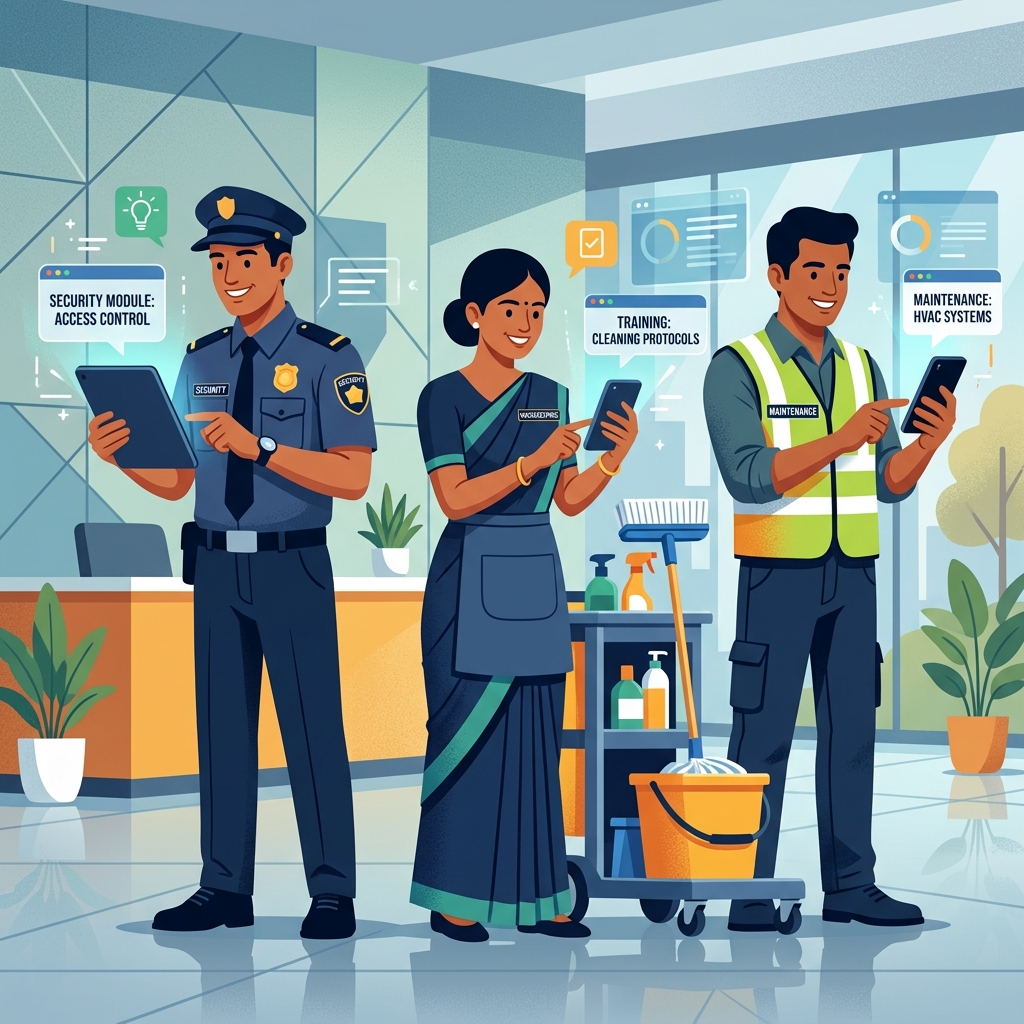
Facility Management Training | Housekeeping & Security
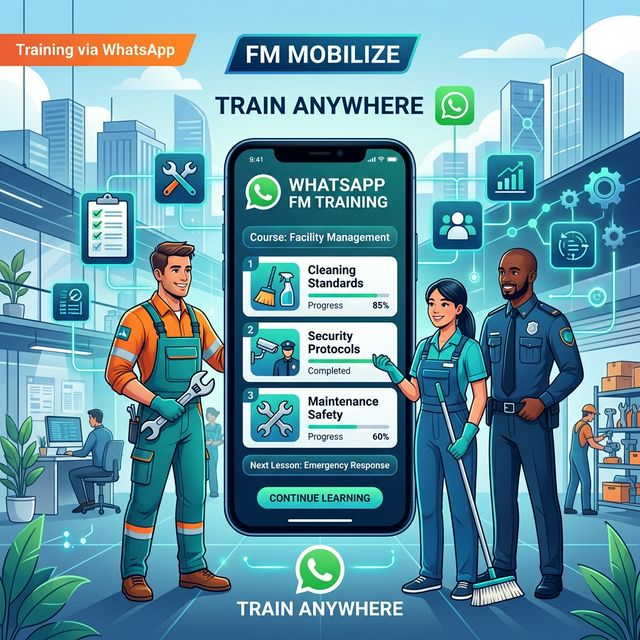
If you run a facility management company, you know the training problem intimately. You have housekeeping staff, security guards, maintenance technicians, and pantry workers spread across 20, 50, or 200 client sites. Each site has its own rules. Your workers rotate between sites. Attrition runs between 60-80% annually. And every client expects their workers to be "trained."
But trained how? You can't build a training center at every client location. You can't pull workers off-site for classroom sessions without disrupting the service you're contracted to deliver. And your workers - many of whom are contract employees from staffing agencies - don't have company email, don't use apps, and often don't speak the same language as your corporate training team.
The result is predictable: training happens inconsistently. Some sites get thorough induction from a diligent site supervisor. Others get a five-minute verbal briefing. And when a client audit asks for training records, you scramble to produce sign-in sheets that prove very little.
This guide covers how facility management companies can deliver consistent, trackable, multilingual training to their entire workforce using WhatsApp - without disrupting operations or depending on individual site supervisors to be trainers.
The Unique Training Challenges in Facility Management
Facility management is unlike manufacturing or retail when it comes to training. The challenges are specific to the industry:
1. Workers are distributed across client sites, not your own premises. Your housekeeping team at a Bangalore IT park, your security guards at a Mumbai residential complex, and your maintenance crew at a Delhi hospital all work in environments you don't control. You can't set up training rooms. You can't schedule group sessions without the client's permission. And you can't guarantee that every site supervisor has the time or skill to conduct training.
2. Client-specific requirements vary dramatically. A pharmaceutical company's facility requires cleanroom protocols and contamination prevention training. A corporate office needs professional etiquette and visitor management training. A hospital needs infection control and biomedical waste handling. Generic "facility management training" doesn't cut it - content must be tailored to each client's site requirements.
3. Regulatory compliance is non-negotiable. Security guards require PSARA (Private Security Agencies Regulation Act) compliance training. All workers need POSH (Prevention of Sexual Harassment) awareness training. Many sites require fire safety certification. Under the new Labour Codes 2026, you need documented proof that every worker - including contract workers - has received mandated safety training.
4. High attrition makes repeated training a permanent cost. With annual attrition rates of 60-80% in facility management, you're essentially rebuilding your trained workforce every 12-18 months. Every worker who leaves takes their training investment with them, and every replacement needs to go through the same cycle. If your training process takes a week to set up per worker, the economics simply don't work.
5. Language diversity is extreme. A facility management company operating in multiple cities faces India's full linguistic diversity. Workers in Hyderabad speak Telugu. Workers in Mumbai may speak Hindi, Marathi, or Konkani. Workers in Chennai speak Tamil. Training content in English - or even Hindi alone - misses a significant portion of your workforce.
What Facility Management Training Needs to Cover
Depending on the worker's role and the client site, training typically falls into these categories:
For Housekeeping Staff:
- Chemical handling and dilution ratios for cleaning agents
- Waste segregation (dry waste, wet waste, biomedical waste where applicable)
- Restroom cleaning SOP and quality checkpoints
- Client-specific protocols (e.g., clean desk policy in corporate offices)
- Professional etiquette and visitor interaction
- PPE requirements (gloves, masks, appropriate footwear)
For Security Guards:
- PSARA compliance awareness
- Access control procedures and visitor management
- Emergency response protocols (fire, medical, intrusion)
- CCTV monitoring procedures
- Shift handover documentation
- Use of force guidelines and legal awareness
- Professional communication and de-escalation
For Maintenance Technicians:
- Electrical safety and lockout-tagout procedures
- Plumbing emergency response
- HVAC system basics
- Equipment maintenance logs and reporting
- Permit-to-work procedures for high-risk tasks
For All Workers (Mandatory):
- POSH awareness training (required under the Act for all organisations with 10+ employees)
- Fire safety and evacuation procedures
- First aid basics
- Code of conduct and workplace behavior
- ESG compliance awareness (increasingly requested by corporate clients)
How WhatsApp-Based Training Works for Facility Management
Here's how facility management companies can deploy training at scale using a platform like Leap10x:
Centralised content, localised delivery. Create a master training library at your corporate office. Include modules for each role (housekeeping, security, maintenance) and each compliance requirement (PSARA, POSH, fire safety). Then deploy specific modules to specific workers at specific sites - all from one dashboard.
A housekeeping worker starting at a new pharmaceutical client receives: generic hygiene SOPs + site-specific cleanroom protocols + POSH training. A security guard at the same site receives: access control procedures + emergency response + PSARA refresher. Same site, different roles, different training - all managed centrally.
Site-specific modules without site-specific effort. When you onboard a new client site, create a 10-minute "site orientation" module: site map, client-specific rules, emergency exits, reporting structure, and contact numbers. This module is specific to that site and gets pushed to every worker deployed there. When a worker rotates to a different site, they receive the new site's orientation module automatically.
Compliance documentation that survives audits. Every training completion is logged: worker name, module completed, date, time, quiz score. When a client or regulator asks "Can you prove your security guards have completed PSARA training?", you pull a report in seconds - not dig through filing cabinets of sign-in sheets.
Continuous reinforcement, not one-time events. Instead of annual training (which everyone forgets), send monthly micro-refreshers: a 2-minute safety reminder, a quick quiz on emergency procedures, a visual tip on proper cleaning technique. This keeps knowledge fresh without requiring workers to attend any session.
A Practical Rollout Plan for Facility Management Companies
Week 1: Identify your highest-risk training gaps. Which training does every client ask about? Usually it's safety induction, POSH compliance, and role-specific SOPs. Start there.
Week 2: Build your core training library. Create 10-15 micro-modules covering the essentials for each role. Use Leap10x's AI to convert your existing SOPs and manuals into bite-sized content. Generate versions in the 3-4 languages your workforce primarily speaks.
Week 3: Pilot at 2-3 sites. Pick sites where you have cooperative supervisors and a mix of new and existing workers. Deploy training via WhatsApp. Measure: completion rates, quiz scores, time-to-complete, and supervisor feedback.
Week 4: Scale. Based on pilot results, roll out to all sites. Set up automated flows: new worker joins → receives onboarding sequence. POSH training due → automatic reminder sent. Monthly safety refresher → scheduled and sent without manual intervention.
Why This Matters for Winning and Retaining Clients
Here's a perspective facility management companies often overlook: training quality is increasingly a competitive differentiator in client proposals.
When a corporate client evaluates facility management vendors, "How do you train your staff?" is a standard question. The company that answers "We have a WhatsApp-based training platform that delivers site-specific, multilingual training with real-time compliance tracking" wins over the company that says "We conduct classroom training at our head office before deployment."
Training documentation also matters during contract renewals. Clients who see clear evidence that their workers are consistently trained and assessed are more likely to renew - and less likely to switch vendors over isolated service quality complaints.
Book a demo to see how Leap10x works for facility management training.
FAQs
Q: Can I deliver different training to workers at different client sites from one platform?
- A: Yes. Leap10x allows you to organise workers by client site, role, and region. You can assign site-specific training modules to workers at specific locations while maintaining a common library of universal training (POSH, fire safety, code of conduct) across all sites.
Q: How do I handle PSARA compliance training for security guards?
- A: Create a PSARA awareness module covering legal requirements, powers and limitations, use of force guidelines, and documentation. Deliver it via WhatsApp with a quiz at the end. Track completion with timestamps. Schedule annual refreshers automatically. This gives you auditable proof that every guard has received PSARA-related training.
Q: What happens when a worker rotates to a new client site?
- A: You update the worker's site assignment in the dashboard. They automatically receive the new site's orientation module via WhatsApp. The universal training (safety, POSH, code of conduct) doesn't need to be repeated - only the site-specific content is pushed.
Q: Our housekeeping workers have limited smartphone literacy. Will they be able to use this?
- A: If a worker can open a WhatsApp message and tap a link, they can access the training. The content is designed to be visual-first - short videos, photo-based cards, and simple tap-to-answer quizzes. No typing required. No navigation through menus. Workers at companies like C&S Electric and Blue Star have successfully completed training through this method.
Q: Can I use this to respond to client audit requests?
- A: Yes. The compliance dashboard shows real-time training status for every worker at every site. You can filter by client, site, role, or training type and export reports as PDF or Excel. Most clients accept this as sufficient training documentation for audits.
Internal Links:
- How to Train Contract & Gig Workers at Scale - No App, No Email
- Why Your Workers Hate Compliance Training (And How to Fix It)
- Why Safety Training is Critical for Your Workforce
- Compliance Training for Manufacturing Workers: 2026 Guide
- Manufacturing Training Solutions
- Safety & Compliance Training Use Case
- Employee Onboarding Microlearning